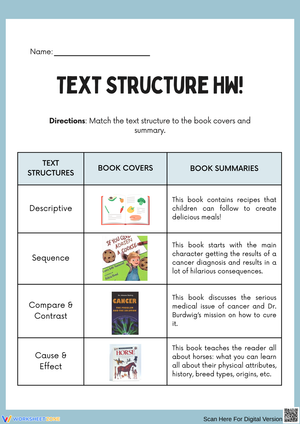
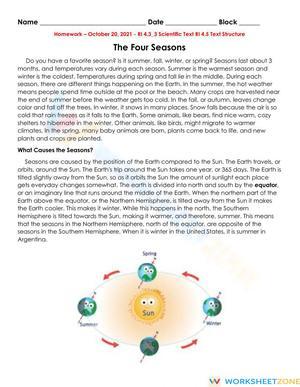
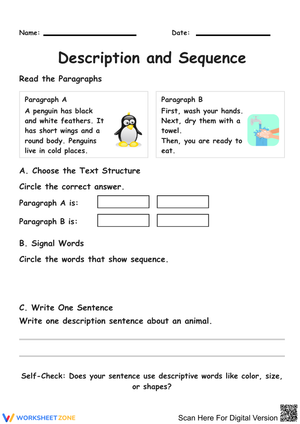
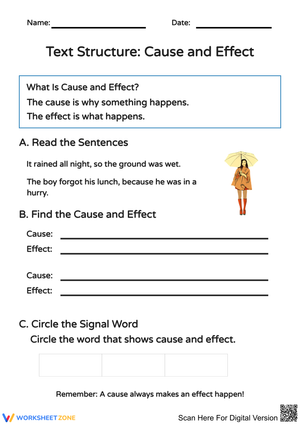
These 4th grade nonfiction text structure worksheets close a gap that shows up reliably around October: students can name the five structures in isolation but fall apart when a real passage mixes signals. Each worksheet pairs a grade-appropriate informational text with text-dependent questions that push students past signal-word hunting toward evidence-based explanation of how an author organized ideas.
The Specific Skills Each Worksheet Targets
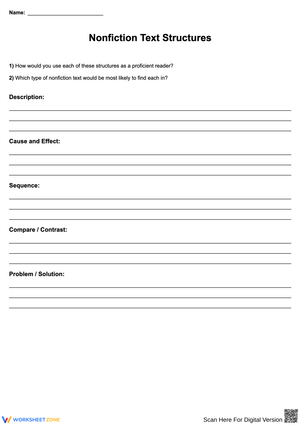
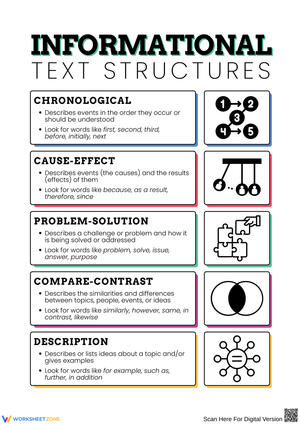
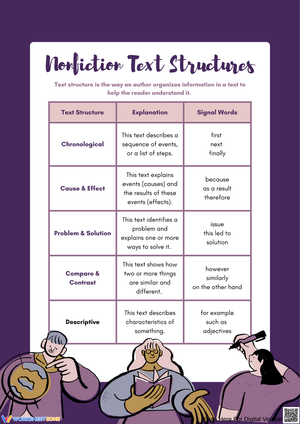
The set covers the four structures fourth graders are expected to work with fluently — chronology, compare and contrast, cause and effect, and problem and solution — along with description, which teachers often need to teach explicitly as a counterpoint to the others. Practice in these 4th grade nonfiction text structure worksheets moves through three levels: identifying the dominant structure, marking the sentences that prove it, then writing a short explanation of how that structure shapes what the author communicates about the topic.
- Underlining signal language and labeling which organizational pattern it signals
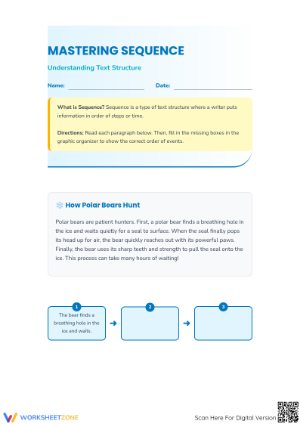
- Completing graphic organizers matched to each structure — timelines for chronology, T-charts for compare and contrast, cause-and-effect chains, and problem-solution boxes
- Answering constructed-response prompts that require citing at least two specific details as evidence
- Sorting a set of short passages by structure type, which reveals students who have memorized definitions without developing real-text recognition
Mistakes Students Make That Are Worth Catching Early
The most persistent confusion in fourth grade sits between cause and effect and problem and solution. Both involve a relationship between two things, and both draw on overlapping signal words like because, so, and as a result. What separates them is whether the text is tracing what happened as a consequence of an event, or presenting a situation that needed fixing and then describing the response. A passage about flooding that focuses on the damage is cause and effect; a passage about flooding that centers on the engineering solutions is problem and solution. Students who don't hold that distinction will mislabel passages even when they can define both terms correctly on a vocabulary quiz. The constructed-response tasks on these worksheets expose that gap quickly — circling a label doesn't.
A second pattern worth watching: students use topic as a shortcut for structure. A passage about the water cycle must be sequential, they assume. It might be — or it might be organized entirely around cause-and-effect relationships that drive each phase. That assumption-driven labeling is hard to interrupt without requiring students to cite the actual sentences that prove their answer. These worksheets build that habit by making the citation task non-optional.
Fitting These Worksheets Into the Reading Block
Most reading blocks have a 10-to-15-minute window after direct instruction when students need something they can start independently while the teacher works with a small group. A self-contained passage with a clear task sequence — read, identify, annotate, explain — works well in that slot because students don't need teacher proximity to get going. Teachers also use individual worksheets as Thursday checks, where the goal isn't a grade but a quick read of who still needs another pass at one structure before the week ends.
For whole-group mini-lessons, project the passage, model the two-question protocol aloud — How is this text organized? and Which details in the passage prove it? — then release students to complete the written response on their own. That sequence runs cleanly in about 20 minutes. One practical refinement: don't accept the structure name as a complete answer. Require students to read their written response aloud to a partner before marking it done; the peer listen often catches the responses that name the structure but don't actually explain it.
Standard Alignment
CCSS.ELA-LITERACY.RI.4.5 requires students to "describe the overall structure (e.g., chronology, comparison, cause/effect, problem/solution) of events, ideas, concepts, or information in a text or part of a text." The operative word is describe — the standard doesn't ask students to label; it expects them to explain how the structure functions. Worksheets that stop at identification fall short of that bar. The constructed-response tasks here address the full standard by asking students to explain not just which structure an author used, but how it shaped the way information was presented to the reader.
Adjusting These Worksheets for a Range of Learners
The same passage can carry students at different levels depending on what support is in place. For students who need more guided practice, provide a word bank of the five structure names, pre-annotate one key signal phrase in the passage, and offer a sentence frame for the written response: "The author organized this text using _____ structure because _____." That reduces the vocabulary retrieval demand without removing the actual thinking task.
On-level readers work through identification and written response without those additions, which is how each worksheet functions by default. For students ready for more, remove the graphic organizer entirely and ask them to design their own visual to show how the ideas in the passage connect — a task that requires internalizing the structure rather than filling a prepared template. A further step is asking students to identify a secondary organizational pattern in the same passage and argue in writing which one is dominant.
In intervention, isolate one structure for two or three sessions before mixing. Repeated exposure to cause-and-effect passages across a week builds reliable recognition before students face the harder cognitive task of discriminating between structures that look similar on the surface. These 4th grade nonfiction text structure worksheets lend themselves to that kind of focused repetition because individual worksheets are easy to assign in sequence without requiring students to track across a larger unit.
Frequently Asked Questions
What text structures does the set cover?
The worksheets address chronology, compare and contrast, cause and effect, problem and solution, and description. Most fourth-grade teachers concentrate heaviest on the first four since those are explicitly named in RI.4.5, but description passages are useful for helping students understand what it looks like when an author organizes around features rather than relationships between ideas.
How long does it take students to complete one worksheet in class?
Most students finish in 12 to 18 minutes. The constructed-response portion is where timing varies most — students who write fluently move quickly, while students who struggle with written explanation often need a few extra minutes or a sentence frame. Planning for about 15 minutes during a reading block and building in a brief share-out afterward tends to work well.
Do the worksheets include answer keys?
Yes. Answer keys cover the structure identification, a sample annotation of supporting evidence, and a model written response for each passage. The model responses are especially useful for teachers who want to show students the difference between a complete explanation and one that simply restates the structure name without citing the text.
Can these work with third or fifth graders?
Third graders working above grade level and fifth graders reviewing informational reading skills both find these appropriate. The passages are written at a Grade 4 complexity level, so a third grader reading below that level will run into difficulty with the text before even reaching the structure task — a lower-complexity passage with the same task format is a better fit in that case. Fifth graders using these 4th grade nonfiction text structure worksheets for review generally move through the identification work quickly and benefit more from the extension tasks than from the baseline prompts.












 Interactive Worksheet Maker
 Quiz Maker
 Word Search Maker
 Crossword Puzzle Maker
 Word Scramble Generator
 Sentence Scramble Generator
 Handwriting Worksheet Generator
 Name Tracing Generator
 Fill In The Blank Generator