Capitalizing Titles PDF Worksheets for 4th Grade
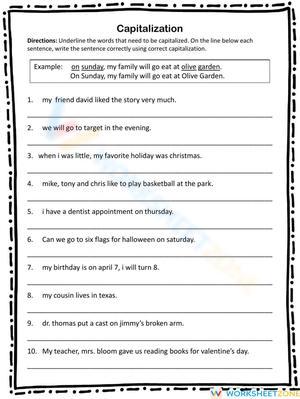
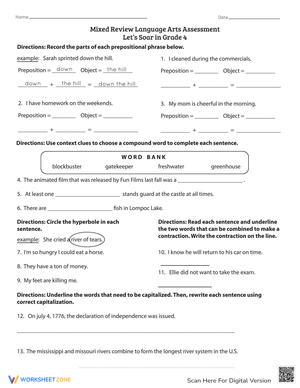
These capitalizing titles pdf worksheets for 4th grade give teachers a ready-made set of targeted practice for one of the more layered mechanics rules students encounter in upper elementary — knowing precisely which words in a title earn capitals and which ones stay lowercase. Students who have sentence capitalization down cold still need deliberate instruction on title case, because the two rules operate on completely different logic. The set spans books, films, songs, and poems, with exercises that build from structured correction to fully independent application.
The Specific Rules These Worksheets Target
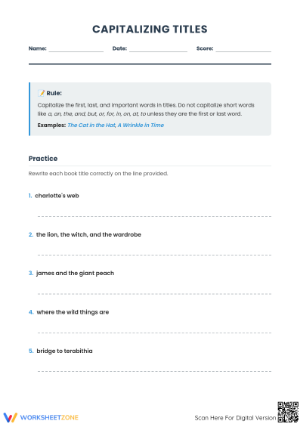
Title case requires students to evaluate every word in a title before writing it — not just the first word, not just proper nouns. First and last words are always capitalized regardless of part of speech. Between those anchors, students capitalize major words: nouns, pronouns, verbs, adjectives, and adverbs. What stays lowercase are articles (a, an, the), coordinating conjunctions (and, but, or, for, nor), and short prepositions (in, on, at, to, by, up, of) — unless any of them fall at the very start or end of the title.
Activity formats across the set include:
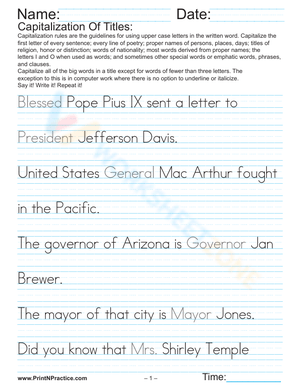
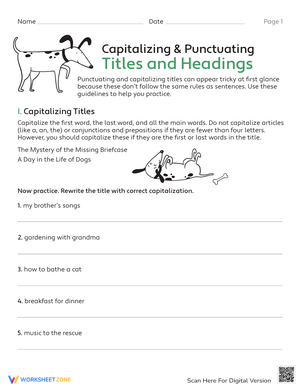
- Rewrite tasks: Titles printed entirely in lowercase letters; students produce the correctly capitalized version from scratch.
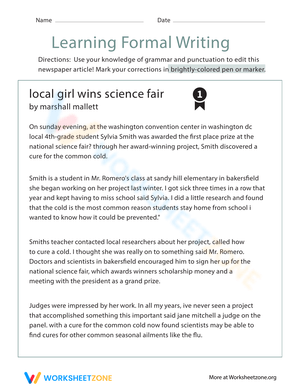
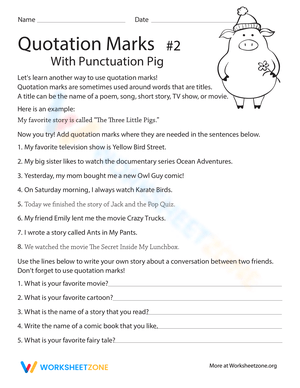
- Error-identification exercises: Students locate and correct improperly capitalized words inside given titles, building proofreading habits alongside rule knowledge.
- Original-title prompts: Students invent a title for an imaginary book, movie, or song and apply the rules to their own word choices.
The original-title format matters more than it first appears. When students supply every word themselves, they cannot rely on visual memory of a title they have seen printed correctly somewhere. They have to reason through the rule each time, which is exactly the kind of active retrieval that moves grammar knowledge from "reviewed it once" to "actually internalized."
Mistakes Students Make That Are Worth Anticipating
The most persistent error is overgeneralizing the "short words stay lowercase" principle. Students learn that articles and prepositions don't get capitals, then quietly extend that logic to any word that feels minor. Two-letter verbs are the most common casualty: a student who correctly writes The Wind in the Willows will still write This is Our Song, lowercasing "is" because it is short and seems unimportant — even though it is a verb and must be capitalized. The fix is to shift students' attention from word length to part of speech, using a simple checklist: if the word is a noun, verb, adjective, or adverb, it gets the capital.
The reverse error appears just as often. Students capitalize the preposition "Of" because it feels like an important connector — Island Of the Blue Dolphins turns up regularly in 4th-grade book reports. Redirecting students to a posted reference list of the specific words that always stay lowercase works better here than re-explaining the full rule from the top.
A smaller but recurring issue: students sometimes copy a title exactly as it appears on a book cover or movie poster, where the designer has set the whole title in ALL CAPS for visual impact. A short class conversation about the difference between typographic display and grammar convention prevents a lot of confusion and saves time in writing conferences later.
How to Work These Worksheets Into Your Lesson Plans
Many teachers use one worksheet as a Monday morning warm-up — a 6-to-8-minute activity that reactivates grammar attention after the weekend and doubles as a quick check on what students retained from the previous week. The task is short and self-contained enough that students can start independently the moment they sit down, which also helps with morning transitions.
A natural fit in writing workshop is to use an error-identification worksheet as the bridge between a mini-lesson on title case and independent writing time. Students review and correct three or four titles on the worksheet, then open their drafts and check whether they have used any titles that need the same treatment. The transfer from worksheet to real writing happens in the same sitting, which is more effective than leaving a day between the two.
Teachers who build capitalizing titles pdf worksheets for 4th grade into their literacy centers often set them up as pair tasks: one student completes the exercise while the partner checks each answer against a reference card listing the lowercase-only words. The discussion that happens when partners disagree — "wait, 'is' is a verb, so it gets capitalized" — does more grammar teaching than the worksheet alone could. Before any of this, it is worth taking 10 minutes to have students pull books from the classroom library and sort the titles by whether they contain any lowercase words in the middle. Students who make that discovery on real published books approach the practice work with noticeably more buy-in.
Standard Alignment
CCSS.ELA-LITERACY.L.4.2.A asks students to "use correct capitalization" when writing. Title case is the most rule-intensive capitalization task at this grade level — more demanding than sentence capitals or proper noun capitals, both of which have simple, single-condition triggers. Title case requires part-of-speech judgment on every word in the title, which is why it earns dedicated practice rather than a passing mention inside a broader lesson on punctuation and mechanics.
In classroom terms, L.4.2.A shows up most visibly during writing units that require students to reference titles: book response essays, research reports, multi-genre projects. Addressing the standard through focused practice before students need it inside a full draft reduces the cognitive load of learning the rule while simultaneously managing a longer piece of writing. Students who have already worked through the rule on targeted exercises handle in-context corrections much more efficiently.
Adjusting the Worksheets for Different Learners
Students who are still building confidence with parts of speech benefit from having a reference card beside them — a laminated list of the articles, conjunctions, and short prepositions that always stay lowercase (except at the start or end of a title). That support removes the recall burden and lets students concentrate on applying the rule rather than trying to remember which specific words belong on the list. As they gain confidence, pull the card and have them work from memory alone.
For students ready for more nuance, two natural extensions push the skill further without abandoning the core rule. The adverb "not" is a consistent stumbling block — it looks minor and short, but it is an adverb and must be capitalized. Hyphenated words introduce a secondary question worth exploring: in a title like "Twenty-One Pilots," does the word after the hyphen get a capital? Generally, yes. Neither of these is a standard 4th-grade expectation, but both make excellent challenge prompts for students who have already internalized the core rules and need something harder to stay engaged.
The creative-application worksheets accommodate a wide range on their own. A student writing "My Big Dog" and a student writing "The Remarkable Adventures of Nobody in Particular" are completing the same task at very different linguistic levels, with the same rule governing both.
Frequently Asked Questions
Which words always stay lowercase in a title?
Articles (a, an, the), coordinating conjunctions (and, but, or, for, nor), and short prepositions (in, on, at, to, by, up, of) stay lowercase when they appear in the middle of a title. The override is simple: the first and last words are always capitalized regardless of category. "A" is lowercase in the middle of any title, but in A Wrinkle in Time, that opening "A" gets its capital because it is the first word.
Does "is" get capitalized in a title?
Yes. "Is" is a verb, and verbs are capitalized in title case regardless of how short they are. This surprises students — and many adults — because "is" sits visually alongside articles and prepositions. The deciding question is always part of speech, not word length. Using the capitalizing titles pdf worksheets for 4th grade that include short verbs in the practice titles (rather than only obvious proper names and longer nouns) gives students enough repetition to stop second-guessing this one.
What do I do when a student copies a title in ALL CAPS from a book cover?
Publisher typography and grammar convention are two different systems. Designers use all-caps, mixed fonts, and other display choices for visual effect; those choices say nothing about how the title should appear in a student's writing. When this comes up in a conference, point students to the copyright page or title page inside the book, where the title is usually printed in standard type. That comparison makes the distinction concrete and takes less than a minute to explain.
When should title capitalization be taught relative to other conventions?
Title capitalization builds on part-of-speech knowledge, particularly the ability to distinguish nouns, verbs, and adjectives from articles, conjunctions, and prepositions. Most 4th graders have enough background from earlier grades to handle this instruction, but teachers who find students struggling with the rule often discover the real obstacle is part-of-speech identification, not title case itself. A focused review of prepositions and conjunctions before returning to the capitalizing titles pdf worksheets for 4th grade typically moves things forward faster than restarting the title case lesson from scratch.
Clear All