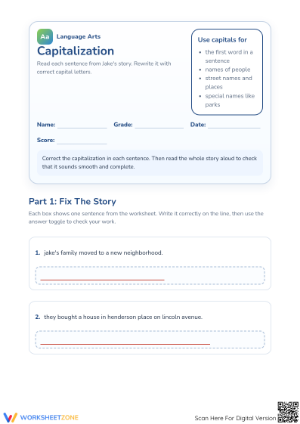
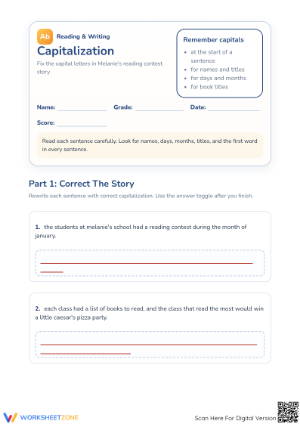
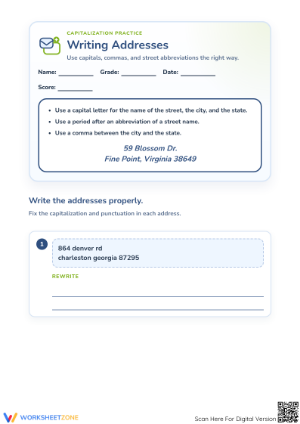
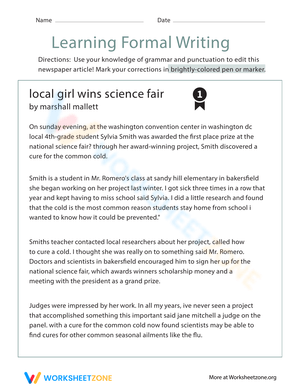
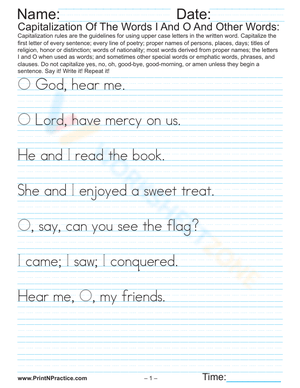
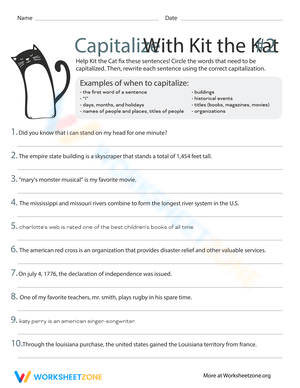
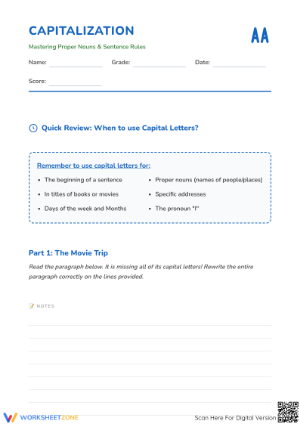
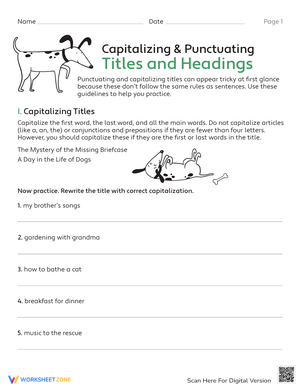
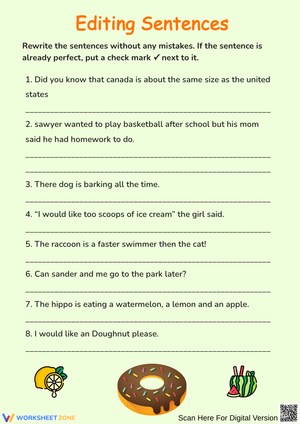
These capitalization pdf worksheets for 4th grade address the rules students hit at this grade level — title capitalization, proper adjectives, and the line between common and proper nouns — not the introductory mechanics that third-grade instruction already covered. Each worksheet isolates one convention so students aren't sorting out whether "Italian" and "Revolutionary War" follow the same logic in the same exercise. The set moves from identifying errors in edited paragraphs to rewriting student-style sentences where overcapitalization turns out to be just as common a problem as missing capitals.
The Specific Skills These Worksheets Build
Fourth grade is when capitalization stops being about first words and people's names and starts requiring students to make real judgment calls about categories of nouns and modifiers. The worksheets in the set cover five distinct skills:
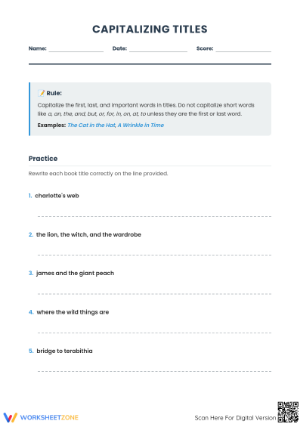
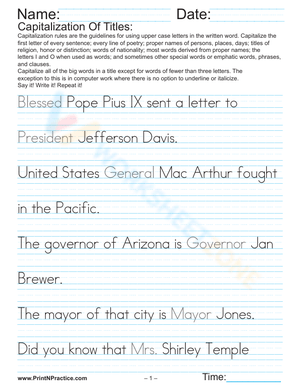
- Title capitalization — students mark which words in a book, film, or song title need capitals and which articles, short prepositions, and coordinating conjunctions stay lowercase
- Proper adjectives — recognizing and correcting "french toast," "italian seasoning," and "spanish language" where the adjective derives from a proper noun
- Historical events and documents — writing "the Boston Tea Party" and "the Declaration of Independence" with every key word capitalized, not just the first
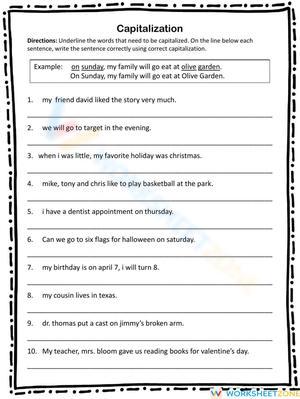
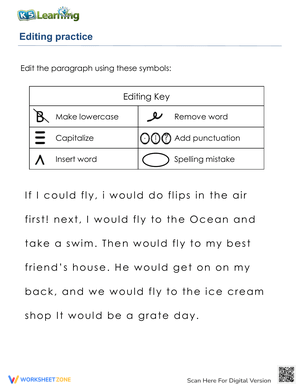
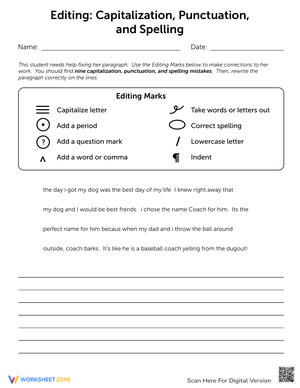
- Proofreading paragraphs — scanning connected text for both missing capitals and capitals that don't belong
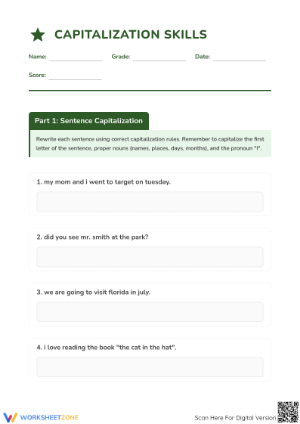
- Overcapitalization correction — identifying sentences where "Teacher," "Principal," or "Government" has been capitalized as if it were a specific title or proper name
That last skill is worth naming explicitly because many teachers underestimate how often fourth graders overcapitalize. Students who have been told since first grade to capitalize "important" words sometimes overcorrect, and worksheets that only target missing capitals never surface the problem.
Mistakes Students Make That These Worksheets Help You Catch
The most persistent error at this level isn't forgetting a capital — it's applying a rule to one word class but missing it in a related form. A student who reliably writes "France" correctly will write "french revolution" in the same paragraph because the connection between proper noun and proper adjective was never made explicit. This shows up most in social studies writing, where students produce long paragraphs about historical events and nations and move quickly enough that the adjective form slips through unchecked.
Title capitalization generates its own distinct patterns. Students tend to split into two camps: those who capitalize every word ("The Girl Who Ran Through The Forest") and those who lowercase everything after the first word ("The girl who ran through the forest"). Getting the middle right — lowercase articles and prepositions, capitalized content words — requires seeing the pattern applied across many different titles before it holds. A related problem: students who write "Declaration of independence" get the first word right but drop "Independence" because the sentence has already "started" and they stop scanning for proper noun status mid-phrase. It shows up more reliably in connected writing than on isolated exercises, which is why proofreading worksheets catch things that single-sentence fill-ins miss.
Standard Alignment
The worksheets address CCSS.ELA-LITERACY.L.4.2.A, which requires students to use correct capitalization as part of the Conventions of Standard English strand. In classroom terms, this standard lives at the intersection of grammar instruction and the writing process — it is not satisfied by knowing a rule in isolation but by applying it reliably during revision and editing. These capitalization pdf worksheets for 4th grade support both ends: rule-identification exercises build declarative knowledge, while the proofreading activities build the editorial habit the standard actually measures. L.4.2.A appears in the editing component of standardized writing tasks and in portfolio-based assessment, so the transfer to real assessment contexts is direct rather than aspirational.
How to Build These Worksheets Into Your Lesson Plans
The capitalization pdf worksheets for 4th grade work best as bell ringers two or three times per week rather than as a concentrated unit. Distributed practice — short exposure across several weeks — does more for long-term retention than a capitalization unit that runs five days and then stops. A reliable sequence: introduce the rule through direct instruction on Monday, use each worksheet for guided practice mid-week while you can circulate and address errors before they solidify, then return to the same worksheet type the following week as a brief review. The gap between first and second practice is where the rule actually moves into durable memory.
For the title capitalization and proofreading worksheets, an effective follow-up is asking students to generate three fictional titles — a book, a film, and a song — and swap with a partner to check each other's capitalization. This requires production rather than recognition, a harder cognitive task and a more honest indicator of whether the rule has landed. For homework, the proofreading worksheets travel better than the rewriting ones; a student stuck on a rule at home has no one to ask, but a student scanning a paragraph for errors can work from the class notes already in their folder.
Adjusting the Set for a Range of Learners
Students still consolidating basic proper noun rules work better with the single-category worksheets before moving to the proofreading exercises. When a paragraph contains five different capitalization rules and a student is uncertain about one of them, the exercise becomes a working memory challenge rather than a test of the conventions themselves. Starting with title capitalization in isolation, moving to proper adjectives, then bringing both into a proofreading exercise gives students the sequential exposure that makes the harder tasks manageable.
For students who have the core rules down, the proofreading worksheets offer more than they first appear. One extension: after correcting errors in each worksheet, ask these students to write one new sentence using the same rule applied to a different subject. If they corrected "civil war" to "Civil War," they write a new sentence that correctly capitalizes a different historical event — one they have to retrieve and apply without a model in front of them. This moves the task from editing toward generation, which is closer to what writing portfolios and on-demand assessments actually require.
Frequently Asked Questions
Which capitalization rules do these worksheets cover?
Each worksheet targets one of the core fourth-grade conventions: title capitalization for books, films, and songs; proper adjectives derived from country or nationality names; historical events and documents; and overcapitalization of common nouns. The proofreading worksheets combine multiple rules in a connected paragraph and work best after students have practiced each rule separately in an earlier exercise.
How do students learn which words in a title stay lowercase?
The worksheets build this through repeated pattern exposure rather than a memorized list. Students see articles, short prepositions, and coordinating conjunctions left lowercase across many different titles until the pattern becomes automatic. A rule recited from memory often drops under pressure; a pattern encountered across twenty different titles tends to hold when students are writing independently.
Can these worksheets be sent home for homework?
The capitalization pdf worksheets for 4th grade work well as homework when students have already encountered the rule in class. Sending home a worksheet on a rule that hasn't been introduced yet produces guessing, not practice. The proofreading and error-identification exercises are best for independent work at home because students apply a rule already discussed rather than generate new language without support.
What is the difference between a proper noun and a proper adjective, and how does the set address it?
A proper noun names a specific place or entity ("France"). A proper adjective derives from that noun and modifies another noun ("French bread"). Fourth graders often capitalize the noun form reliably and miss the adjective form entirely. The worksheets targeting proper adjectives present both forms in the same exercise so students see the contrast directly, rather than treating the two as separate unrelated rules discovered weeks apart.
Do the proofreading worksheets work as formative assessment tools?
They function well as quick formative checks. When a student marks every error in a proofreading paragraph correctly — including the overcapitalized common nouns, not just the missing capitals — that gives a clearer picture of rule mastery than a fill-in exercise does. For summative purposes, most teachers find that examining capitalization in a student's independent writing piece gives a more accurate read on whether the rules have transferred out of worksheet context and into real composition.












 Interactive Worksheet Maker
 Quiz Maker
 Word Search Maker
 Crossword Puzzle Maker
 Word Scramble Generator
 Sentence Scramble Generator
 Handwriting Worksheet Generator
 Name Tracing Generator
 Fill In The Blank Generator