3rd Grade Metric Measurement Worksheets
3rd grade metric measurement worksheets give students the focused, repeatable practice they need to internalize centimeters, meters, grams, kilograms, and liters before those units appear in word problems and science contexts. Each worksheet targets a single domain and skill type — estimation, scale or ruler reading, unit selection, or one-step problem solving — so teachers can assign one directly after a lesson without any additional prep. The set covers length, mass, and liquid volume, matching the full scope of third-grade metric expectations.
The Specific Skills Targeted in Each Worksheet
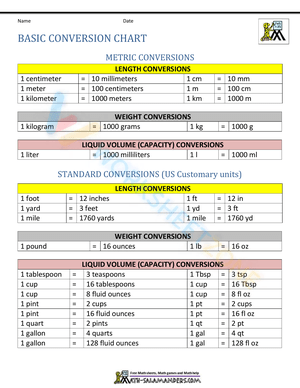
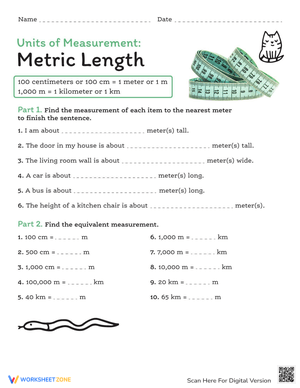
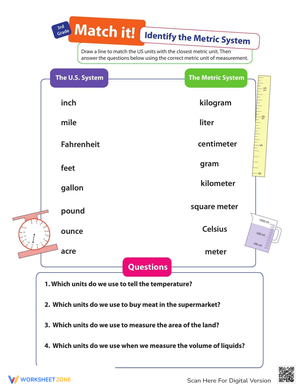
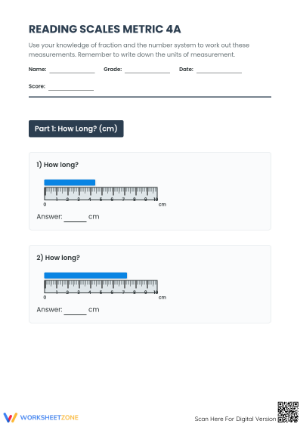
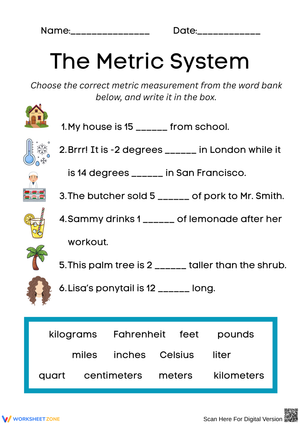
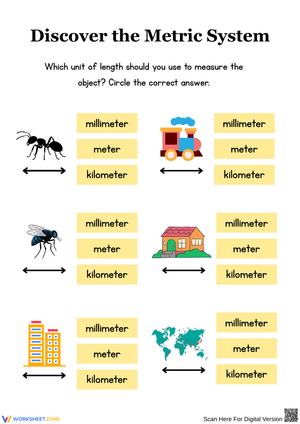
Length worksheets ask students to measure illustrated line segments and object outlines to the nearest centimeter, use drawn metric ruler images to record readings, and make unit-selection decisions — determining whether the length of a hallway is better expressed in centimeters or meters. Several worksheets pair an estimation column with the measurement column, requiring students to commit to a predicted value before reading the ruler. That extra step separates genuine benchmark thinking from simply transcribing numbers off a tool.
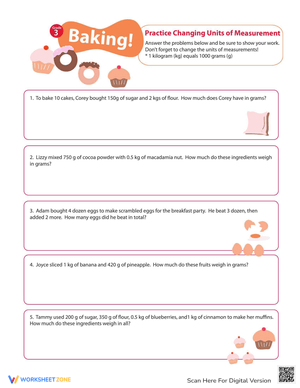
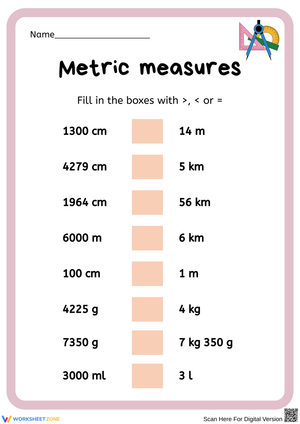
Mass worksheets center on balance scale illustrations and written scale readings. Students sort common objects into grams or kilograms, interpret two-pan balance diagrams, and work through single-operation word problems. The more advanced worksheets in this group use mixed-unit scenarios — a recipe listing 250 g of butter alongside 2 kg of potatoes — where students must recognize the relationship between the two units before they can calculate anything.
Liquid volume worksheets use labeled graduated container diagrams. Students identify the volume at a marked line, estimate how much liquid would need to be added or removed to reach a target amount, and work through capacity word problems. The container illustrations use clearly spaced intervals so the focus stays on reading and reasoning rather than deciphering a cluttered visual.
Measurement Mistakes Students Make That Are Worth Anticipating
The most persistent length error is counting tick marks instead of intervals. A student measuring a 6 cm segment places the ruler at zero, counts every line from zero through six — seven marks total — and writes "7 cm." This off-by-one mistake is structurally identical to the number line errors that appear earlier in the year, and the same fix works: have students shade the spaces between marks rather than point to the lines. One class demonstration tends to resolve it faster than repeated written corrections on returned worksheets.
With mass, the breakdown happens in the middle range. Students confidently handle the extremes — a car belongs in kilograms, a paperclip in grams — but stall on a 500 g bag of rice or a medium hardcover book. The reasoning is consistent: they have internalized "heavy things use kilograms," so something that feels substantial seems like it should clear that threshold, regardless of whether it actually reaches 1 kg. Direct practice comparing objects against a known 1 kg reference works better here than restating the definition.
For liquid volume, watch for students who correctly subtract to find how much water is needed to fill a container but then report the amount already in the jug rather than the amount still needed. The arithmetic is right; the question is misread. These errors are worth discussing as a class because they reveal something that shows up across many math topics: students jumping past the language of a problem to reach the calculation.
Building These Worksheets Into Your Lesson Sequence
The approach that works best starts with a physical reference before students sit down with their worksheet. If the lesson introduces grams and kilograms, spend five minutes passing around a small coin — a U.S. nickel weighs about 5 g — and a standard textbook that sits close to 1 kg before students begin estimating objects on the page. That physical contact makes the estimation column feel grounded. Without it, students are guessing. With it, they are reasoning from something they have actually held.
During math centers, 3rd grade metric measurement worksheets focused on length and unit selection work well for independent rotation groups while a small group uses meter sticks and rulers at a nearby station. Students who finish early can cross-check an answer by walking over to measure the same type of object, which creates a natural self-correction loop without any teacher coordination. Mass and volume worksheets, which require closer supervision when combined with physical tools, tend to work better as exit checks or short whole-group tasks at the end of class rather than unsupervised center work.
The estimation-before-measurement format also supports spaced retrieval across weeks. Reassigning a unit-selection worksheet from week one as a Monday warm-up in week three gives you a fast read on whether benchmark knowledge is holding. Students who have internalized the units answer quickly and consistently; those still operating from memorized lists slow down and hesitate. That contrast is more informative than most quiz scores.
Standard Alignment
CCSS.MATH.CONTENT.3.MD.A.2 requires students to measure and estimate liquid volumes and masses using grams, kilograms, and liters, and to solve one-step word problems with those units using any of the four operations. The mass and volume worksheets in this set address that standard directly — the estimation columns satisfy the "estimate" requirement, and the word problems cover the computation requirement. In most third-grade pacing guides, this standard falls mid-year, after students have worked through place value to the thousands. A student who understands that 1,000 ones make one thousand can reason about why 1,000 grams make one kilogram rather than simply memorizing the conversion — and that understanding is worth building into instruction explicitly when the timing aligns.
Metric length is covered in related second- and third-grade standards that vary by state framework. The centimeter and meter worksheets in the set align with those expectations and work as introductory practice or consolidation review depending on where your class is in the sequence.
Adjusting the Set for Students at Different Levels
Within the set, these 3rd grade metric measurement worksheets progress from benchmark-building tasks — estimation and categorization — to scale and ruler reading, then to word problems. That sequence maps onto where skill gaps typically appear in student work: a student who freezes on word problems almost always has a shaky mental image of the unit, not a computation problem.
Students who need more support with mass start with the sorting worksheets — grams or kilograms only, no scale reading required — before moving to illustrated balance scales and then to word problems. Pairing those students with a physical reference object during independent work helps considerably. A student who has held a 1 kg weight while working with a balance scale illustration reads that illustration differently than one relying on memory alone.
For students ready for more challenge, the mixed-unit word problems involve a qualitatively different kind of thinking. A problem stating that a recipe needs 2 kg of sugar and the student has four 400 g bags asks them to recognize that conversion is even necessary — before any arithmetic begins. That recognition is the hard part, and it is worth telling students explicitly that this is a new cognitive move, not just harder arithmetic of the same kind they have already practiced.
Frequently Asked Questions
Does this set cover all three metric domains — length, mass, and liquid volume — or just the ones in CCSS 3.MD.A.2?
All three domains are represented. CCSS.MATH.CONTENT.3.MD.A.2 specifies grams, kilograms, and liters, so the mass and volume worksheets address that standard most directly. Length worksheets are included because most third-grade metric instruction covers centimeters and meters alongside mass and volume, even when state standards list them in separate strands.
What physical tools should I have on hand when assigning these?
For length: metric rulers and a meter stick. For mass: a two-pan balance with gram and kilogram weights. For volume: a clear 1-liter container — even if students never fill it, visible size alone anchors the benchmark. None of these are required, since students can complete every exercise from the illustrations on the worksheet. That said, accuracy on estimation tasks improves noticeably when students have handled the actual units before working independently.
Can these be used for homework if families don't have rulers or scales at home?
Yes. The 3rd grade metric measurement worksheets in this set are fully illustrated — all measurements are readable from the page, and no physical tools are needed at home. Estimation prompts rely on mental benchmarks rather than measuring devices, and the word problem worksheets are entirely self-contained. One practical note: the scale-reading and ruler-reading exercises carry a relatively low language demand, which makes them accessible for students in households where English is not the primary language.
How do I decide which worksheet to assign first within each domain?
Move from estimation and categorization exercises to scale and ruler reading, then to word problems. Students who have not yet formed a working mental image of a gram or a liter will struggle with word problems — not because the arithmetic is difficult, but because the units do not yet mean anything concrete to them. The estimation worksheets are the right entry point for that reason: a quick look at student estimates tells you whether the class is ready to advance to reading and computation tasks before you commit a full lesson block to them.
Clear All