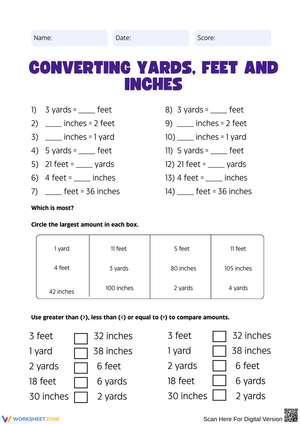
These 3rd grade length and metric units worksheets give teachers a set of targeted, ready-to-use practice resources covering millimeter, centimeter, and meter measurement from unit selection through word problems. Each worksheet focuses on one aspect of metric length — reading rulers, choosing appropriate units, comparing measurements, or applying metric quantities in story contexts — so teachers can slot them in exactly where a lesson needs reinforcement.
The Specific Skills Targeted
Metric measurement shows up at third grade for a clear developmental reason: students are already fluent with base-ten place value, and the metric system maps directly onto that knowledge. Ten millimeters make one centimeter; one hundred centimeters make one meter. That structure is the same logic students use when bundling tens into hundreds. The worksheets build on that parallel rather than treating metric units as an isolated topic.
Across the set, students:
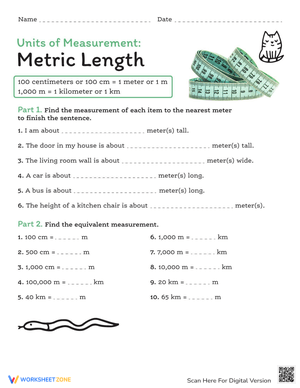
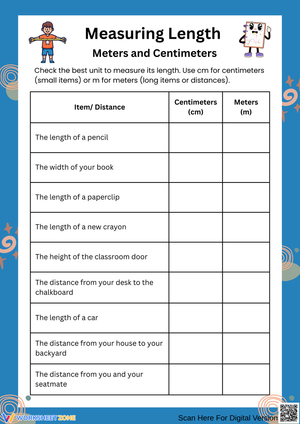
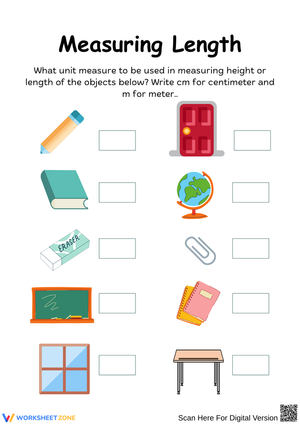
- Identify the most appropriate unit — mm, cm, or m — for measuring specific real-world objects
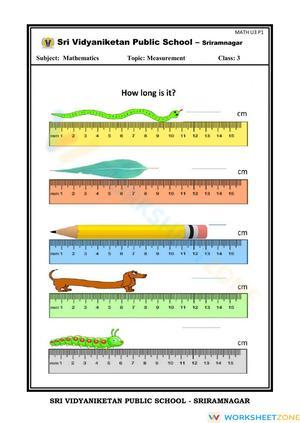
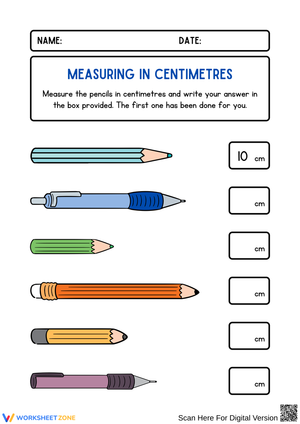
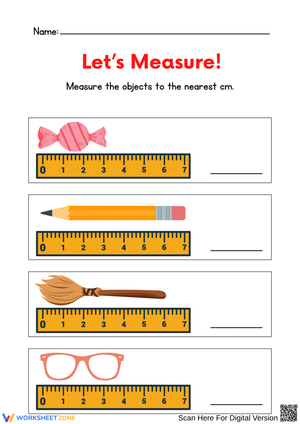
- Read centimeter and millimeter increments on illustrated rulers, including measurements that fall between whole centimeters
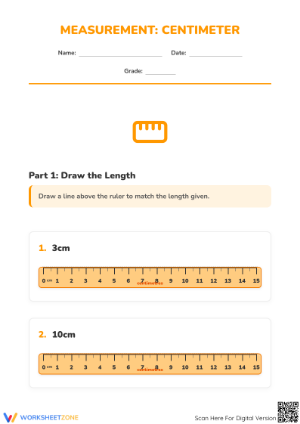
- Mark a target length on a drawn ruler by placing the endpoint at the correct graduation
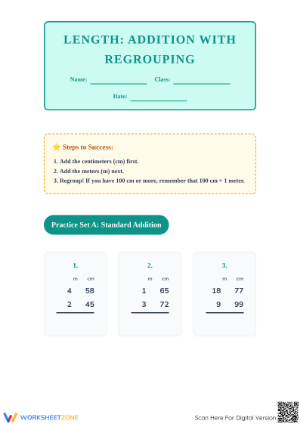
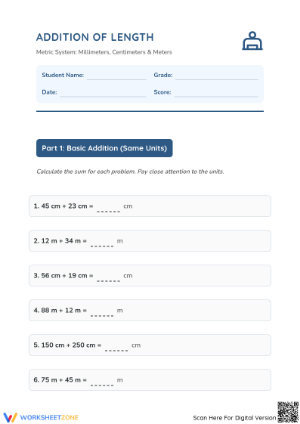
- Add and subtract metric lengths within a single unit, such as finding the remaining length of a piece of string after a section is cut
- Solve two-step word problems that combine measurement with basic arithmetic
- Record an estimate before measuring, then compare it against the actual value
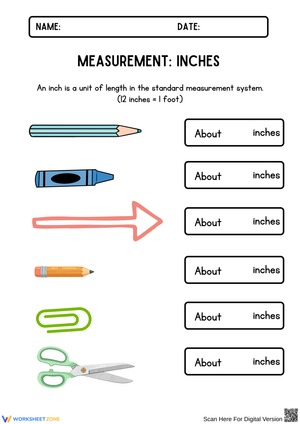
The estimate-then-measure format appears across several worksheets because estimation is where real conceptual understanding surfaces. A student who writes "about 40 cm" for a classroom pencil has a working mental image of what a centimeter represents. A student who writes "about 2 mm" for the same pencil is guessing without any anchor — and that's useful diagnostic information before the actual measuring even begins.
Student Errors Worth Anticipating Before You Teach
The most persistent mistake at this grade is misreading the ruler's starting point. Students place the physical end of the object at the edge of the ruler — the plastic or wood casing — rather than at the zero graduation, which sits a few millimeters inward. The result is a systematic overcount, often by 1 cm or more. Several worksheets include a "what went wrong?" task that shows a ruler with an object misaligned and asks students to explain the error and give the correct measurement. Catching this misconception in a worksheet context is far easier than catching it mid-activity when every student has a ruler in hand and the room has gotten loud.
A second predictable problem: students treat every numbered mark on a ruler as a centimeter. When asked to measure to the nearest millimeter, a student reads the "4" at what is actually the 4 cm mark and records 4 mm. The underlying confusion is that a ruler shows two overlapping scales simultaneously, and students haven't yet learned to track which scale they're reading. The worksheets address this by pairing close-up diagrams of a ruler section — showing the ten small marks between, say, 3 cm and 4 cm — with questions requiring students to name both the centimeter and millimeter reading for the same point. That side-by-side format makes the two scales visible in a way that verbal explanation alone rarely achieves.
Building These Worksheets Into Your Lesson Plans
The single most effective placement for this set is the Monday warm-up slot right after the morning meeting. Five minutes spent measuring two drawn objects and selecting the correct unit re-activates the prior week's learning before new instruction starts. Students who struggle during that warm-up tell you exactly who needs a pull-aside during independent work time later in the day.
For full lesson integration, the unit-selection worksheets work well as a pre-activity before any hands-on measuring session. Students reason through which unit fits which object on paper first, then test their choices physically. That sequence — predict, then verify — reduces the cognitive load of handling both unit selection and ruler technique simultaneously. The word-problem worksheets, by contrast, make a strong exit ticket: three problems in the last eight minutes of class give a clean read on who can translate a measurement context into arithmetic and who still needs support staying within a single unit.
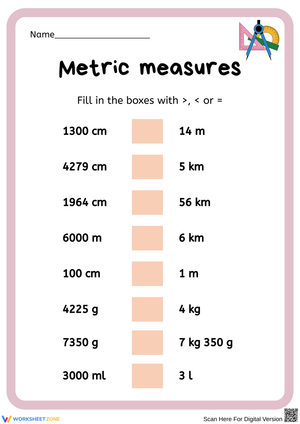
The 3rd grade length and metric units worksheets also slot naturally into a science block when students are tracking plant growth. A class measuring a bean plant weekly in centimeters can use the comparison worksheets to record and interpret that data, tying metric fluency to an ongoing observation task rather than treating it as isolated math-period content.
Standard Alignment
CCSS.MATH.CONTENT.3.MD.B.4 requires students to generate measurement data by measuring lengths using rulers marked with halves and fourths of an inch, then display that data on line plots. The standard names customary units, but the underlying tool-use and data-recording demands — reading graduated scales accurately, recording values, and comparing measurements — are exactly what metric ruler work builds. Teachers in states with explicit metric benchmarks, or those integrating NGSS science practices at the third-grade level, will find the set directly supports expected grade-level measurement fluency. The decimal structure of metric units is also particularly useful here: when a class measures plant heights in centimeters and records them on a line plot, comparing 12 cm against 15 cm requires no fraction reasoning, which keeps the focus on data interpretation rather than the arithmetic complexity students are still developing with fractions.
Adjusting the Set for a Range of Learners
Students still working to read whole-number centimeters accurately do best starting with worksheets where objects align flush to the zero mark and measurements land exactly on a labeled graduation. Removing the millimeter layer temporarily lets those students build confidence with the ruler's structure before they have to interpret the smaller marks between numbered lines.
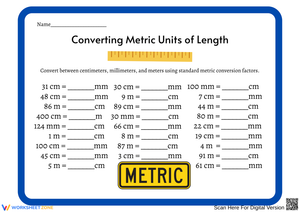
For students ready to push further, the word-problem worksheets can be extended by asking them to convert their answers — expressing a centimeter measurement in millimeters, or explaining why a meter measurement would be impractical for a small object in the problem. The 3rd grade length and metric units worksheets that feature broken-ruler tasks, where the object doesn't start at zero, are well suited as extension work for students who already measure accurately from a standard starting point. Those tasks require students to understand that measurement is the difference between two points rather than simply the number where an object ends — a conceptual step up from reading a ruler in the conventional way.
Frequently Asked Questions
Do students need physical rulers to complete these worksheets?
Not for most tasks. The ruler-reading exercises use printed, to-scale ruler illustrations so students can work independently without a physical tool. A few estimation tasks benefit from access to a real ruler or meter stick for self-checking, but the core measurement-reading and unit-selection work is fully contained within each worksheet.
How do I handle students who rush through ruler readings and consistently get wrong answers?
The most effective intervention is slowing the task down by requiring students to write the nearest whole centimeter first, then the remaining millimeters separately, before combining them into a single reading. This two-step annotation process makes the partial centimeter visible and prevents students from eyeballing the endpoint and writing whichever whole number looks closest.
Are these appropriate for students who haven't been introduced to millimeters yet?
Yes. The set moves from centimeter-only tasks toward millimeter precision, so teachers can assign the earlier worksheets before millimeters are introduced at all. Once that unit is taught, the later worksheets provide the follow-up practice needed to make the new graduation marks feel less overwhelming.
Can these work as assessment tools rather than practice?
Several worksheets function well as formative checks: the unit-selection tasks and word problems both yield quick, scorable data on where individual students stand. The 3rd grade length and metric units worksheets are not normed assessments, but teachers routinely use them as progress evidence during a measurement unit — particularly when preparing for parent conferences or documenting which students need additional support before the class moves on.













 Interactive Worksheet Maker
 Quiz Maker
 Word Search Maker
 Crossword Puzzle Maker
 Word Scramble Generator
 Sentence Scramble Generator
 Handwriting Worksheet Generator
 Name Tracing Generator
 Fill In The Blank Generator