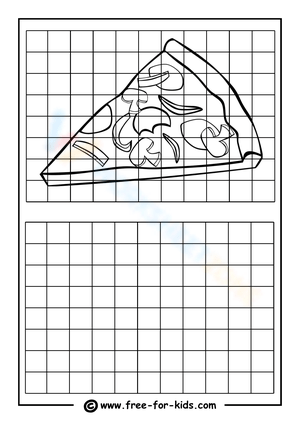
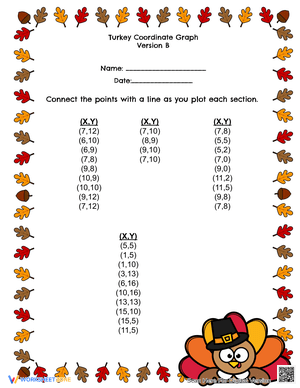
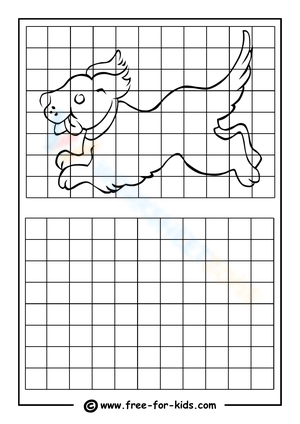
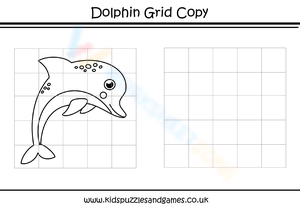
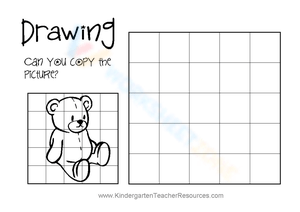
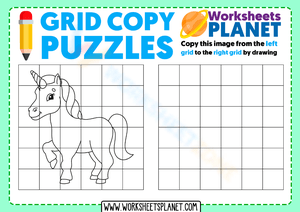
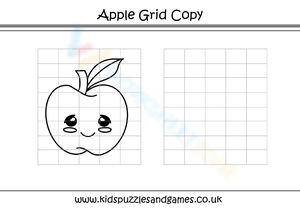
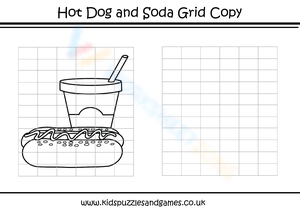
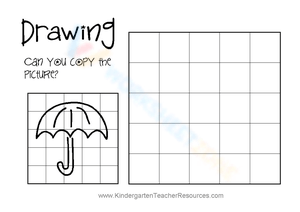
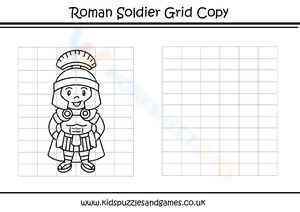
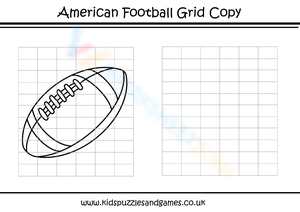
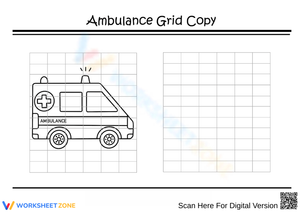
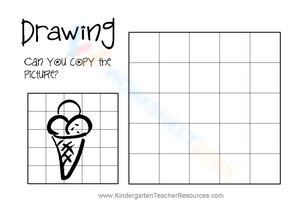
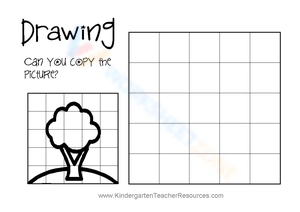
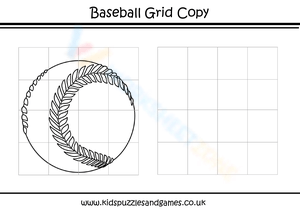
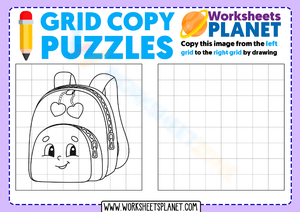
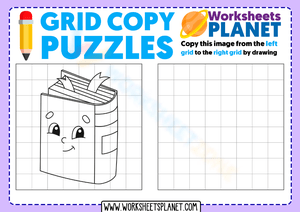
These grid drawing worksheets pdf for 3rd grade give teachers a structured entry point into observational drawing — one that works with how 8- and 9-year-olds actually see the world, rather than fighting their instinct to draw from memory. Each worksheet pairs a reference image divided into a labeled grid with a blank matching grid where students reproduce what they observe, square by square. The set covers animals, seasonal subjects, and geometric forms, so individual worksheets fit into existing art units or run as a focused drawing sequence.
The Specific Skills Each Worksheet Targets
The core practice is looking — not at a whole image, but at a single bounded cell. That shift is harder than it sounds for third graders. At this developmental stage, most students still draw from mental schema: they draw "a dog" rather than the actual curve of a jaw or the angle of an ear along the top edge of a specific square. The grid interrupts that habit by forcing the eye to report what is actually inside each cell rather than what the brain expects to find there. What students practice as a result:
- Translating observed line angles onto paper without defaulting to a remembered symbol
- Estimating where a line enters and exits a cell — a direct precursor to coordinate reasoning
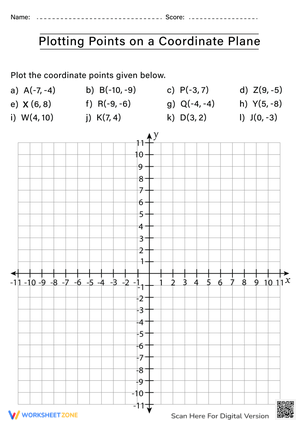
- Tracking position across a labeled grid using letter-number coordinates
- Controlling pencil pressure, since light strokes make corrections far easier
- Building a complete image incrementally, which develops follow-through and patience in a way open-ended drawing tasks often do not
The coordinate labeling on every worksheet — letters across the top, numbers down the side — matters beyond mere organization. Students who lose their place mid-drawing typically abandon the grid logic and jump to recognizable parts of the image. Having a grid address to return to gives them a way to self-correct before the error compounds.
Mistakes Worth Anticipating Before You Pass These Out
The most consistent error in third-grade grid drawing is starting from the center of the image rather than from a corner or edge. Students spot the most interesting part — usually the eye of an animal — and begin there, which leaves insufficient room for surrounding sections. A brief demonstration that starts deliberately in square A1 and works across rows by address corrects this before it becomes a habit.
A subtler error: students look at the reference square, look away, then draw from what they briefly memorized rather than continuing to consult the source. The result is that curved lines become generic arcs and distinctive angles flatten out, cell by cell. Reminding students to glance back with each pencil stroke — not just at the start of a cell — noticeably improves fidelity. A cardstock frame with a cutout matching the cell size, placed over the reference so only one square shows at a time, solves this almost immediately. Students stop being distracted by the full image and read just the shape they actually need.
Fitting These Worksheets Into Your Weekly Lesson Plan
The first introduction should happen as a whole-group lesson with a projected or large-format reference. Walk through two or three squares together before releasing students to work independently — name your coordinates aloud as you go and think out loud about where a line enters the square. Pick the simplest worksheet in the set for this first session: bold lines, minimal interior detail. Process confidence has to come before subject complexity.
Once the method is in place, the grid drawing worksheets pdf for 3rd grade slot comfortably into a 20- to 30-minute independent block. They hold up equally well as art center rotations, early-finisher work, and sub plans — the reference and the grid are both on the same worksheet, so a substitute needs no technique knowledge to run the activity. One practical note: students who rush will skip the coordinate check and start drawing from recognition. A posted anchor chart showing the letter-number system, visible during work time, keeps that in check without requiring constant redirection.
Where Grid Drawing Connects to Grade 3 Math
The coordinate system on every worksheet — letters on the horizontal axis, numbers on the vertical — gives teachers a natural cross-curricular hook. When students say "I'm in C4 and the line curves toward the bottom-right corner," they are already using the language of a coordinate plane before that term appears formally in math class. Spatial estimation also surfaces throughout: to draw a line that enters near the bottom-left corner of a cell and exits near the top-right, a student has to judge distance within a bounded space — the same reasoning that underlies early fraction and measurement work.
The grid drawing worksheets pdf for 3rd grade do not become a math lesson, but teachers who use the coordinate vocabulary explicitly during the art block find that students recognize that same logic when it reappears in math class. Transfer across two different contexts tends to produce stronger retention than encountering a concept in only one setting, and this is one of the more genuine places where that transfer happens without any forced integration.
Standard Alignment
These worksheets support National Core Arts Standards anchor standard VA:Cr2.1, which asks students to demonstrate craftsmanship through art-making techniques at the 3rd grade band. The specific expectation — that students apply knowledge of tools and approaches to plan and create artwork — maps directly onto what the grid method requires: deliberate observation, methodical execution, and self-correction during the process. The finished drawing is visible evidence of that decision-making, which makes it straightforward to assess against this standard in a way that open-ended work often is not.
The coordinate vocabulary also touches CCSS.MATH.CONTENT.3.G.A.1, which covers recognizing and describing shapes and their attributes, and lays informal groundwork for CCSS.MATH.CONTENT.5.G.A.1, where the formal coordinate plane is introduced. In schools where art and classroom teachers coordinate planning, these worksheets represent one of the more substantive points of overlap between the two content areas.
Adjusting the Set for Your Range of Learners
For students who find the standard grid density difficult, the most practical adjustment is to begin with the animal outline worksheets, which use the fewest interior line changes per cell. Reducing the number of cells completed in a session — rather than lowering the complexity of each cell — preserves the full observational practice within a shorter task. Students who move through the work quickly benefit from a different constraint: ask them to reproduce the image at a different scale, either smaller or larger than the reference. That requires proportional reasoning within each cell rather than direct copying, and it adds a meaningful level of challenge without requiring separate materials.
For students with fine motor difficulties, photocopying at 125 or 150 percent increases cell size enough to ease the physical demand. The grid drawing worksheets pdf for 3rd grade accommodate this well because the printed grids stay legible at enlarged sizes — the lines are clean enough that enlargement does not introduce distortion. The observational goal remains fully intact; only the physical scale of execution changes.
Frequently Asked Questions
How do I introduce this method to students who have never used a grid before?
Use a large demonstration grid on chart paper or a whiteboard alongside a projected reference. Complete two or three cells as a class, calling out the coordinate address before drawing each one and describing what you observe aloud — "In A1, there is a curved line that starts near the top-left corner and dips toward the center-bottom." Students should watch at least two full squares completed before picking up their own pencils. Starting with a bold geometric animal silhouette rather than a detailed figure keeps the first attempt achievable and sets realistic expectations for what the process actually looks and feels like.
What should I do when a student is convinced their drawing looks wrong halfway through?
Redirect them to a single-cell comparison rather than asking them to evaluate the whole image. Discouragement at this stage almost always comes from looking at the overall drawing before enough cells are filled in for the form to emerge. Ask them to find one specific square — say, C3 — and compare just that cell to the reference. If the placement is actually off, erasing one cell is far less demoralizing than erasing a large area, which is another reason light pencil pressure matters from the very first stroke.
Do these worksheets work in a classroom where some students finish much faster than others?
The variance in completion time is actually lower with grid drawing than with open-ended tasks because every student has a clear next step: finish this cell, move to the next address. Students who finish early can shift to coloring, matching observed tones from a reference photo rather than choosing freely — that keeps the observational focus active after the drawing is done. Students working more slowly do not feel rushed because the grid structure makes incremental progress visible even when overall completion is further off.
Can these be used outside of art class?
Classroom teachers use individual worksheets during the last 10 minutes before pickup, Monday morning warm-ups after the opening routine, and indoor recess blocks. Because the activity requires focused, quiet attention without reading or writing demands, it is also useful during transitions that need to be independent and calm. Once the method has been introduced in art, no re-teaching is needed — students already know the process and can get started without instruction.












 Interactive Worksheet Maker
 Quiz Maker
 Word Search Maker
 Crossword Puzzle Maker
 Word Scramble Generator
 Sentence Scramble Generator
 Handwriting Worksheet Generator
 Name Tracing Generator
 Fill In The Blank Generator