


























Views
Downloads

Hot Dog Grid Drawing | Essential Grade 2-5 Art
Paste this activity's link or code into your existing LMS (Google Classroom, Canvas, Teams, Schoology, Moodle, etc.).
Students can open and work on the activity right away, with no student login required.
You'll still be able to track student progress and results from your teacher account.
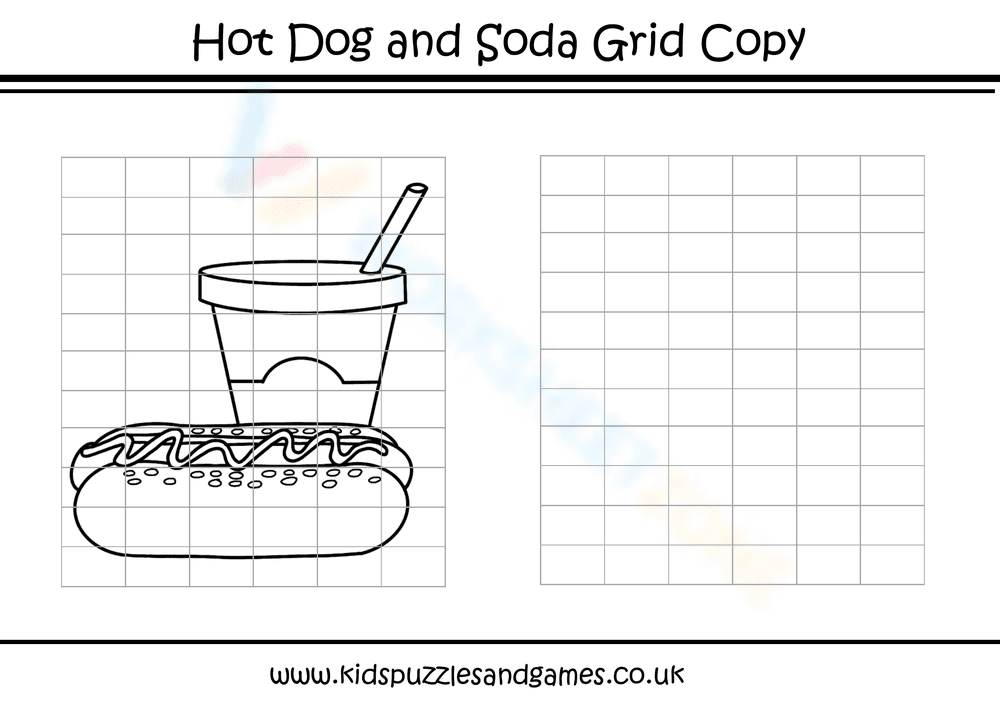
This Grade 2-5 grid drawing worksheet helps students develop critical spatial reasoning and fine motor control by replicating a complex image. By using a coordinate-style grid, learners break down a hot dog and soda illustration into manageable segments, ensuring proportional accuracy and attention to detail. It is an effective tool for visual-motor integration and artistic confidence.
At a Glance
- Grade: 2-5 · Subject: Fine Art / English
- Standard:
CCSS.ELA-LITERACY.RI.2.7— Use information from illustrations to demonstrate understanding of a text or task- Skill Focus: Spatial awareness and line replication
- Format: 1 page · 1 task · Answer key not required · PDF
- Best For: Early finishers and spatial skill building
- Time: 15–20 minutes
The worksheet features a single-page layout containing a reference image of a hot dog and soda cup set against a 7x8 grid. Adjacent to the reference is an identical empty grid for student work. The clean, high-contrast lines make it easy for students to identify where specific shapes intersect with grid lines, facilitating a successful drawing experience without constant teacher intervention. The task encourages students to observe small details, such as the mustard swirl and the straw placement.
The zero-prep workflow is designed for immediate classroom implementation. First, print the single-page PDF in seconds. Second, distribute the sheets to students as a warm-up or early finisher task. Third, review the completed drawings by checking for spatial alignment and line accuracy. Total teacher preparation time is under 2 minutes, making this an ideal resource for emergency sub plans or transition periods between core subjects.
Standards Alignment: `CCSS.ELA-LITERACY.RI.2.7` — "Explain how specific images contribute to and clarify a text." While primarily an art activity, this worksheet requires students to interpret visual information and translate it into a new space, a core component of visual literacy and technical following of directions. Both standard codes can be copied directly into lesson plans, IEP goals, or district curriculum mapping tools.
Use this as a "bell-ringer" activity to settle students at the start of an art or English block. It also serves as an excellent formative assessment for tracking fine motor development and spatial awareness. Teachers can observe which students struggle with specific quadrants to identify needs for further visual-motor support. Expect students to spend 15–20 minutes completing the drawing with careful attention to the mustard and straw details.
This resource is ideal for elementary students in grades 2 through 5, particularly those who benefit from structured creative outlets. It is highly effective for occupational therapy sessions or as a quiet-time activity. Pair this with a descriptive writing prompt about a baseball game or favorite snacks to create a cross-curricular lesson that bridges art and language arts.
Research by Fisher & Frey (2014) emphasizes the importance of visual literacy and the ability of students to decode and encode visual information as a precursor to complex reading comprehension. This grid copy worksheet utilizes the scaffolded drawing method, which reduces cognitive load by allowing students to focus on one quadrant at a time. By aligning with CCSS.ELA-LITERACY.RI.2.7, the activity bridges the gap between artistic expression and technical observation. Studies in the NAEP framework suggest that students who engage in regular spatial reasoning tasks show improved performance in STEM-related fields and geometry. This 1-page printable provides a low-stakes environment for practicing these high-leverage skills. The use of familiar imagery, like a hot dog and soda, increases student engagement while maintaining the rigor of technical drawing. It is a reliable resource for any classroom requiring a quick, standards-aligned visual task.


