


























Views
Downloads
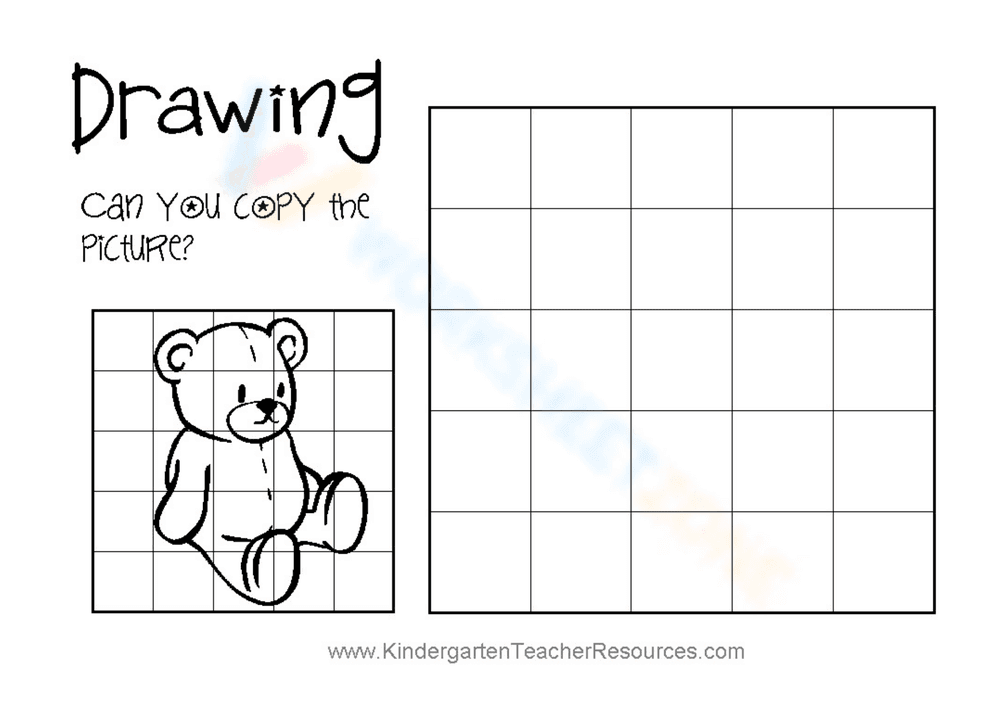

Grid Bear Drawing Worksheet | Grade 1 Essential
Paste this activity's link or code into your existing LMS (Google Classroom, Canvas, Teams, Schoology, Moodle, etc.).
Students can open and work on the activity right away, with no student login required.
You'll still be able to track student progress and results from your teacher account.
This Grade 1 grid bear drawing worksheet helps students develop critical spatial reasoning and fine motor control by replicating a complex image square by square. By breaking down the teddy bear into a 5x5 grid, learners practice observational accuracy and hand-eye coordination. It is an effective tool for transitioning from freehand drawing to structured artistic composition.
At a Glance
- Grade: 1 · Subject: Fine Art
- Standard:
VA:Cr2.1.1a— Explore uses of materials and tools to create works of art- Skill Focus: Grid drawing and spatial awareness
- Format: 1 page · 1 task · No-prep · PDF
- Best For: Early finishers or art centers
- Time: 15–20 minutes
Inside this resource, you will find a single-page PDF featuring a reference image of a teddy bear mapped onto a 5x5 grid. Adjacent to the reference is an identical empty grid, providing students with a clear workspace. The layout is designed to minimize distraction, focusing entirely on the relationship between the lines in the reference box and the blank canvas.
The zero-prep workflow for this activity is designed for maximum efficiency. First, print the single-page PDF (30 seconds). Next, distribute the sheets to students with pencils and erasers (1 minute). Finally, review the completed drawings by checking for line placement accuracy within the grid coordinates (30 seconds). Total teacher preparation time is under 2 minutes, making it an ideal sub plan addition.
This activity aligns with VA:Cr2.1.1a, which focuses on exploring tools and materials to create art. It also supports spatial reasoning skills found in early geometry standards. By using a grid, students learn to perceive shapes as a collection of parts rather than a single overwhelming object. This standard code can be copied directly into lesson plans, IEP goals, or district curriculum mapping tools.
Use this worksheet as a quiet bell-ringer activity to start an art period or as a focused task for early finishers during general instruction. For a formative assessment, observe if students are drawing the bear as a whole or if they are correctly using the grid lines to guide their pencil strokes. Completion typically takes 15 to 20 minutes depending on the student's attention to detail.
This worksheet is ideal for Grade 1 students, though it remains accessible for Kindergarten through Grade 3. It is particularly helpful for students who struggle with proportions in freehand drawing. Pair this resource with a short lesson on mapping or use it alongside a teddy bear-themed literacy unit to integrate art into the broader curriculum.
Research by Fisher & Frey (2014) emphasizes the importance of scaffolded tasks in developing complex motor skills and cognitive mapping. Grid drawing serves as a powerful scaffold, reducing the cognitive load of what to draw so students can focus on the how of spatial relationships. By isolating visual information into 25 distinct squares, the worksheet prevents students from becoming overwhelmed by the complexity of the subject. This method is a proven technique for improving observational skills, which are foundational for both visual arts and scientific illustration. According to recent NAEP data, students who engage in regular fine motor practice show higher levels of engagement in multi-step academic tasks. This resource provides a structured environment for that practice, ensuring that learners build the confidence needed for independent artistic expression while meeting core visual arts standards like VA:Cr2.1.1a.


