3rd Grade Peer Editing printable worksheets
These 3rd grade peer editing printable worksheets give students a step-by-step process for reading a classmate's draft with purpose — not scanning for "something wrong" in general, but moving through specific mechanical and structural checks in deliberate sequence. Each worksheet is built around frameworks that eight- and nine-year-olds can apply independently after two or three modeled sessions, and the set covers both the revising and editing phases of the writing process.
What Each Worksheet Asks Students to Do
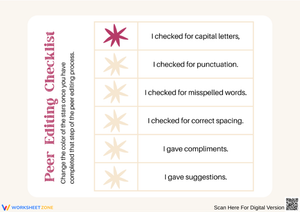
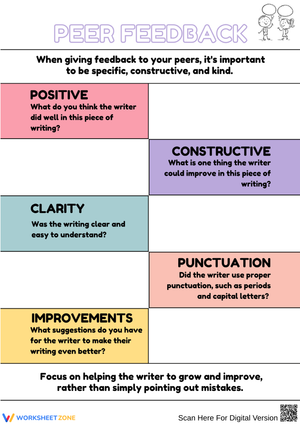
The editing worksheets are organized around CUPS — Capitalization, Usage, Punctuation, Spelling — which gives students a separate pass through the draft for each category. On a typical session, a student reads a partner's writing once with attention entirely on capital letters: are they present at the start of each sentence, and on every proper noun? Then comes a second read for end marks, a third for usage, and so on. That structure works because it takes the impossible task of "catch everything at once" and breaks it into something a nine-year-old can actually accomplish.
Some worksheets also introduce a small set of editor's marks, which students use to annotate the actual draft:
- Three underlines beneath a lowercase letter that should be capitalized
- A caret (^) to show where a missing word or phrase belongs
- A circle around a suspected spelling error
Third graders respond to these marks with unusual seriousness. There is something about annotating a real draft with real symbols that makes the task feel substantive rather than like another fill-in-the-blank exercise.
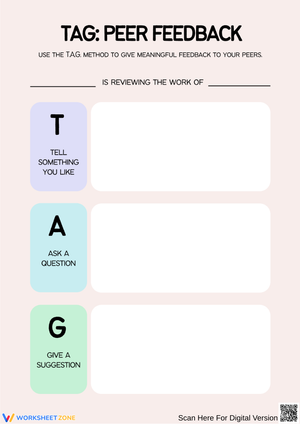
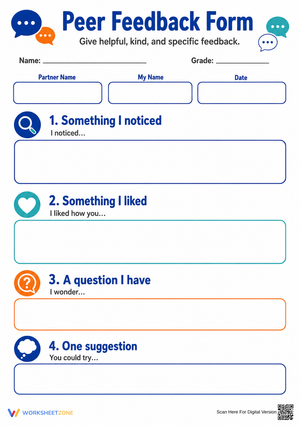
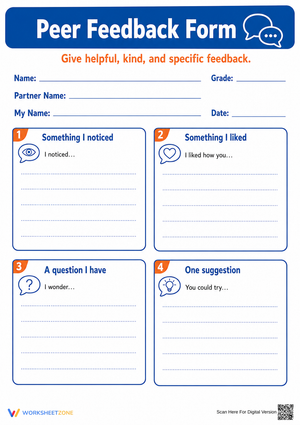
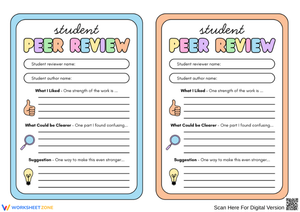
The revising worksheets use the ARMS framework — Add, Remove, Move, Substitute — and guide students toward structural questions: Is there an off-topic sentence? Does this story have enough detail? Could two short, choppy sentences become one stronger one? The Two Stars and a Wish structure appears on each revising worksheet as well, asking students to name two specific strengths before identifying one area for improvement. The key word there is "specific." A useful star sounds like "You used 'shivering' instead of 'cold' in your third sentence" rather than "Your writing was interesting." The worksheet prompts push toward that level of precision, though it takes repeated practice to get students there.
Why These Worksheets Keep Revision and Editing Separate
Third grade is one of the first points in the writing progression where the distinction between revising and editing becomes genuinely teachable. Students now have enough command of sentence mechanics to provide meaningful feedback to a peer — but they still need a structure that tells them which type of reading to do first. A checklist that mixes content questions ("Does this paragraph have a clear topic sentence?") with mechanical ones ("Are all words spelled correctly?") produces shallow passes at each category. These worksheets avoid that collapse by keeping the phases on separate documents. Students who complete the ARMS-based revising worksheet first arrive at the CUPS editing worksheet having already read the draft carefully, so they're not starting cold when it's time to look at punctuation and spelling.
Mistakes Students Make That These Worksheets Help You Catch
The most predictable problem in third-grade peer editing isn't unkind feedback — it's inaccuracy. Students check a category as "okay" when it contains an error they haven't learned to name yet. A student who places periods correctly after her own declarative sentences will often miss an unmarked question in a peer's draft — "where did she go" sitting there without a question mark — because she's been checking for periods, not for the match between sentence type and end mark. The CUPS checklist on these worksheets treats question marks and exclamation points as explicit line items, separate from periods, so that distinction gets its own attention rather than getting folded into a generic "check punctuation" prompt.
A second, quieter problem: students approve capitalization that matches their own instincts. Third graders frequently capitalize words they consider important — seasons, animal names, school subjects — because those words feel significant to them. A peer editor at this grade will see "I love Spring" and leave it unmarked, because capitalizing "Spring" is exactly what they would write. Checklist items need to be specific enough to catch this. "Are season names lowercase unless they start a sentence?" is more useful than "Check capitalization."
Building These Worksheets Into Your Writing Block
Plan two full days of modeling before students work independently. On the first day, project a paragraph you drafted yourself — with deliberate errors in capitalization, end punctuation, and structure — and work through the revising worksheet in front of the class, thinking aloud about every decision. On the second day, return to the same paragraph for the editing worksheet. Students need to see both passes before they can approximate either on their own. What you're modeling isn't just the checklist items; it's how to read a piece of writing with a specific job in mind.
Keep the peer editing sessions themselves to 15–20 minutes. Beyond that window, the social dynamic between partners tends to overtake the academic task, and feedback quality drops noticeably. Many teachers find it cleaner to split the two phases across days: ARMS-based revising on Tuesday, CUPS editing on Wednesday, with a five-minute class share at the end of each session about what partners noticed. That pacing reinforces the two-phase habit without asking students to sustain close reading longer than they can.
Rotate partners across a writing unit rather than keeping the same pair session after session. One 3rd grade peer editing printable worksheets session with an unfamiliar partner often yields sharper, more careful feedback than several sessions with a familiar one — students read more deliberately when they can't predict the other person's writing patterns. Before the swap, have students read their own draft aloud in a low whisper to themselves. Hearing the words spoken catches missing words, dropped punctuation, and awkward phrasing that the eye skips over during silent reading, which means the peer editor inherits a cleaner draft and can focus on subtler issues.
Standard Alignment
These worksheets directly address CCSS.ELA-LITERACY.W.3.5, which requires students to develop and strengthen writing through planning, revising, and editing with guidance from peers and adults. Third grade is where this standard becomes operational: students have enough command of sentence mechanics to provide meaningful feedback to a peer, but they still need enough structure to do it reliably. The worksheets supply that structure without replacing the teacher's role — the teacher still models, circulates, and intervenes — but they keep student attention on specific tasks between those touchpoints.
The discussion that follows each peer editing session also connects to CCSS.ELA-LITERACY.SL.3.1, which covers engaging effectively in collaborative conversation and building on others' ideas. The three to five minutes a pair spends talking through the marks on the worksheet — why the editor flagged something, whether the writer agrees — is where a significant portion of the actual learning lands. The worksheet gives both students enough specificity to hold that conversation without it becoming "I just thought it sounded weird."
Adjusting These Worksheets for a Range of Writers
For students still working to internalize basic sentence mechanics, narrow the editing checklist to two items: capital letter at the start, period at the end. Asking a developing writer to check all four CUPS categories in a peer's draft usually produces a quick, unreliable scan of each rather than a careful check of any. Two reliable catches from a guided, step-by-step process are more valuable than four superficial ones.
For students who move through the checklist accurately and quickly, add a prompt asking them to identify one sentence they would rewrite and to write their revised version at the bottom of the worksheet. That task requires synthesis — the editor has to understand what the sentence is trying to do before improving it — and pushes well past what a checklist can demand on its own. The 3rd grade peer editing printable worksheets format stays consistent for the whole class; what shifts is the expectation for what a "complete" response looks like.
Frequently Asked Questions
How do I stop students from writing "good job" for their Two Stars?
Require students to include the specific sentence or detail they're praising. "You used 'enormous' instead of 'big' in your second sentence — that's a stronger word choice" counts as a star. "Your writing was good" does not. Model the difference explicitly on day one and keep a sample on display during editing sessions. Most students can produce specific praise once they see clearly what it looks like.
What if a student gets upset when their draft gets marked up?
This is most likely when students haven't yet internalized the idea that marks on a draft are a normal part of writing — that every piece of writing anyone considers finished has gone through rounds of feedback first. Before the first peer editing session, show students examples of marked-up drafts, including your own work in progress. Some teachers keep a draft they've been revising on the board throughout an entire writing unit to make the point that editing is ongoing, not a signal of failure. The Two Stars structure also softens the first impression because the writer hears what's working before hearing what to revisit.
How many errors should a peer editor realistically catch at this grade?
Three to five clear errors in a short paragraph is a solid result for a third grader working from a checklist. The point of these sessions isn't an exhaustive audit — it's building the habit of systematic, focused reading. A student who finds one error by following the checklist carefully has done the work. A 3rd grade peer editing printable worksheets is practice in how to look, not a measure of how many errors the editor catches in a single pass.
Clear All