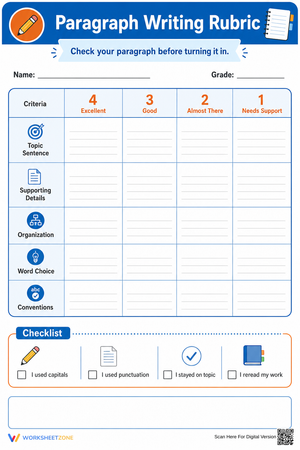
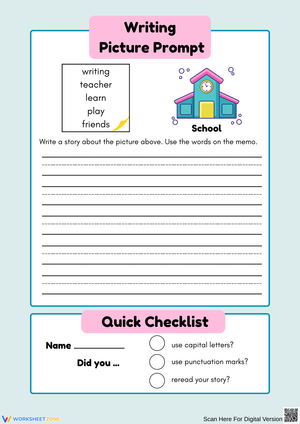
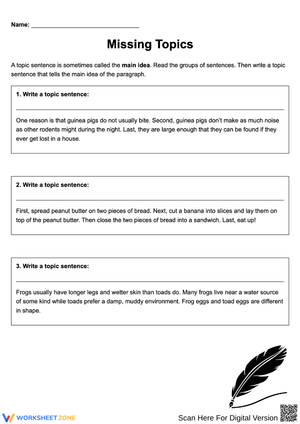
These 3rd grade paragraph structure worksheets resources give teachers a ready sequence of practice that moves students from recognizing paragraph parts to producing organized writing on their own. The set works through the three-part structure — topic sentence, supporting details, and closing sentence — using labeling exercises, sentence sorting, scrambled-paragraph reordering, partial completion tasks, and full guided writing, with each worksheet targeting a distinct stage in that progression.
Skills These Worksheets Build
Grade 3 is the point where paragraph structure shifts from an incidental observation to an explicit instructional goal. Students may have written loosely related sentences before this grade, but the expectation that a paragraph has identifiable parts — each doing a different job — is genuinely new territory for most eight-year-olds.
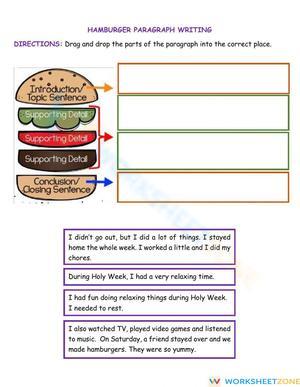
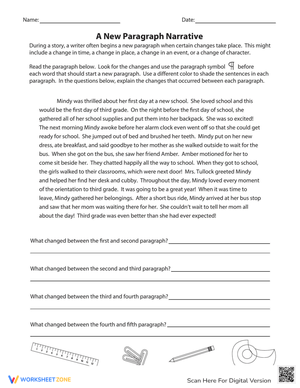
The labeling tasks come first. Students read a short paragraph and mark the topic sentence, supporting details, and closing sentence using different colors. That routine traces back to the paragraph hamburger model used widely in elementary classrooms and referenced by resources like Reading Rockets. The physical action of color-coding each part makes writing-conference feedback faster — and when 3rd grade paragraph structure worksheets sets carry that same color system from the first worksheet through the last, students begin transferring the habit into their own drafts without being reminded.
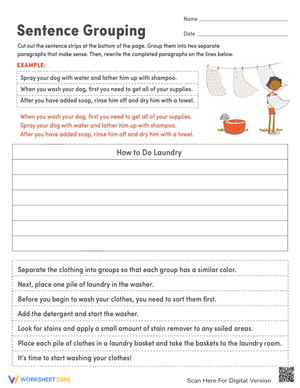
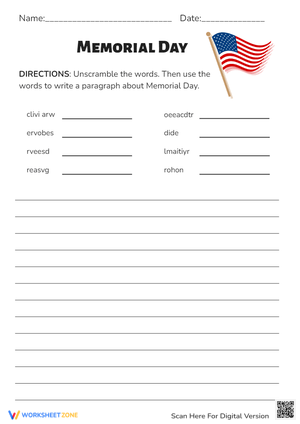
The sorting and reordering tasks do something labeling cannot: they put students in the position of making decisions rather than finding answers. Sorting sentences by function — topic sentence, detail, closing sentence — builds the judgment that shows up later in revision. Reordering a scrambled paragraph adds the challenge of determining where sentences belong relative to each other. Many third graders find that harder than expected, and that difficulty surfaces gaps that labeling exercises alone will not catch.
Where Student Paragraphs Typically Fall Apart
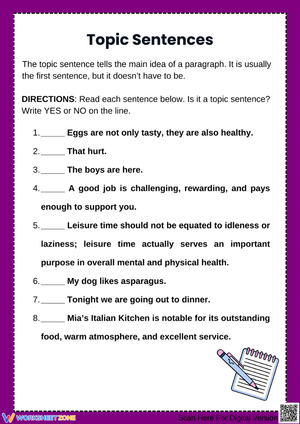
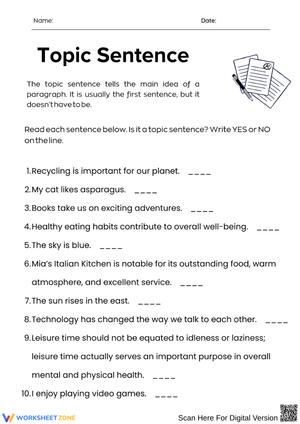
The most persistent error is a topic sentence that names the subject without making a statement about it. Students write "My paragraph is about dogs" because it mentions the topic — that counts, in their view. Worksheets that ask students to evaluate a range of sample topic sentences, including several weak versions and one that genuinely works, give them the comparisons they need to understand what a topic sentence is supposed to do, rather than simply what it is.
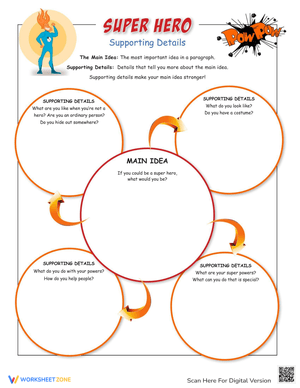
Supporting details produce a second pattern. Students write details that are true and on-topic but do not actually develop the specific claim in the topic sentence. A paragraph opening with "Dogs make good family pets" might include the sentence "Dogs come in many sizes and colors" — accurate and related, but beside the point. At age 8, the difference between a related fact and a supporting detail is genuinely hard to feel. The sentence-sorting tasks make it concrete: when students must decide whether a sentence belongs in this specific paragraph versus another paragraph about the same subject, that distinction becomes practical rather than abstract.
Closing sentences bring a third pattern worth watching. Many students change one or two words from the topic sentence and consider that a valid closing. Including sample closings in worksheets and asking students to rank them from strongest to weakest — with a brief written reason — builds the evaluative habit they need before revision of their own endings becomes possible.
Lesson-Planning Strategies for Getting the Most From These Worksheets
A five-minute model at the start of the lesson carries more instructional weight than most teachers expect. Read one short paragraph aloud, label the parts together on a projected copy, and have students do the same color-coding on their own copy before the worksheet begins. Thinking aloud through one uncertain moment — "I'm not sure whether this sentence is a detail or a topic sentence; let me reread" — is more useful than simply marking correct answers, because it shows students the reasoning process, not just the result.
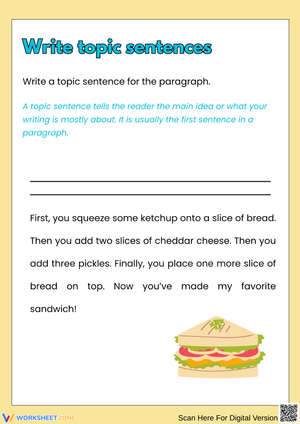
For small groups, the partial-completion tasks are especially productive. A student who writes "My dog is really fast" as a supporting detail for a paragraph about why libraries are good places to study cannot always spot that mismatch independently. Named in the moment and revised on the spot, that kind of gap closes faster than any written comment on a returned worksheet.
These worksheets slot naturally into the ten minutes after a mini-lesson and before independent writing time in a workshop model. They also work as Monday morning warm-ups — short, structured, and low-stakes before students are asked for a full draft. The 3rd grade paragraph structure worksheets format requires no preparation for a substitute, because the directions are self-contained and do not depend on knowing where the class is in a longer writing unit.
Adapting the Set for Writers at Different Stages
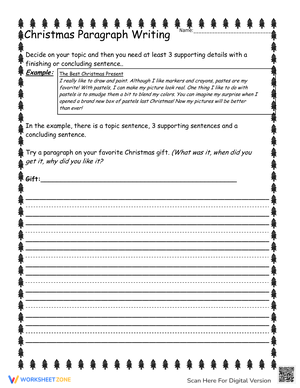
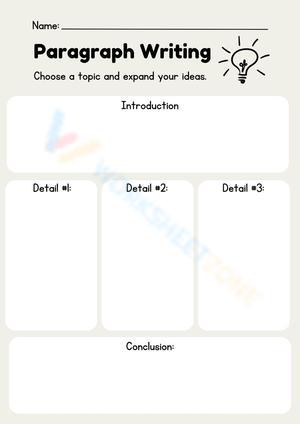
Grade 3 writing classes almost always include students who can talk through a topic clearly but freeze when asked to write sentences. For those students, the most effective adjustment reduces the production demand without lowering the structural expectation. Keep the full three-part requirement — topic sentence, supporting details, closing sentence — but provide targeted support:
- Sentence starters for the topic and closing sentences
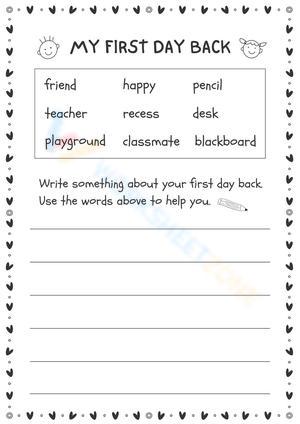
- A word bank of content vocabulary tied to the prompt
- A paragraph frame with labeled blanks for each structural part
- Planning space for notes before writing begins
Some teachers avoid paragraph frames because the resulting writing sounds formulaic. That concern matters more in revision and publication work. At the introduction stage, the frame lets students experience a structurally complete paragraph — often for the first time — before they are expected to generate that structure on their own. The frame can be removed across later worksheets as students gain control. For students who are well ahead, removing the provided paragraph from the labeling tasks and asking them to locate or recall a paragraph from memory adds genuine challenge without requiring a separate set of materials.
Standard Alignment
These worksheets align most directly to CCSS.ELA-LITERACY.W.3.2, which asks third graders to write informative and explanatory texts that include an introductory sentence, supporting facts and definitions, and a concluding statement. The three-part paragraph structure practiced across the set maps onto those components directly. The worksheets also address CCSS.ELA-LITERACY.W.3.1, which applies the same organizational framework to opinion writing — the topic sentence becomes an opinion statement, the details become supporting reasons, and the closing becomes a concluding statement. Because the structural logic transfers cleanly between modes, teachers can introduce the set during an informational writing unit and return to the same worksheets when the class begins opinion writing, with students applying a familiar pattern to a new purpose.
Frequently Asked Questions
What paragraph parts should a third grader be able to identify and write?
By the end of third grade, students should reliably identify and produce a topic sentence that makes a statement rather than just naming the subject, two or three supporting details that connect to the specific claim, and a closing sentence that ends the paragraph without copying the opener. The 3rd grade paragraph structure worksheets format builds toward that standard by addressing each component separately before expecting students to control all three at once.
How do I introduce paragraph structure without overwhelming students?
Start with a completed paragraph and label it together as a class. Then move to labeling with partial guidance, then to sorting and reordering, and finally to original writing. That progression uses gradual release — the teacher holds more of the cognitive load at the start and transfers responsibility in deliberate steps. The most common mistake is moving directly to independent paragraph writing before students have spent time reading and marking strong models. Most third graders need several labeled examples before they can produce one.
Can these worksheets work in writing centers or as morning work?
Sorting and reordering tasks are well suited to centers because they have a clear endpoint and students can check their work against a provided key. Labeling worksheets work for morning work because they finish in 5 to 8 minutes using only a pencil and crayons. Full paragraph writing tasks are better reserved for teacher-guided settings early in the unit — students often do not catch their own structural gaps without real-time feedback, and those gaps harden into habits quickly if left uncorrected.
What is the difference between a supporting detail and a related fact?
A supporting detail connects directly to the claim in the topic sentence; a related fact is true and on-topic but does not develop that specific claim. This is one of the harder distinctions in the unit, and most students encounter it as an abstract rule until they see it applied repeatedly. The sentence-sorting tasks put that contrast in front of students across multiple worksheets, and drawing examples from actual student writing — rather than clean textbook paragraphs — makes the difference register more clearly than any definition alone.












 Interactive Worksheet Maker
 Quiz Maker
 Word Search Maker
 Crossword Puzzle Maker
 Word Scramble Generator
 Sentence Scramble Generator
 Handwriting Worksheet Generator
 Name Tracing Generator
 Fill In The Blank Generator