These topic sentence pdf worksheets for 3rd grade address the specific transition point where writing instruction changes shape: students who've spent two years producing sentences and short narratives are now asked to build organized paragraphs, and the opening sentence is where most of them stall. The set gives teachers a focused, print-ready sequence — recognition, analysis, and original drafting — built around exactly that skill.
What Students Practice Across the Set
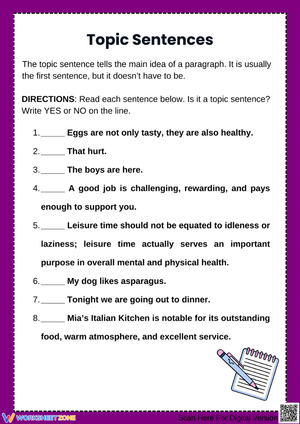
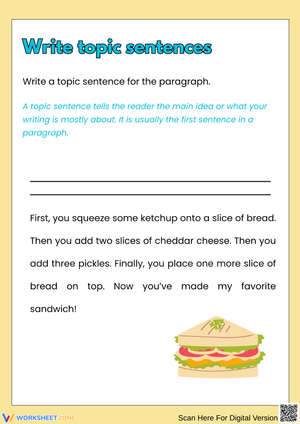
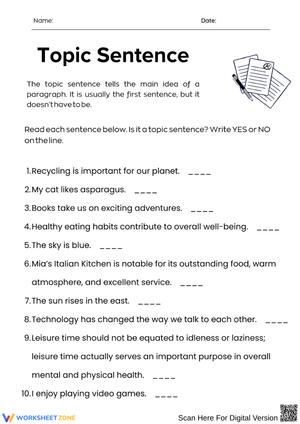
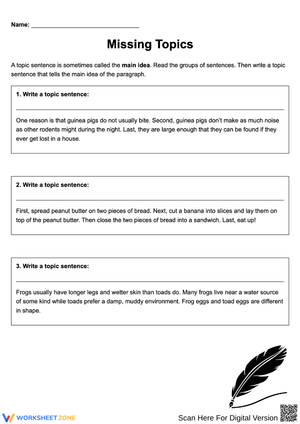
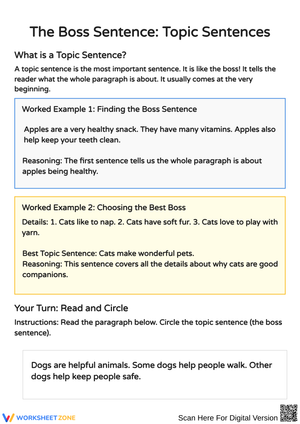
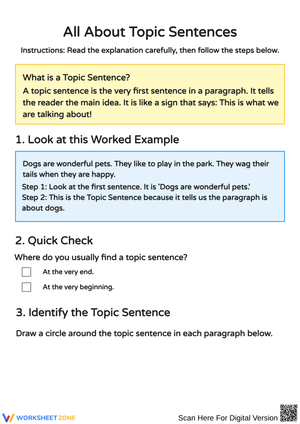
The worksheets move through a deliberate sequence. Students begin by reading short paragraphs and underlining the sentence that sets the paragraph's direction. Then they sort: given four or five supporting details, they select from a list the opening statement that best unifies them. Later worksheets ask students to rewrite weak openers, and the final activities have students drafting their own from a supplied topic and detail set.
Both informational and opinion paragraphs are covered. In the informational strand, students practice openers like "The water cycle moves water through the Earth in four main stages" — a sentence that previews content without listing all the facts upfront. In the opinion strand, they shift toward assertion: "School lunches should include more fresh fruit" rather than "I am going to tell you about school lunches." That gap — announcement versus assertion — is the clearest single improvement a third grader can make in early paragraph writing, and the set builds toward it across both genres.
The Errors Third Graders Make When Writing Paragraph Openers
The most predictable error is the announcement opener: "My paragraph is about dogs." Nearly every third grader produces this when asked to write a topic sentence unprompted, because it mirrors how they introduce topics verbally in class discussion. The trouble is that this phrasing sets no direction — the paragraph that follows tends to become a random list of facts because the opener gave no organizing idea. The rewriting activities directly target that pattern by pairing weak announcements with stronger alternatives and asking students to explain the difference out loud or in writing.
A second error worth catching early: students frequently confuse a title with a topic sentence. If the prompt mentions recycling, a student might write "Recycling" or "Recycling is something we will talk about." The sorting worksheets surface this by including title-style fragments as deliberate wrong answers. The third common error appears in the matching activities — students select the most specific detail as the opener rather than the broadest controlling idea. Catching that pattern in a multiple-choice format, before students draft independently, prevents it from taking root in their actual paragraphs.
Standard Alignment
These worksheets align to CCSS.ELA-LITERACY.W.3.1 (introduce a topic and state an opinion) and CCSS.ELA-LITERACY.W.3.2 (introduce a topic and group related information). Both standards require a clear introductory statement — not just a beginning, but a controlling one — which makes topic sentence work a direct instructional target, not a peripheral skill. In most third-grade ELA scopes, these standards come into focus in the second or third writing unit, when students first attempt multi-paragraph pieces. That's when the identification and sorting worksheets fit most naturally: targeted practice before students draft full pieces independently.
Where These Worksheets Fit in a Writing Unit
The identification and sorting worksheets work well as a whole-group warm-up at the start of a writing lesson — five to eight minutes projected on the board, with students justifying their choices aloud before you confirm. That brief discussion, where students say things like "that one doesn't tell me what the paragraph will argue," is where most of the conceptual shift happens.
For the rewriting and original-drafting worksheets, small groups outperform independent work, at least early in the unit. When three or four students work through a rewriting worksheet together, they generate the kind of peer argument — "that's still just a fact, it's not the main idea" — that whole-class instruction rarely produces. Save the independent-drafting worksheets for later in the week, after students have had two or three exposures through group work. That sequence — recognize, analyze with peers, draft independently — turns the topic sentence pdf worksheets for 3rd grade into a short formative cycle rather than one-off practice.
When Students in the Same Room Are Ready for Different Things
Students who need more support get the most from the identification and multiple-choice sorting worksheets, which reduce production demands while keeping the conceptual work intact. Adding a sentence frame to a drafting worksheet — writing "One reason why ___ is ___" directly on the sheet before copying — lets struggling writers focus on the controlling idea rather than the mechanics of getting started.
Students ready to push further can be given a paragraph with no opener and asked to write two versions: one for an informational piece, one for an opinion piece covering the same content. Comparing those two sentences exposes how purpose shapes the opening — a conversation that runs about five minutes and moves students toward the flexible thinking fourth-grade writing will require. The topic sentence pdf worksheets for 3rd grade give you enough material to run both tracks simultaneously without doubling your prep work.
Frequently Asked Questions
Why do third graders almost always default to "I am going to tell you about..."?
That phrasing comes directly from oral language. When students verbally introduce a topic in class, they literally say "I'm going to tell you about my weekend." The written version is a transcription of speech, not a composed sentence. Explicit instruction on what a written opener does differently — controlling the paragraph's direction, not just naming a subject — is what breaks that habit. The sorting activities accelerate this because they force students to compare an announcement against an assertion and argue for one over the other.
Should identification practice come before students try to write their own topic sentences?
Yes. Students who attempt to draft a topic sentence before they can reliably find one in a text tend to produce either announcements or detail-level sentences, because they haven't yet internalized what the opener is supposed to do. Reading several short paragraphs, underlining the opening, and discussing why it works — before any production is required — builds the mental model that makes independent drafting possible.
How many practice sessions does it typically take before students write topic sentences independently?
Most third graders need four to six focused exposures over one to two weeks before independent drafting is functional — not polished, but purposeful. Two or three identification worksheets, one sorting worksheet, one rewriting worksheet, and then independent drafting covers that arc. Using the topic sentence pdf worksheets for 3rd grade as the spine of a focused mini-unit, rather than assigning each worksheet as isolated homework, reliably shortens the time from introduction to independent use.












 Interactive Worksheet Maker
 Quiz Maker
 Word Search Maker
 Crossword Puzzle Maker
 Word Scramble Generator
 Sentence Scramble Generator
 Handwriting Worksheet Generator
 Name Tracing Generator
 Fill In The Blank Generator