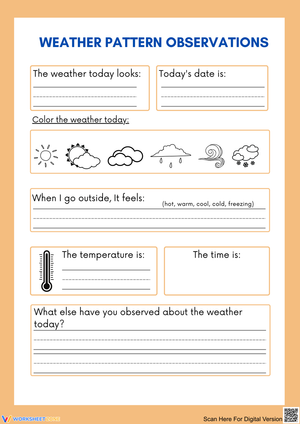
3rd Grade Weather Patterns printable worksheets
These 3rd grade weather patterns worksheets give students a structured path into informational writing by putting real content at the center of the task — temperature trends, seasonal precipitation, cloud formation, severe weather events. When the subject matter is this concrete and familiar, students have something genuine to explain, which is exactly the condition that produces stronger first drafts.
What's Inside the Set
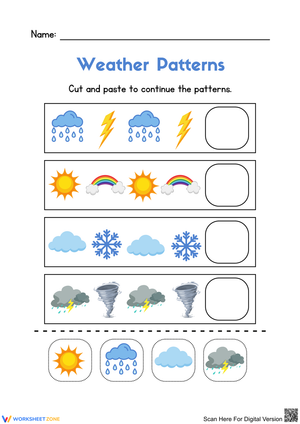
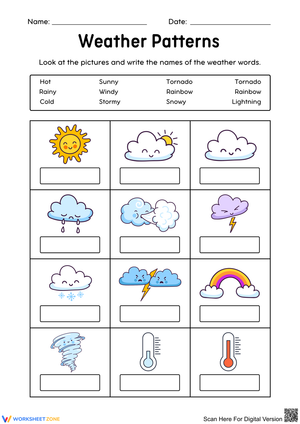
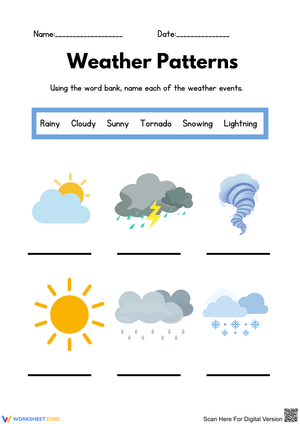
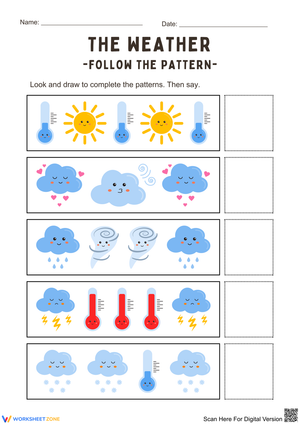
Each worksheet targets a specific stage of the informational writing process rather than treating the whole thing as one undifferentiated task. Graphic organizers ask students to sort weather facts into labeled categories before they write a single sentence — a pre-writing move that pays off in more focused paragraphs. Vocabulary-matching worksheets build the domain language students need to write precisely: distinguishing precipitation from condensation, or knowing what meteorologist actually means before dropping it into a report. Data interpretation prompts supply a simple weather chart or temperature graph and ask students to read it, identify a pattern, and write a short explanatory paragraph about what the numbers show. Paragraph frames provide sentence starters and transition scaffolds for students who know what they want to say but get stuck on how to begin. Longer research-report templates ask students to synthesize multiple facts about a single weather phenomenon — a tornado, the water cycle, a blizzard — into a structured piece with an introduction, developed body, and a closing statement.
Standard Alignment
The worksheets align primarily with CCSS W.3.2, which requires students to write informative or explanatory texts that introduce a topic, develop it with facts and definitions, use linking words to connect ideas, and provide a concluding statement. Each worksheet targets a discrete part of that standard rather than the whole thing at once — so the graphic organizer addresses idea organization, the vocabulary worksheet addresses domain-specific language, and the paragraph frame addresses structure and transitions. Using them in sequence across a unit gives students repeated, targeted contact with each component before they are asked to produce all of them together in a complete piece. For teachers tracking science integration, the content connects to NGSS 2-ESS2-1, which addresses Earth's systems and the patterns observable in weather data, though the primary instructional target here is ELA writing.
Lesson-Planning Ideas to Get the Most From These Worksheets
The vocabulary and graphic organizer worksheets slot naturally into the first ten minutes of a writing block as a knowledge-activation move before the day's main task. Data interpretation works especially well as morning work when you can tie it to an actual forecast — students record the day's predicted high, precipitation probability, and cloud cover on the worksheet, then write their explanatory paragraph using numbers they collected themselves. That sequence shifts the task from abstract exercise to something closer to real reporting.
The paragraph frame worksheets belong in whole-class or small-group instruction during the gradual-release phase, when you are modeling how informational sentences are constructed before asking students to work independently. Reserve the longer report templates for a multi-day writing unit, using the graphic organizer and vocabulary worksheets as prep work earlier in the week so the drafting session is not slowed down by concept gaps. These also hold up well in a substitute folder — the structured formats mean a guest teacher can run the lesson without content expertise.
Why This Format Fits Informational Writing at Third Grade
Third grade is when CCSS W.3.2 first asks students to write informative texts that examine a topic and convey information clearly — including facts, definitions, and a concluding statement. That is a meaningful jump from the personal narrative work that dominated second grade, and many students hit it without a clear mental model of what "facts organized around a topic" actually looks like on the page. Weather works well here because students already carry informal knowledge about it. They know what a thunderstorm feels like; they know winter is colder than summer. The worksheets give that prior knowledge a place to land — a category, a label, a sentence frame — which reduces the cognitive load of the structural demands enough that students can actually think about the content they are writing.
There is also a word-count benefit. Because weather vocabulary is specific and learnable (front, precipitation, evaporation, forecast), students who build that language early produce more precise sentences. "The air pressure dropped before the storm" is a more informative sentence than "the weather got bad," and students can write the first version once they have the terminology anchored through the matching worksheets.
Frequent Student Errors Worth Watching For
The most common pattern in student work at this level is a body paragraph that lists facts without connecting them. A student will write three true sentences about hurricanes — wind speed, ocean temperature, rainfall totals — with no signal to the reader about how these details relate. The graphic organizers in this set address that directly by asking students to identify not just facts but the category or concept those facts develop. Running a class discussion around a completed organizer before drafting helps students see that related facts belong together and need a topic sentence to introduce them.
A subtler issue shows up in the data interpretation worksheets: students who read a temperature chart correctly will often write a summary that describes each individual data point rather than stating the overall pattern. They will write "Monday was 62 degrees, Tuesday was 58 degrees, Wednesday was 55 degrees" when the task asks them to explain the trend. Modeling the difference between narrating data and interpreting it — explicitly, with a think-aloud — is worth doing before students attempt those worksheets independently. Once they see that move demonstrated, they can replicate it.
Adjusting the Worksheets for a Range of Learners
For students who need more support, pre-filling part of the graphic organizer removes the blank-page problem without eliminating the writing task itself. Adding a word bank to any worksheet reduces the cognitive split between vocabulary retrieval and sentence construction, which helps students who know the concepts but lose momentum hunting for spelling. Limiting the assignment to one well-built paragraph — rather than a full report — is a reasonable scope adjustment that still produces genuine writing practice.
Advanced writers benefit from tasks that require comparison and synthesis across weather systems. Asking a student to contrast how a hurricane forms versus how a blizzard forms, and then explain which type of severe weather poses more risk to a coastal city and why, pushes beyond fact retrieval into the kind of analytical writing they will encounter in fourth and fifth grade. The longer report templates in this set can carry that kind of task if you build the prompt yourself and give the student latitude to argue a position within their informational framework.
Frequently Asked Questions
Do students need prior science instruction on weather before using these worksheets?
Most worksheets build enough context into the prompt or vocabulary section that students can engage without a full science unit behind them. That said, students who have already heard a read-aloud on the water cycle or watched a short video on storm formation will produce noticeably more developed paragraphs. A ten-minute background-knowledge activity before introducing the drafting worksheets is worth the time.
Are the data interpretation worksheets appropriate for students who struggle with reading graphs?
They are accessible for most third graders but will frustrate students who have not yet worked with bar graphs or simple line plots. If your class has not covered basic data reading in math, do the vocabulary and graphic organizer worksheets first, and introduce the data interpretation task after students have practiced reading a similar chart in a math context. The writing demand is manageable once the graph-reading demand is not new.
How does this set hold up as formative assessment?
The graphic organizers and paragraph frames produce written work that shows clearly where a student's understanding breaks down — whether in categorizing ideas, using domain vocabulary, or constructing a closing statement. They are better suited to formative use than summative grading because the scaffolds are part of the task. If you want a summative piece, have students complete the organizer first and then draft independently on a blank template, removing the frame once the planning work is done.
Clear All