These cause and effect pdf worksheets for 3rd grade give teachers a focused set of resources that address the concept at several levels of complexity — from spotting signal words in short sentences to tracing chain reactions across a multi-paragraph nonfiction passage. Each worksheet targets a specific piece of the skill, so teachers can assign them based on where individual students actually are rather than running everyone through the same practice at the same time.
Skills Covered in the Set
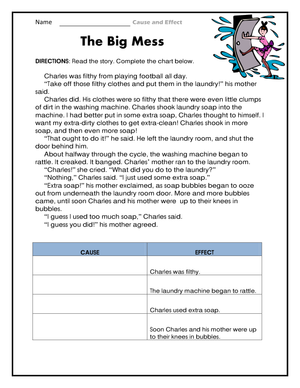
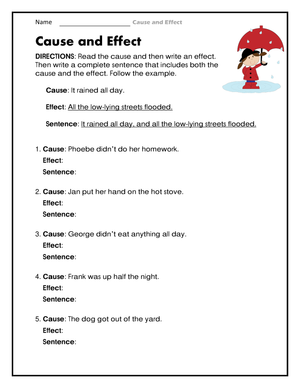
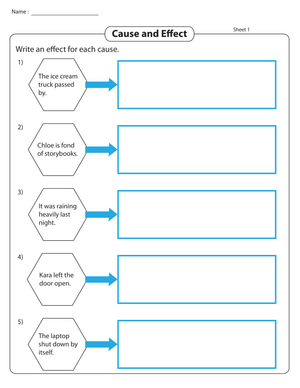
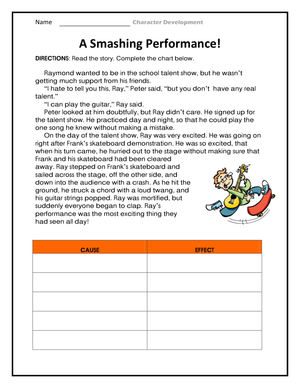
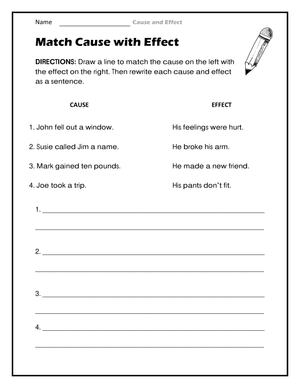
The worksheets address cause-and-effect identification from multiple angles. In the foundational tasks, students read short narrative or science-themed passages and underline the cause once and the effect twice — that double-underline convention is useful during whole-group sharing because you can see at a glance whether students have the relationship correctly oriented. From there, students move to T-chart completion, signal word sorting, and writing original sentences using a given cause or a given effect as a starting point.
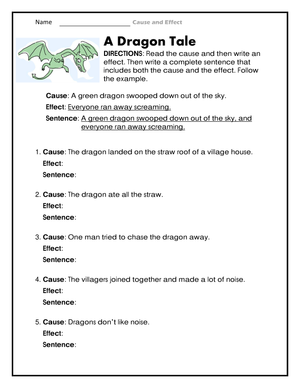
Several worksheets specifically address the chain-event structure: one cause leading to a series of downstream effects, or one effect traced backward through multiple contributing causes. This matters for third grade because RI.3.3 requires students to describe relationships across a series of events, not just isolated pairs. The informational passages in the set use contexts students recognize — weather events, animal behavior, plant growth — which reduces the cognitive demand of unfamiliar vocabulary so students can focus on the structural relationship rather than decoding new content words.
Student Errors Worth Anticipating Before You Assign These
The most stubborn error pattern at this grade level is conflating sequence with causality. Students who spent second grade practicing temporal words — first, next, then, finally — sometimes carry that habit directly into cause-and-effect work. They mark the first event in a passage as the cause and the second as the effect whether or not a causal relationship actually exists. In student work, this produces answers like: "The character woke up early [cause] → she went to school [effect]" even when the passage never implied that waking early caused the school trip. A fast diagnostic: ask students to substitute so or because to test the relationship. "She woke up early, so she went to school" falls apart immediately. That substitution test exposes the sequence-versus-causality confusion faster than re-explaining the definition.
A second issue surfaces in nonfiction reading. When the relationship is stated plainly in fiction — "He tripped because he wasn't looking" — students find it. When the cause appears in one paragraph and the effect is described three sentences later in an informational text, they lose the thread. The informational passages in these worksheets are built specifically to surface that gap so teachers can address it before students hit it on a standardized assessment.
Ways to Work These Worksheets Into Your Instructional Week
Most of these resources fit naturally inside the reading block rather than standing alone as a separate literacy activity. After a whole-group lesson using a read-aloud or shared text, one worksheet functions as a short formative check — five minutes of independent practice that tells you before the next day who needs reteaching. The signal-word sorting tasks work well during word study time or as a transition warm-up; they are quick enough to complete in the twelve minutes before specials without feeling rushed.
These cause and effect pdf worksheets for 3rd grade also anchor small-group instruction efficiently. In a group of four or five students who are solid decoders but struggle with inferential comprehension, working through the chain-event worksheet together — pausing to discuss why one outcome leads to the next — builds the kind of logical reasoning that whole-class instruction rarely gives those students enough time to practice. Keeping an answer key accessible during independent work also lets you pull a small group without leaving the rest of the class stuck mid-task.
Standard Alignment
These worksheets address CCSS.ELA-LITERACY.RI.3.3, which requires third graders to describe the relationship between a series of historical events, scientific ideas, or steps in technical procedures using language that pertains to time, sequence, and cause and effect. That standard appears at third grade because it is the year students are expected to read and analyze informational text independently, not just process it with direct teacher guidance. The informational passages in the set — weather systems, animal adaptations, plant life cycles — reflect the science and social studies contexts RI.3.3 was written for. The signal-word tasks also support CCSS.ELA-LITERACY.L.3.1 and L.3.3 by building students' ability to deploy transitional language purposefully in their own writing rather than just recognize it in someone else's text.
Adjusting the Set for Different Learners in the Room
For students still developing reading fluency, the passages can be read aloud before they complete the written task. The T-chart and graphic organizer formats reduce the transcription burden, keeping the focus on the analytical thinking. Pairing those students with a sentence frame — "_____ happened because _____" or "When _____ happened, the result was _____" — provides a structure to work within without removing the cognitive demand of identifying the relationship itself.
For students who move quickly, the extension is direct: assign the chain-event worksheet, then ask students to write a short paragraph explaining the chain in their own words using at least three signal words. Some students also benefit from building an original cause-effect chain using a real event from a current science unit — water evaporation, erosion, the water cycle — which reveals whether they can transfer the skill beyond the provided text. These cause and effect pdf worksheets for 3rd grade give those students enough room to go deeper without requiring the teacher to prepare a separate set of materials.
Frequently Asked Questions
Do these worksheets include both fiction and nonfiction passages?
Yes. The set includes narrative passages built around character decisions and events alongside informational passages drawn from science contexts. The nonfiction passages are consistently harder for most third graders — the causal relationship is less emotionally obvious than in fiction — so many teachers use the narrative worksheets first, then move to informational text once students are comfortable identifying the basic structure.
Where in a unit do these worksheets fit best?
The signal-word recognition worksheet works early, before students are expected to analyze full passages on their own. Most of the passage-based cause and effect pdf worksheets for 3rd grade are suited to mid-unit or end-of-unit practice, after at least one whole-group lesson with a shared text. The chain-event worksheet typically lands last — it is the most cognitively demanding task in the set and functions best as a culminating check or small-group challenge rather than an introduction.
Can these be used as a formal grade?
The T-chart and passage-based worksheets can serve as a formative or classwork grade without much adaptation. The open-ended writing tasks — where students generate original causes or effects — are harder to score quickly and work better as discussion anchors or portfolio pieces than as gradebook entries. In a standards-based grading system, the signal-word identification and T-chart tasks map cleanly to RI.3.3 proficiency indicators and are straightforward to evaluate against a simple rubric.












 Interactive Worksheet Maker
 Quiz Maker
 Word Search Maker
 Crossword Puzzle Maker
 Word Scramble Generator
 Sentence Scramble Generator
 Handwriting Worksheet Generator
 Name Tracing Generator
 Fill In The Blank Generator