Cause and Effect in Fiction Printable Worksheets for 3rd Grade
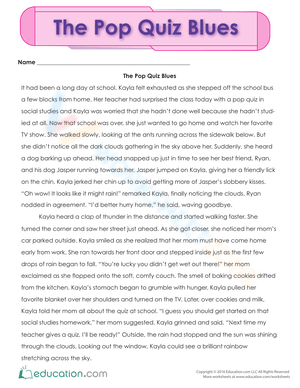
Cause and effect in fiction printable worksheets for 3rd grade tackle a distinction that trips up a lot of eight-year-olds: the difference between events that happen in order and events where one actually caused the other. Each worksheet pairs a short fiction passage with questions that ask students to identify causes, name effects, and in several cases, explain the connection in writing. The passages are brief enough for a single reading block but rich enough to support real discussion about character decisions and story outcomes.
What Each Worksheet Asks Students to Do
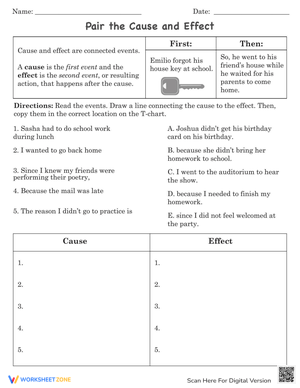
The skill demands across the set move from concrete to abstract. Early worksheets focus on situations where the cause and effect are both directly stated and easy to map — a character leaves the windows open, rain gets in, the books are ruined. Students underline the cause, circle the effect, and write a sentence connecting them. That format gives third graders a clear entry point before the questions get harder.
Later worksheets introduce more layered relationships. A character makes a choice early in the story; the consequence doesn't arrive until two or three paragraphs later. Students also work with signal words — because, so, since, as a result — and then encounter passages where no signal word appears and the relationship has to be inferred from events. That progression reflects what students actually need to work through over a unit, not just a single lesson. Specific skills across the set include:
- Identifying character decisions as causes and tracing their consequences as effects
- Recognizing signal words that mark cause-and-effect relationships in fiction
- Distinguishing causal relationships from simple chronological sequence
- Understanding that one cause can produce more than one effect
- Explaining implied cause-and-effect pairs using text evidence
Patterns in Student Work Worth Catching Early
The most persistent error at this grade is treating sequence as causation. A student reads that a character ate breakfast and then tripped over a backpack. Some students mark "eating breakfast" as the cause of the trip because it came first — they are applying a before/after frame rather than asking whether one event actually produced the other. Left uncorrected, that habit carries into more complex literary analysis in later grades.
Reversal is the second pattern to watch. Students understand that a cause and an effect are two connected things, but they flip the direction. In a passage where a character forgot to feed the dog and the dog then chewed the furniture, students sometimes write "the dog chewed the furniture because he forgot to feed it" — a sentence that accidentally reverses the logical chain. The most efficient fix is a sentence-frame test: ask students to say the relationship aloud using "___ happened because ___." Most students hear the reversal immediately when it comes out of their mouth rather than sitting silently on paper.
A third pattern involves scale. Students frequently anchor on a minor background detail instead of the event that drives the plot. In fiction, the most usable causes are character decisions, central problems, and turning points — not setting descriptions or small observations the author dropped in for atmosphere. Teaching students to ask "Would the story have gone differently if this hadn't happened?" helps them find the events that actually matter.
Working These Worksheets Into the Reading Block
The most productive entry point is whole-group modeling with a passage the class already knows. Project the text, read through a key scene, and think aloud about whether one event truly caused another — not just followed it. Students need to hear that reasoning process out loud before they attempt it in writing. A gradual release into partner work and then independent practice over two or three lessons usually produces cleaner results than assigning a worksheet cold.
Cause and effect in fiction printable worksheets for 3rd grade work especially well as a follow-up to guided reading groups. After a small group finishes a short fiction text, students take five to eight minutes to complete one worksheet independently. The timing is tight enough that the reading is still fresh, and the written response gives teachers a quick look at who is sorting events logically and who is still treating sequence as cause.
For centers, one worksheet per rotation slot keeps the activity contained. Students read the passage, answer the questions, and check the answer key if one is available — no extra materials needed. The same format also holds up for sub days: the directions are self-evident and the passages are short enough for a substitute to read aloud without any preview.
Standard Alignment
These worksheets connect most directly to CCSS.ELA-LITERACY.RL.3.3, which asks third graders to describe characters and explain how their actions contribute to the sequence of events. Cause and effect work lives inside that standard: when students analyze why a character acted a certain way and what followed because of it, they are doing exactly what RL.3.3 names. The worksheets make that connection concrete by grounding every question in a specific story event rather than asking students to generalize about characters in the abstract.
Teachers working with state-specific standards will find this skill present in Grade 3 reading literature expectations across most frameworks. The core demand — explaining story causation with reference to the text — is consistent at this level regardless of the standard label.
Adjusting the Set for a Range of Learners
Readers who need additional support benefit from worksheets where signal words are visible in the passage and the answer choices are provided. Selecting the correct cause from three options still requires real reading comprehension; it just removes the writing demand so students can focus on the actual relationship. That tradeoff is worth making for students who shut down when they see a blank answer line before they have fully understood the text.
On-level practice looks like reading the passage independently, identifying the cause and effect, and writing one or two sentences explaining the connection. The sentence frame — "___ happened because ___" — gives students enough structure to start writing without turning the response into an open-ended composition task.
For students who are ready to go further, cause and effect in fiction printable worksheets for 3rd grade can be extended by asking them to trace a chain: one cause leads to an effect, which then becomes the cause of a second effect. That kind of multi-step analysis appears regularly in Grade 4 and 5 comprehension work, so students who can do it in 3rd grade are building ahead. Asking them to write the chain in their own words — without a frame — pushes the work firmly into analytical writing territory.
Frequently Asked Questions
How do these worksheets help students move past sequence thinking?
Each worksheet includes at least one event pair where no signal word points the way — students have to decide whether one event actually caused the other, not just list the order of events. Adding one consistent follow-up question — "Would this effect have happened if the cause hadn't occurred?" — accelerates that shift from listing to reasoning. Students who practice this check regularly start applying it on their own during independent reading.
What helps a student who keeps reversing cause and effect?
Oral practice corrects reversal faster than written feedback alone. Have the student say the relationship aloud: "___ happened because ___." Most students catch the error when they hear it. After two or three oral attempts, written accuracy on the next worksheet usually improves noticeably. Writing the correction down after saying it correctly locks in the fix.
Can these worksheets work for students reading below grade level?
Yes, with deliberate selection. Start with the worksheets that use the shortest passages and the most visible signal words, and read the passage aloud together before students work independently. Cause and effect in fiction printable worksheets for 3rd grade center on short texts for exactly this reason — below-level readers are not fighting through a long passage on top of the skill work. Keeping the reading manageable lets them focus on the relationship itself.
Do signal words need to be pre-taught before the first worksheet?
A brief introduction helps, but a full lesson is not required. Writing because, so, since, and as a result on the board and having students spot one example in a shared text takes about three minutes and makes the first worksheet feel familiar. The worksheets reinforce those words through repeated exposure across the set, so the vocabulary builds through use rather than frontloaded instruction.
Clear All