These 3rd grade shades of meaning worksheets give students structured practice ranking, sorting, and selecting words along a gradient of intensity — moving from warm to hot to scorching, or from walk to march to strut. Each worksheet targets verbs or adjectives, with several addressing the trickier territory of states of mind and certainty that L.3.5c specifically calls out. Teachers get ready-to-use resources that fit warm-ups, pre-writing blocks, and small-group rotations without extra setup time.
What Students Practice in Each Worksheet
The exercises ask students to do real work with words, not just match definitions. Depending on the worksheet, students will:
- Rank a set of three or four related words from weakest to strongest on a semantic gradient
- Fill in a blank with the most precise word from a given list, using sentence context as a guide
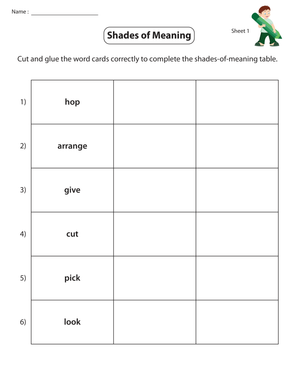
- Sort verbs or adjectives into a word ladder by intensity
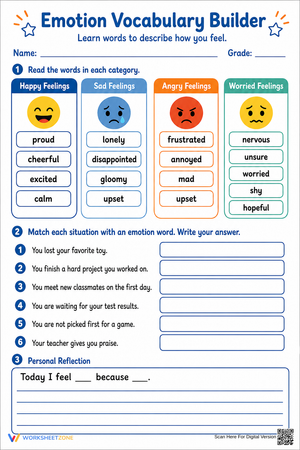
- Match words describing states of mind to scenarios that make the distinctions concrete
- Identify which word in a pair fits a specific sentence and explain the choice
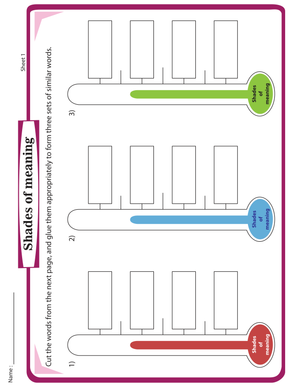
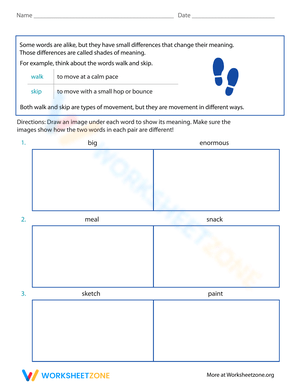
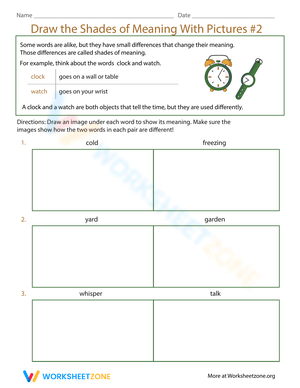
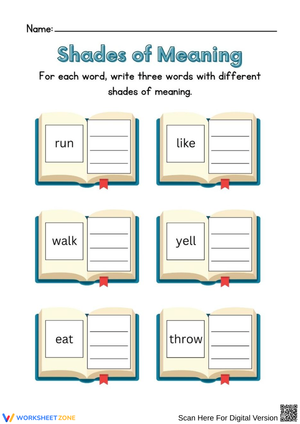
Verb sets include toss / throw / hurl, whisper / talk / shout, and cry / sob / wail. Adjective sets span emotion — happy, cheerful, ecstatic — and physical sensation — cool, cold, freezing. Several worksheets use a horizontal gradient bar so students place words along a scale rather than simply selecting from a list. That spatial format helps third graders anchor the abstract concept of intensity to something visible, which matters at a developmental stage when abstract vocabulary reasoning is still building.
Student Errors to Anticipate Before You Hand These Out
The most consistent error isn't misspelling — it's random selection. Students who know that both angry and furious mean "mad" often pick between them without attention to degree, treating synonyms as interchangeable rather than as points on a continuum. Worksheets that require ranking three or four words in sequence make that shortcut impossible to sustain, which is exactly when the real learning happens.
States of mind produce a subtler problem. Third graders use "think" as a catch-all — they write "I think the answer is correct" whether they are nearly certain or genuinely guessing. When an exercise asks them to place think, believe, and know at different points on a gradient, many students initially stack all three at the same spot because they haven't been asked to evaluate the strength of a claim before. A brief verbal discussion before independent work — five minutes, not more — noticeably reduces the number of papers where all three words land in the same box.
There is also a transfer gap worth naming. A student who correctly ranks sob above cry on a worksheet will still write "she was crying a lot" in the next story draft. The worksheet builds recognition; applying that recognition during writing requires a separate revision step — usually a focused pass where students identify and upgrade two or three weak verbs or adjectives before submitting. Without that follow-up, the gap between worksheet performance and writing quality persists.
How to Work These Worksheets Into Your Week
The most consistent use I've seen — and the one that produces visible results — is the Monday morning warm-up, completed right after morning meeting. Two or three minutes ranking a verb set reactivates word knowledge from the previous week and gives students a low-stakes entry point before the day's main instruction begins. It takes almost no teacher direction once students know the routine.
For small-group rotations, a sorting worksheet works well as the independent station task while you work with a guided reading group. Students complete the gradient ranking without needing additional direction, which is genuinely useful during the stretch of a lesson when you can't circulate. Pairing the worksheet with a quick physical demonstration beforehand — having students actually whisper, then talk, then shout before they rank those words — helps students who struggle to evaluate intensity from print alone. When you build a vocabulary sequence across the week, 3rd grade shades of meaning worksheets return the most value as recurring short practice rather than isolated events; the concept needs repeated exposure to move from recognition into independent writing choices.
Pre-writing is the other reliable fit. Before a narrative assignment, a worksheet focused on vivid verbs gives students a working reference they can consult while drafting. When word ladders from completed worksheets go up on the classroom wall, students start reaching for them mid-writing without prompting — low-stakes repetition across several weeks is what moves students toward choosing precise language automatically.
Standard Alignment
These worksheets address L.3.5c, which asks third graders to distinguish shades of meaning among related words that describe states of mind (e.g., knew, believed, suspected, heard, wondered). In practice, this standard surfaces in two places: reading, when students need to evaluate how certain or uncertain a narrator sounds, and writing, when students need to match a word's emotional weight to the scene they are describing. L.3.5c isn't a grammar standard — it sits at the intersection of vocabulary and craft. These worksheets keep words inside sentence context wherever possible, because isolated word lists don't give students enough information to make the distinctions the standard requires.
Differentiating for Your Full Range of Students
For students still developing basic synonym recognition, narrow the gradient sets to two words rather than three. Asking a student to decide whether cold or freezing is more intense is a manageable comparison; adding a third word can overwhelm a student who hasn't yet solidified the two-point distinction. Sentence context helps — providing a sentence where the blank clearly calls for the stronger word gives students a concrete anchor rather than an abstract choice.
The range of task types across 3rd grade shades of meaning worksheets — from two-word comparisons to four-word gradients and open-ended sentence writing — means teachers can assign different worksheets to different groups without building separate materials from scratch. Students ready for extension work with four- or five-word gradients and tackle the states-of-mind exercises independently. Asking those students to write original sentences that demonstrate the difference between ranked words, rather than simply ordering them, moves the task from recognition into production — a significantly harder cognitive demand. Some teachers have advanced students create their own gradient sets and explain their reasoning to a partner, which surfaces thinking that fill-in exercises don't capture.
Frequently Asked Questions
What are some practical examples of shades of meaning for third grade?
Common verb sets include walk / march / strut, cry / sob / wail, and toss / throw / hurl. Adjective sets typically address emotion — happy, cheerful, ecstatic — or physical sensation — cool, cold, freezing. The states-of-mind examples L.3.5c specifically targets include think, believe, know and wonder, suspect, realize. These groupings appear frequently in third-grade narrative and opinion writing, which is why they're the focus.
How does word-gradient practice connect to descriptive writing?
Students who have ranked words by intensity are more likely to reach past their default vocabulary when they write. A student who has placed sprint above run on a gradient is more likely to choose sprint in a story than a student who has only read a definition. The worksheet builds the recognition; a revision step — asking students to find and upgrade two weak verbs per draft — pushes that recognition into actual writing behavior.
What distinguishes shades of meaning from synonyms?
Synonyms are words with similar meanings. Shades of meaning refers to the gradations between those synonyms — where each word falls on an intensity scale. Cool and freezing are both synonyms for cold, but they occupy different positions on a temperature gradient. That positional difference is what allows a writer to choose the precise word rather than simply a correct one.
Do paint chips actually help teach this concept?
They work well during the introduction phase. A student who writes a weak word on the lightest shade of a paint strip and a strong word on the darkest shade gets a visual that matches the concept's own name — literal shades of meaning. Many 3rd grade shades of meaning worksheets use a similar horizontal gradient format precisely because that visual already makes sense to students who have handled paint strips. After the initial lesson, the worksheet format holds up on its own; students transfer the image of light-to-dark intensity onto the printed gradient bar without needing the physical prop.
Why does the Common Core place this standard at Grade 3 rather than earlier?
Grade 3 is where students shift from learning to decode text toward using reading as a tool for learning new content. That shift demands a more precise relationship with language — students need to evaluate what an author means, not just what individual words say. Placing shades of meaning at this grade reflects the abstract reasoning that solidifies around ages 8 and 9. Earlier grades build synonym recognition; third grade asks students to compare and rank the synonyms they already know, which is a different and considerably harder cognitive task.












 Interactive Worksheet Maker
 Quiz Maker
 Word Search Maker
 Crossword Puzzle Maker
 Word Scramble Generator
 Sentence Scramble Generator
 Handwriting Worksheet Generator
 Name Tracing Generator
 Fill In The Blank Generator