Plurals Printable Worksheets for 3rd Grade
These plurals printable worksheets for 3rd grade cover every rule pattern students encounter this year — the -es rule for sibilant endings, the y-to-ies transformation, the f/fe-to-ves change, and the irregular forms that follow no pattern at all. Each worksheet targets a single rule or presents a mixed review, so teachers can drop individual worksheets directly into an ELA sequence rather than working through a fixed packet order.
The Specific Rules Each Worksheet Targets
Third grade is where "just add an s" stops being enough. The curriculum introduces five distinct plural patterns, and students need dedicated practice with each one before a mixed review makes sense.
- -es for words ending in s, x, z, ch, and sh — Students learn to hear the extra syllable these endings require: bench/benches, fox/foxes, buzz/buzzes. Sorting and sentence-completion activities reinforce the auditory cue.
- The vowel-or-consonant check for y endings — A consonant before the y means drop the y and add -ies (city/cities); a vowel before the y means keep it and add -s (monkey/monkeys). This rule requires a two-step process every time, which is different from everything else students have learned up to this point.
- f and fe endings to -ves — Many nouns ending in f or fe shift to -ves in plural form: leaf/leaves, knife/knives, wolf/wolves. The set addresses exceptions explicitly so students don't overapply the pattern.
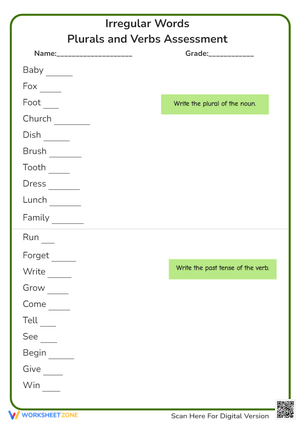
- Irregular plurals — Foot/feet, tooth/teeth, child/children, mouse/mice, goose/geese, and zero-change nouns like deer and sheep require direct memorization. Matching and fill-in formats reinforce these without reducing them to a word list students skim once and forget.
- Plural versus possessive — Because both often end in -s, students need sentence-context practice to stop placing apostrophes in plain plural nouns. Each worksheet in this category asks students to read for meaning before writing anything.
Frequent Student Errors Worth Catching Before They Stick
The y-to-ies rule produces a completely predictable error: students who correctly write babies will turn around and write monkies on the same worksheet. They've learned "y changes to ies" without internalizing the vowel-before-y exception. The fix is making the two-step check automatic — identify the letter before the y, then decide — rather than teaching the rule as a single statement. Students who practice this check explicitly across a few worksheets stop making the monkies error quickly; students who only hear the rule once tend to carry it into fourth grade.
The f/fe-to-ves transformation gets skipped entirely by students who haven't encountered it yet. Expect to see leafs, wolfs, and knifes in writing assignments until it's been taught directly. Worksheets that ask students to rewrite a list of f/fe words in plural form — then sort genuine exceptions like roofs and chiefs into a separate column — surface this confusion in about ten minutes and give a clear picture of who needs more time before moving on.
Apostrophe creep in plural nouns is the most persistent writing error third grade produces. Students see any word ending in -s and assume an apostrophe might belong there. A grammar explanation alone rarely fixes this. What works is repeated sentence-context practice where students identify function before form: does this sentence show ownership, or does it describe more than one? The worksheets in the plural/possessive category are built around that meaning-first distinction, which is what makes them useful beyond the grammar unit itself.
Fitting These Worksheets Into Your ELA Week
The most efficient use of the plurals printable worksheets for 3rd grade is right after explicit instruction on each rule, not days later. When you teach the -es rule on Monday, the corresponding worksheet works as a five-minute formative check at the end of that same block. Scan papers during transition time and you know exactly who needs re-teaching before Tuesday's lesson — waiting until Friday review loses that window entirely.
Mixed-review worksheets belong later in the sequence, once students have had dedicated practice with individual rules. Running one as a Monday morning warm-up after you've wrapped the f/fe section gives students their first real experience deciding which rule applies — a harder cognitive move than applying a rule they've just been told. That decision-making task is also what the standard ultimately expects in independent writing, so it's worth doing before you leave the unit.
For literacy centers, each worksheet in the set works as a self-contained station. Students complete a single-rule worksheet independently while you pull a small group for re-teaching. A brief partner check before the group rotates takes less than a minute and keeps the center moving without requiring you to manage every correction.
Standard Alignment
These worksheets directly address CCSS ELA-Literacy L.3.1.b, which requires students to form and use regular and irregular plural nouns. The standard sits in the Language strand and shows up in student writing long after the grammar unit ends — every writing genre that follows depends on students applying these rules automatically. That's the reason the mixed-review worksheets and the plural/possessive distinction worksheets carry as much instructional weight as the rule-specific practice: L.3.1.b isn't really satisfied until students make these judgment calls in their own sentences without a prompt telling them which rule is relevant.
Adjusting the Set for a Range of Learners
Students who struggle with the rule patterns benefit most from staying in sequence — one rule per worksheet, with a visible word bank while they work. Pairing these students with a peer during the check portion, rather than waiting for a teacher conference, gives them immediate low-stakes feedback at the moment they actually need it.
Students who move through rule-based worksheets quickly need a different challenge: generating examples rather than working with provided words. Ask them to find five plural nouns in their independent reading book that match each rule, then use those forms in original sentences. The plurals printable worksheets for 3rd grade that focus on mixed review function as a starting point for these students, not an endpoint — they finish the review quickly and move into application work that pulls grammar into authentic text, which is where mastery actually shows up.
Frequently Asked Questions
Which irregular plurals should third graders have solid by the end of the year?
Prioritize the high-frequency forms students encounter constantly: man/men, woman/women, child/children, tooth/teeth, foot/feet, mouse/mice, and goose/geese. Zero-change nouns — deer, sheep, fish — are equally important because the expectation that "something must change" leads students to invent deers and sheeps well into fourth grade if that category isn't addressed directly.
How do I help students stop putting apostrophes in plural nouns?
Teach the distinction through meaning before form. Give students sentence pairs — The dog's bowl is empty next to Three dogs ran past — and ask them to decide what each sentence is doing before they write anything down. The apostrophe error persists when instruction focuses on the rule in isolation; it fades when students build the habit of checking for ownership versus quantity. The plural/possessive worksheets in this set use that sequence throughout.
Can these work as assessment tools rather than just practice?
The rule-specific worksheets make reliable post-lesson formative checks — three to five minutes at the end of explicit instruction tells you whether the class is ready to move on. The mixed-review worksheet does something different: it shows whether students can transfer rules to unfamiliar words without being told which rule applies, which is a stronger indicator of actual mastery. Using the plurals printable worksheets for 3rd grade this way — rule-specific worksheets as formative checks, mixed review as a mid-unit transfer gauge — gives you enough assessment evidence to make small-group decisions without writing a separate test.
When in the school year should plurals instruction happen?
Most third-grade pacing guides place L.3.1.b in the first semester, typically within the noun unit. The practical reason is that plural errors show up in every writing genre that follows — if students don't have these forms solid by late fall, you're correcting the same mistakes in December narrative drafts, February informational pieces, and April opinion essays. Building in a brief plural/possessive revisit in the spring, when students are writing more complex sentences, catches the apostrophe errors that tend to resurface once sentence structures get harder.