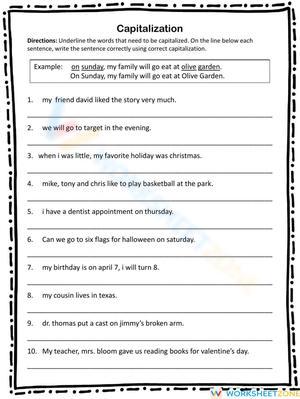
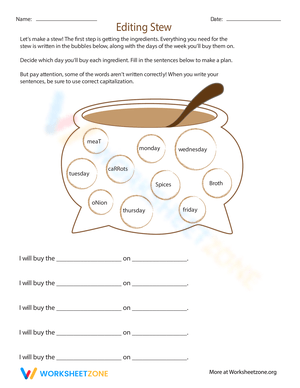
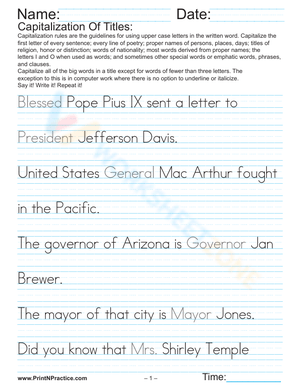
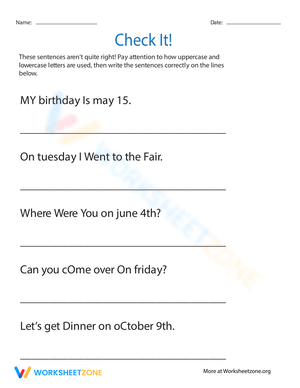
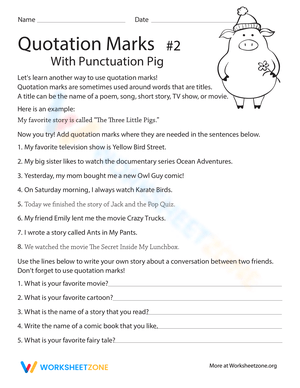
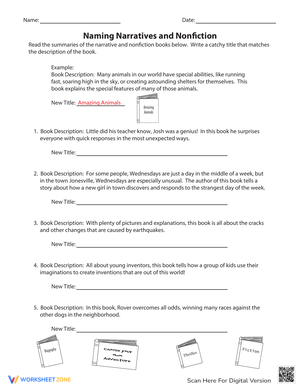
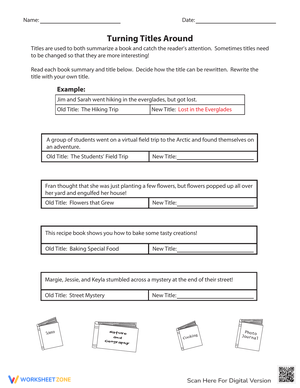
These 3rd grade capitalizing titles printable worksheets give teachers a direct way to address a capitalization rule that behaves differently from every other one students have learned — because applying title case correctly requires knowing whether a word is a noun, verb, short preposition, or coordinating conjunction, not just recognizing that it starts a sentence. That dependency on parts-of-speech knowledge is what makes this rule harder than it looks in third grade, and it's why varied, structured practice holds up better here than one-off instruction.
Skills Each Worksheet Builds
The exercises across these 3rd grade capitalizing titles printable worksheets move through the rule in deliberate layers. Students begin by selecting the correctly capitalized title from multiple-choice options — building familiarity with how title case looks before they have to produce it independently. From there, the exercises shift to error correction: students read titles with deliberate mistakes and rewrite them correctly. The most demanding worksheets ask students to take a full sentence containing a book or movie title written entirely in lowercase and restore proper capitalization throughout.
The core skill students are practicing is a three-category sort. The always-capitalize group includes the first and last words of any title, plus nouns, pronouns, verbs, adjectives, and adverbs. The never-capitalize-unless-first-or-last group includes articles (a, an, the), short prepositions (in, on, of, at, for), and coordinating conjunctions (and, but, or). Some worksheets include a brief parts-of-speech warm-up before the title exercises so that classification language is active in working memory at the moment students need it.
What Student Work Reveals About Title Case Confusion
The two most common error patterns are nearly opposite. One group over-capitalizes — every word gets a capital because titles feel formal and important. The other group treats the title like a sentence: only the first word is capitalized. Both patterns reflect the same underlying gap. Students haven't yet connected the rule to grammar categories, so they're guessing by feel rather than applying a system.
The subtler errors appear in the middle of a title. A student who correctly writes The Lion, the Witch and the Wardrobe may still write A Wrinkle In Time, capitalizing In because it feels content-heavy — it points to a place, after all. Prepositions that seem meaningful (into, through, inside) get capitalized far more often than neutral-feeling ones like of or at. That specific error tells you whether a student needs more preposition work or just more repetition with the rule itself. There's also a production gap worth catching: students who correctly identify a properly formatted title in a multiple-choice exercise will sometimes write an entire title in all lowercase when generating text from scratch. Recognition and production are different skills, and watching for both tells you exactly where each student is.
Standard Alignment
CCSS.ELA-LITERACY.L.3.2.A requires third graders to capitalize appropriate words in titles. In classroom terms, that standard surfaces most visibly during writing workshop — book recommendations, research posters, report covers, and any piece that mentions a published work. The standard doesn't sit in isolation; students need working knowledge from the L.3.1 parts-of-speech cluster to apply it correctly. That's why some of the 3rd grade capitalizing titles printable worksheets in this set include a brief grammar prompt before the capitalization exercises begin. Teachers who are actively reinforcing noun, verb, and adjective identification find that the two skill areas cross-support each other without requiring separate lesson time.
Building Title-Case Practice Into Your Lesson Sequence
These worksheets work best after direct instruction, not in place of it. A solid starting point is a 10-minute board lesson where you think aloud through two or three titles — naming the part of speech as you evaluate each word and deciding together which ones get capitals. Then use the identification worksheet as guided practice the same day. The error-correction format holds up well as independent practice the following day or as a warm-up the next Monday before writing workshop begins.
For classes that need a physical sorting step before they write, a highlighter strategy works well: students mark every article, short preposition, and conjunction in a title before deciding what to capitalize. That visual step separates the identification task from the writing task, which reduces the number of decisions students have to make at once. Once a student can apply the rule without the highlighter, the category distinctions have moved to automatic recall. The 3rd grade capitalizing titles printable worksheets in this set are structured to move students through exactly that progression — recognition first, correction second, independent production last.
Adjusting the Resources for a Range of Learners
Students who are still developing their parts-of-speech knowledge do best starting with the multiple-choice identification worksheets, paired with an anchor chart listing which word types stay lowercase. Seeing a correct title before being asked to produce one reduces the decision-making load early on, and the multiple-choice format lets a teacher spot error patterns quickly rather than deciphering partial attempts.
Students who move through the standard exercises quickly benefit from applying the rule to their own writing. Sending them back to a piece they've already drafted to locate and fix every title they referenced is a more demanding task than any worksheet — it asks for genuine transfer, not just compliance with a predictable exercise format. For students who remain confused after two rounds of practice, a word-sort activity often clarifies what the written rule hasn't: give them individual word cards from a title and have them physically place each card into one of three columns — "always capitalize," "lowercase unless first or last," or "check the part of speech." That tangible sort makes the abstract categories concrete in a way that re-reading directions rarely does.
Frequently Asked Questions
Do students need solid parts-of-speech knowledge before starting these worksheets?
A basic familiarity helps — students should be able to recognize nouns and verbs and distinguish them from articles and short connecting words. Full mastery isn't required. The identification worksheets work well as an entry point while parts-of-speech instruction continues in parallel, since students can see correctly formatted examples before they need to generate them independently.
What kinds of titles do the exercises use?
The exercises use recognizable children's book and movie titles rather than invented ones. Third graders are more invested in correcting a title they know, and familiar titles let students use prior knowledge as a partial self-check. That recognition factor also keeps the cognitive focus where it belongs — on the capitalization rule, not on processing an unfamiliar title.
How do these fit alongside writing workshop?
They connect most directly at the point where students are writing book recommendations, report covers, or any piece that names a published work. Using a correction or rewriting worksheet as a focused mechanics lesson before that writing task — or during a revision session — gives the rule a clear transfer point. The skill stops being an abstract grammar exercise and becomes something students can immediately apply in their own drafts.
Can the error-correction format serve as a formative check?
It can. A completed error-correction worksheet, especially one using titles the student hasn't seen before, shows whether a student can apply the rule to new material rather than rely on memorized classroom examples. Looking at which specific words a student incorrectly capitalizes or leaves lowercase points directly to the next instructional step — more preposition work, more parts-of-speech review, or simply more repeated exposure to the rule across different contexts.












 Interactive Worksheet Maker
 Quiz Maker
 Word Search Maker
 Crossword Puzzle Maker
 Word Scramble Generator
 Sentence Scramble Generator
 Handwriting Worksheet Generator
 Name Tracing Generator
 Fill In The Blank Generator