These 2nd grade hundreds charts printable worksheets give teachers a focused set of resources for the stretch of the curriculum where students stop counting individual objects and start treating tens and ones as units. Each worksheet addresses a specific skill within that progression — filling in a partially blanked grid, using the chart's spatial layout to solve two-digit addition, or identifying skip counting patterns. Together the set covers the full range of what second-grade math standards require from hundreds chart work, without repeating the same exercise format across every worksheet.
What Each Worksheet Targets
The resources divide across five distinct formats, each building a different facet of base-10 understanding.
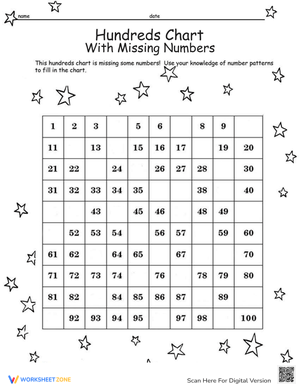
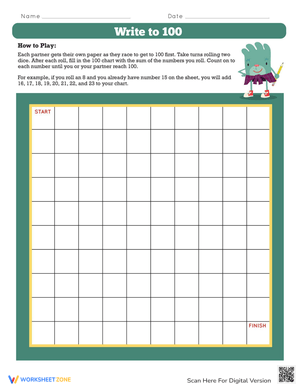
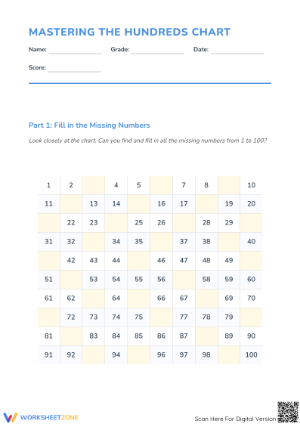
- Blank and partially filled charts: Students write in the missing numbers, with difficulty varying based on how many cells are pre-filled. A chart with five missing numbers suits early practice; a fully blank grid tests whether a student truly owns the structure.
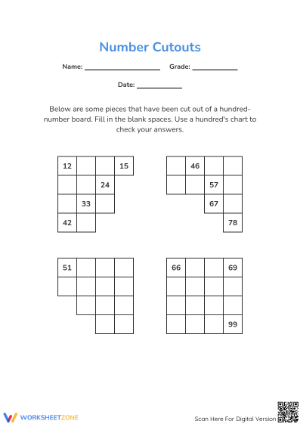
- Missing number puzzles (number neighbors): Each puzzle shows a target number and four empty cells — above, below, left, right. Students fill in the neighbors by mentally adding or subtracting one and ten, making the grid's logic explicit rather than assumed.
- Skip counting focus sheets: Students color or circle multiples of two, five, or ten, producing a visual record of the repeated-digit patterns in the ones column. These worksheets build the number sense that multiplication will later depend on.
- Mystery picture worksheets: Students follow number clues to color specific cells, revealing a hidden image. The format sustains engagement during independent work and center rotations without sacrificing the mathematical thinking involved.
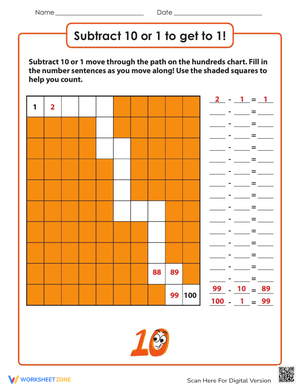
- Addition and subtraction strategy sheets: Students solve equations by drawing arrows on the chart — jumping down rows to add ten and moving right to add ones. This makes the decomposition of two-digit numbers visible rather than purely mental.
How to Build These Worksheets Into Your Lesson Plans
The most consistent use pattern is the morning warm-up. A partially filled chart takes about six minutes for most second graders, which fits neatly between morning meeting and the main math block. Because the format is predictable, students settle into it without needing directions read aloud — that routine consistency frees the teacher to take attendance, check in with students from the previous day, or note who is still uncertain about the tens column before instruction begins.
These 2nd grade hundreds charts printable worksheets also work well midway through the year as a bridge between place value instruction and the two-digit addition unit. The addition strategy worksheets ask students to locate a starting number, jump down rows equal to the tens digit, then move right by the ones digit. That physical tracing across the grid makes the tens-then-ones decomposition concrete before students transition to the open number line or the standard algorithm. Running a think-aloud session on the smartboard with the strategy sheet before sending students to independent work gives every student a shared reference point for the process.
For Friday review blocks, the mystery picture worksheets are reliable. Students who have been doing abstract computation all week respond well to a format where there is a visible, satisfying payoff at the end.
Errors Students Make That These Worksheets Help You Catch
The most telling mistake appears on the missing number puzzles: students who correctly write the left and right neighbors will confidently write the wrong number for the cell directly below, adding one instead of ten. A student working on the number 47 will correctly write 46 to the left and 48 to the right, then write 48 below instead of 57. The error reveals that the student has memorized the "one step" rule but has not genuinely internalized the row structure. A follow-up conversation asking the student to explain where 57 lives on the chart almost always surfaces the gap.
A second pattern appears near the bottom rows. Students lose confidence around 89 and 90 because those numbers feel distant from the anchor points they know well. You will see gaps left blank, numbers repeated, or the sequence jumping straight to 100 after 89. This is different from a student who understands the structure and simply miscounts — it signals that the student's mental model of the chart collapses past the mid-eighties. The partially filled charts, which pre-fill the tens column, address this directly by giving students an anchor they can count from in both directions.
A third error shows up on the 1–120 extension worksheets: after filling in 99 and 100, some students write 200, then 300. They recognize 100 as a landmark and overgeneralize what they notice about the hundreds digit, skipping 101 through 109 entirely. It is a reasonable error — it shows the student is noticing something real about the structure — but it needs direct correction before the class moves to three-digit computation.
Standard Alignment
The primary standard these worksheets address is CCSS.MATH.CONTENT.2.NBT.A.2, which requires students to count within 1,000 and skip-count by 5s, 10s, and 100s. In most second-grade pacing guides this standard appears in the first quarter alongside place value foundational work, making the 2nd grade hundreds charts printable worksheets appropriate as both instructional tools and informal assessment material during that window. The extension chart to 120 also supports CCSS.MATH.CONTENT.1.NBT.A.1, which some second graders are still consolidating at the start of the year, and previews CCSS.MATH.CONTENT.2.NBT.A.1, which addresses understanding hundreds as units of ten tens.
Adjusting the Set for Different Learners
For students still uncertain about the ones sequence, start with a chart that has only the tens column pre-filled — 10, 20, 30, and so on. From that anchor they count forward by ones to fill each row, which keeps the task manageable without removing the counting work entirely. Alternating row colors on the printed chart — even just running a yellow highlighter across every other row before distributing — helps students track horizontally without losing their place mid-row, a surprisingly common source of errors that has nothing to do with number sense.
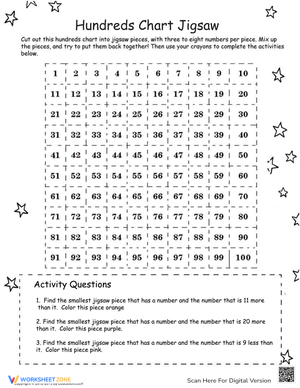
For students who have already demonstrated fluency on standard 1–100 charts, the 2nd grade hundreds charts printable worksheets that extend to 120 push their understanding into three-digit territory. A further challenge: cut a filled chart into irregular puzzle pieces and ask the student to reassemble it correctly without consulting a reference chart. Students who truly own the structure can do this quickly; students who have been pattern-matching without understanding will struggle and benefit from the resulting conversation about why specific numbers must be neighbors.
Frequently Asked Questions
Should we use a 1–100 chart or a 1–120 chart in second grade?
Second-grade standards in most states require students to count and recognize numbers beyond 100, so a 1–120 chart is worth introducing once students are comfortable with the 1–100 version. The main value of the extension is that it forces students to cross the century boundary, preventing the fairly common belief that the base-10 pattern resets at 100. Many teachers introduce the standard chart in the fall and swap to the extended version after winter break, when the curriculum turns toward three-digit numbers.
How do I use these worksheets as formative assessment rather than just practice?
The missing number puzzles are the most diagnostic format in the set. Circulate while students work and note specifically whether errors appear in the left/right cells, the up/down cells, or both. Left/right errors typically signal uncertainty about the ones sequence. Up/down errors point to gaps in tens understanding. A student making both types of errors needs a different response than one who only struggles with the vertical relationship. The mystery picture worksheets, by contrast, are better suited to independent practice than formative data — the color-coding makes it hard to trace where a student's reasoning broke down.
Can these worksheets go home as homework without confusing parents?
Yes, and the partially filled charts are the best choice for that purpose. Parents can support a child completing a partially filled chart without needing to understand the full instructional reasoning behind it — the task is visible and self-explanatory. The addition strategy worksheets require more context and are better kept in school, where you can reteach the arrow-jumping method if a student returns confused. Sending home a brief note explaining that the chart's rows represent groups of ten is usually enough to help parents answer questions without accidentally reinforcing a count-by-ones approach.













 Interactive Worksheet Maker
 Quiz Maker
 Word Search Maker
 Crossword Puzzle Maker
 Word Scramble Generator
 Sentence Scramble Generator
 Handwriting Worksheet Generator
 Name Tracing Generator
 Fill In The Blank Generator