




























Views
Downloads

Printable Number Cutouts Hundred Chart Worksheet | Grade 2

Paste this activity's link or code into your existing LMS (Google Classroom, Canvas, Teams, Schoology, Moodle, etc.).
Students can open and work on the activity right away, with no student login required.
You'll still be able to track student progress and results from your teacher account.
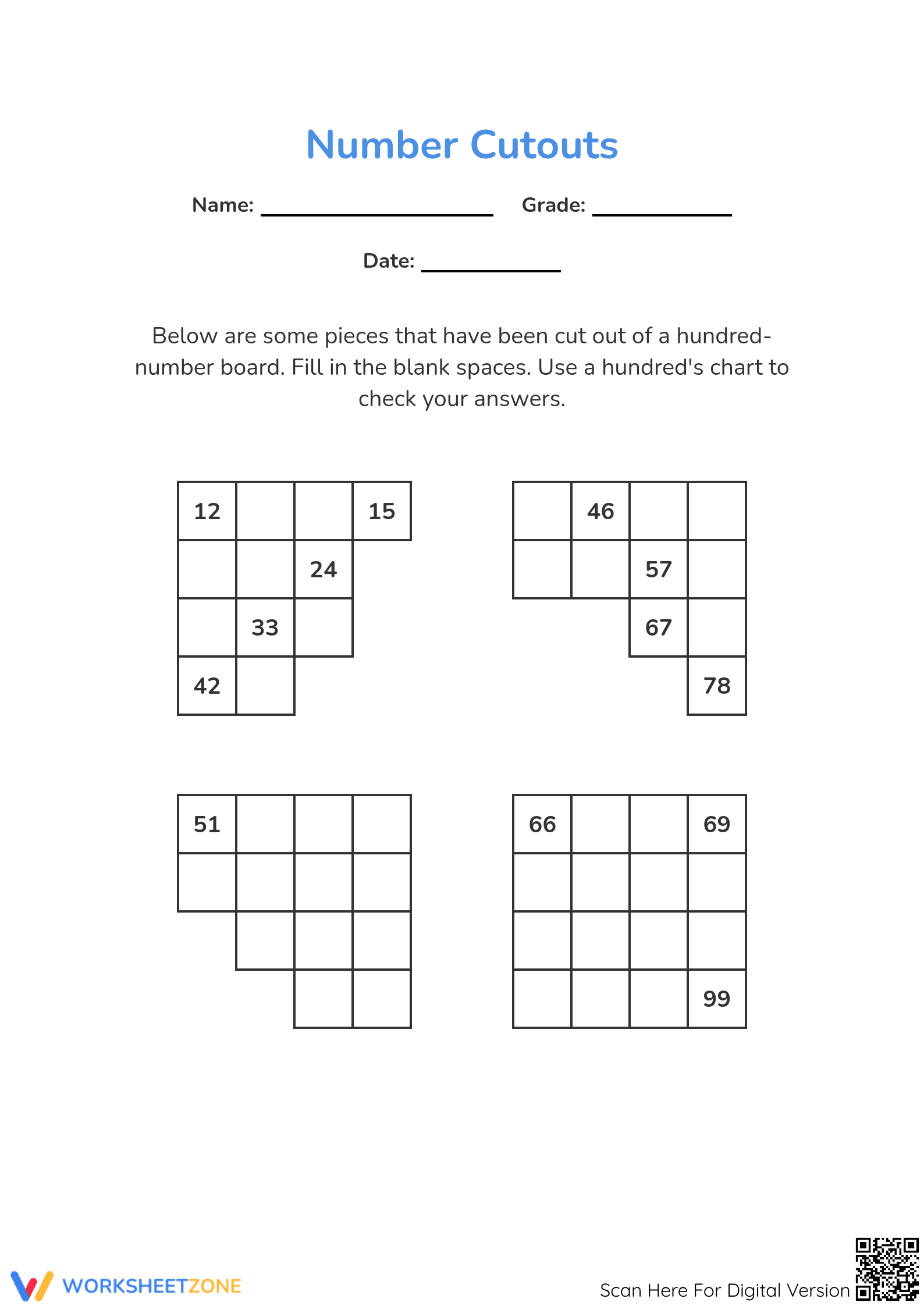
This Printable Number Cutouts worksheet helps Grade 2 students master hundred chart navigation through engaging logic puzzles. By filling in missing numbers in fragmented chart pieces, learners develop a deep conceptual understanding of base-ten relationships and mental math. Students will successfully identify numbers that come before, after, and ten more or less than a given numeral.
At a Glance
- Grade: 2 · Subject: Math
- Standard:
1.NBT.C.5— Mentally find 10 more or 10 less than a two-digit number- Skill Focus: Hundred Chart Navigation
- Format: 2 pages · 69 problems · Answer key included · PDF
- Best For: Independent math centers and morning work
- Time: 15–25 minutes
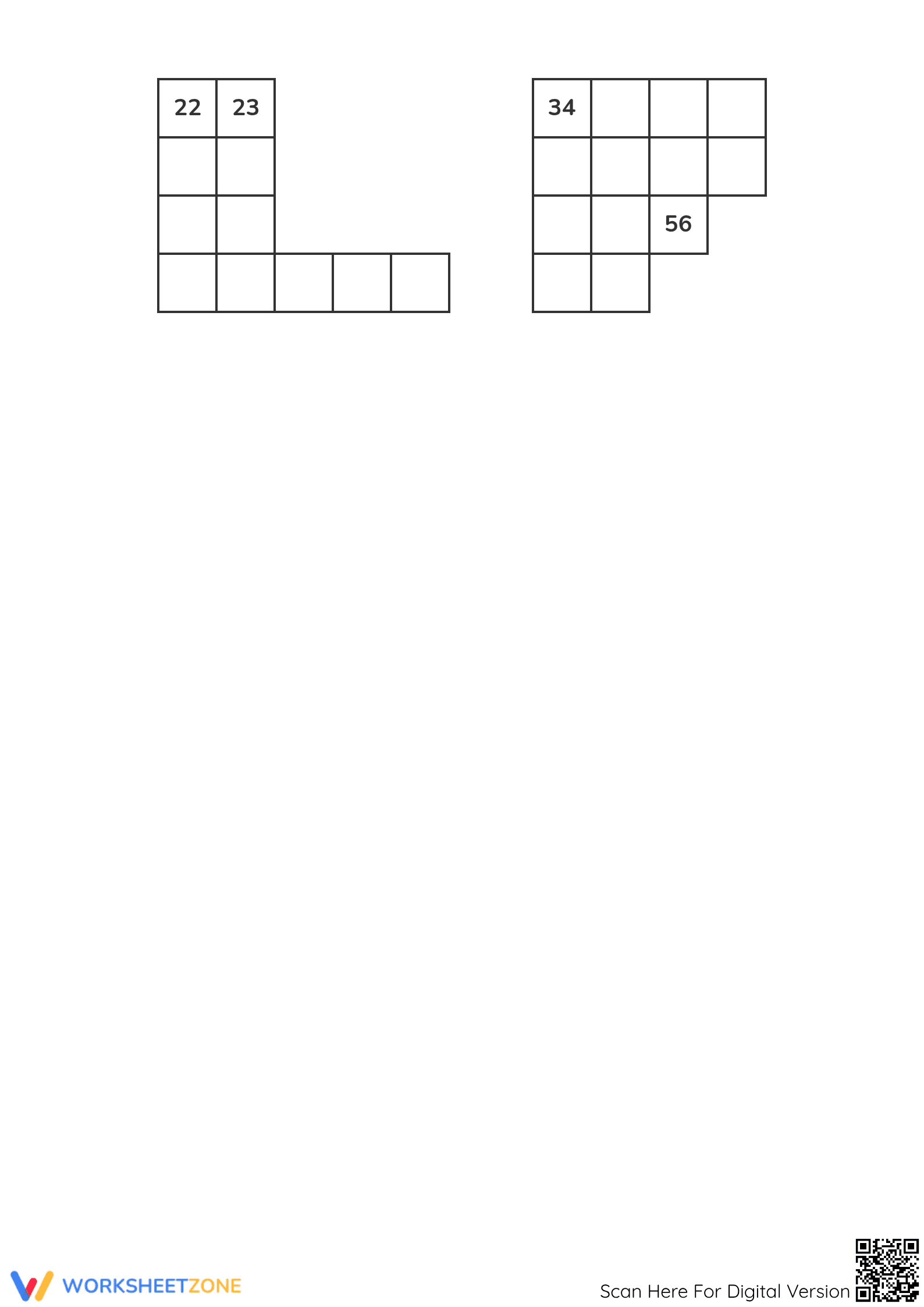
The packet contains two comprehensive pages featuring six unique hundred-chart "cutout" fragments. Each puzzle presents a non-linear grid shape with one or two anchor numbers provided. Students must use their knowledge of the 10x10 grid structure to fill in the surrounding empty cells. The collection includes a complete answer key for student self-correction or quick teacher grading, ensuring a streamlined classroom workflow.
Skill Progression
- Guided Practice: The first page features smaller fragments with clear anchor points, allowing students to visualize simple +1 and -1 transitions across rows.
- Supported Practice: Middle fragments introduce "L-shaped" and "T-shaped" cutouts, requiring students to pivot between horizontal (+1/-1) and vertical (+10/-10) movements.
- Independent Practice: The final puzzles on page two offer larger, more complex shapes with fewer starting numbers, challenging students to apply multi-step mental calculation.
This sequence follows a gradual-release model, moving from basic recognition to higher-order spatial reasoning within the base-ten system.
Standards Alignment
The primary focus is 1.NBT.C.5, which requires students to mentally find 10 more or 10 less than a given number without having to count. Additionally, it supports 2.NBT.A.2 as students count within 100 to complete the puzzles. Both standard codes can be copied directly into lesson plans, IEP goals, or district curriculum mapping tools.
How to Use It
Use this worksheet during small-group rotations after a direct instruction lesson on the hundred chart. It serves as an excellent formative assessment; observe if students count by ones to find vertical neighbors or if they instantly apply the "ten more" rule. Expect most students to complete the 69 blank spaces within 20 minutes during independent seatwork.
Who It's For
This resource is designed for Grade 2 students mastering place value. It also provides a rigorous challenge for Grade 1 learners or a vital remediation tool for Grade 3 students struggling with number sense. Pair this with a physical hundred chart or a transparent overlay for students who need tactile support.
Mathematical proficiency in the early grades depends heavily on the ability to visualize number relationships and structural patterns. This worksheet aligns with 1.NBT.C.5 by requiring students to mentally navigate the base-ten grid, a skill that Fisher & Frey (2014) identify as essential for transitioning from basic counting to advanced arithmetic. Research from the NAEP highlights that students who master hundred chart patterns demonstrate significantly higher accuracy in mental addition and subtraction compared to those who rely solely on finger counting or number lines. By isolating "cutout" pieces, this activity forces students to rely on internal cognitive maps of the 1-100 sequence rather than external cues. This targeted approach to number sense development ensures that learners build the fluency required for three-digit operations and regrouping. It is a proven method for reinforcing the vertical and horizontal properties of our numeral system.


