Tally Marks Worksheets for 2nd Grade
These tally marks worksheets for 2nd grade address the specific sequence where second-grade data instruction tends to stumble — from drawing the diagonal fifth mark correctly to reading multi-category charts and transferring tally totals onto bar graphs. Each worksheet targets one piece of that progression, so teachers can match the assignment to exactly where a student's understanding breaks down.
The Specific Skills These Worksheets Build
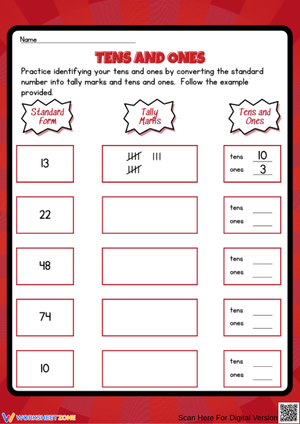
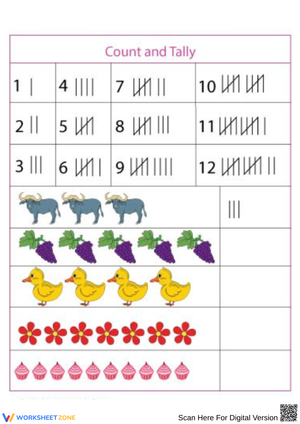
The set works through four interconnected skill areas. Drawing the diagonal fifth mark is the foundational one: students need to form four vertical strokes and then cross them with a clean diagonal before they can make sense of any tally chart. Several worksheets have students practice this physical act in isolation, producing grouped sets of five that they then count by fives rather than by ones.
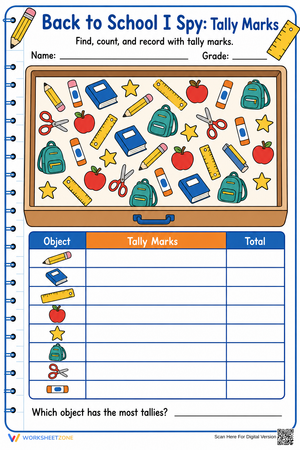
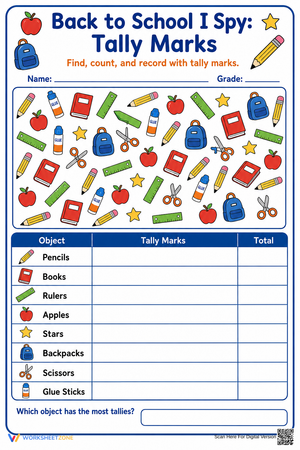
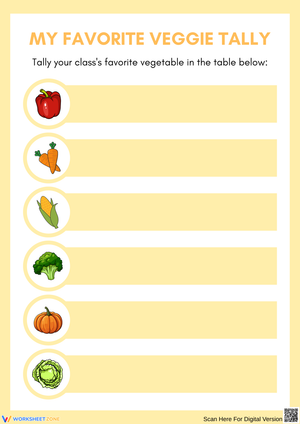
From there, worksheets move into reading pre-filled tally charts with three or four categories — counting groups of five plus any remaining single marks, then writing in the totals. A second tier of practice takes those totals and asks students to fill in a bar graph, building the representational bridge between tallying and graphing that 2.MD.D.10 requires. The final skill layer adds comparison problems: given two category totals, students write a subtraction sentence to find how many more or fewer items appear in one row than another.
Common Errors to Watch for and Correct
The diagonal fifth mark causes more confusion than teachers usually expect. Students frequently draw it vertically — adding a fifth straight stroke — instead of diagonally across the group. This produces a cluster of five parallel lines that stops working as a skip-counting visual: students can no longer distinguish where one set of five ends and the next begins. Pointing this out before students touch a worksheet, with a side-by-side demonstration of the wrong and right versions, prevents most of this.
A subtler error appears during the transfer step. Even after correctly counting a tally group as fourteen, students will shade the bar graph to thirteen — one count gets dropped somewhere in the transition. This is a working-memory issue more than a conceptual one: holding the tally total in mind while locating the right bar and the right scale row is a two-step cognitive demand. Having students write the numerical total directly onto the tally chart before turning to the graph eliminates most of these off-by-one mistakes.
Comparison problems surface a third pattern. When asked "how many more students chose red than blue," students with totals of twelve and nine will often write twelve plus nine rather than twelve minus nine. The phrase "how many more" still signals addition to many second graders. These tally marks worksheets for 2nd grade give teachers a low-stakes context to surface that confusion before it appears on a unit assessment.
Building These Worksheets Into Your Lesson Plans
Drawing-practice worksheets fit naturally at the start of a data unit — either as morning work or during the first five minutes of the math block before direct instruction. Once students can produce clean tally groups, the chart-reading worksheets work well in small-group rotation: three or four students working through the same worksheet while the teacher circulates and catches errors as they form.
Before sending students to the graphing-transfer worksheets independently, spend a few minutes with a class tally chart on the board — literally walking through the move from a marked chart to a shaded bar, narrating each step out loud. Students who watch that modeled transition once make far fewer errors on the worksheet than those who receive only written instructions. The comparison-problem worksheets serve well as a formative check at the end of the unit; they reveal quickly which students have internalized the subtraction interpretation of "how many more."
A practical addition before the drawing-worksheet phase: have students lay out craft sticks in groups of five on their desks — four upright, one laid diagonally across them. That physical arrangement builds a concrete model for the abstract marks, and students who have handled the sticks first make the diagonal stroke far more reliably than those who go straight to pencil and paper.
Standard Alignment
These worksheets align directly with CCSS.Math.Content.2.MD.D.10, which requires students to draw picture graphs and bar graphs representing data sets with up to four categories, and to solve simple put-together, take-apart, and compare problems using information in those graphs. Tally marks function here as the data-collection step that precedes graphing: students use tallies to gather and organize totals, then carry those figures into the bar graph the standard describes. Without a reliable tallying system, the graphing task becomes harder because students arrive at the graph stage still managing uncounted marks rather than organized totals. The worksheets treat tallying as preparation for graphing, which matches the instructional sequence the standard's logic implies.
Differentiating the Set Across Ability Levels
Students who struggle with counting by fives benefit from a reference strip showing multiples of five from zero to thirty taped to their desk. This removes the skip-counting barrier and lets them focus on the tally structure itself. For students who can read tally charts but aren't ready to produce graphs, keep those two tasks on separate worksheets and release them sequentially — there is no reason to require both skills in the same sitting until the first one is solid.
Students who move quickly through the foundational worksheets can work with data sets that produce totals requiring more careful counting — groups that add up to twenty-three or twenty-seven rather than neat multiples of five, for instance. They can also generate their own tally charts from scratch, using a survey question they write themselves, transfer that data to a bar graph, and draft two comparison questions for a partner to solve. That extension preserves the same skill set but shifts the demand from answering a problem to constructing one.
Frequently Asked Questions
Why do students so often draw the fifth mark straight instead of diagonally?
By the time second graders encounter tally marks, they have practiced vertical and horizontal strokes extensively. The diagonal feels like an exception to the rules they already know, especially when they are simultaneously focused on counting accurately. Explicit side-by-side modeling — showing the incorrect version first, then correcting it — helps more than simply demonstrating the right stroke, because students see and name the distinction rather than just imitating a correct motion.
How do tally groups connect to what students learn later about multiplication?
When a student reads a tally chart by saying "five, ten, fifteen, sixteen, seventeen," the mental operation is structurally the same as three groups of five plus two. Teachers working with tally marks worksheets for 2nd grade are building skip-count fluency at exactly the grade level where it underpins both third-grade multiplication and second-grade clock reading. That connection is worth naming explicitly for students — it helps them see counting tally groups as a thinking strategy rather than a mechanical chore.
Can individual worksheets function as a quick formative check?
Yes, particularly the chart-reading and comparison-problem worksheets. A completed worksheet shows three distinct data points: whether a student counts tally groups accurately, whether the transfer to a graph total is reliable, and whether comparison language maps to subtraction. Those three observations together give a clear picture of where a student sits in the 2.MD.D progression. This collection of tally marks worksheets for 2nd grade works well as a mid-unit formative check or as a brief summative task before moving on to picture graphs.
Clear All