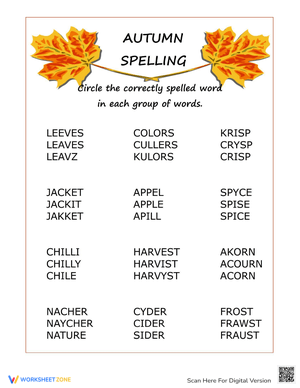
These spelling strategies printable worksheets for 2nd grade address a developmental moment that often gets underestimated: second grade is when students start generating paragraphs, and the cognitive demand of composition leaves very little working memory for thinking through individual letter sequences. The set gives teachers structured, pattern-based practice across phonics rules, word families, syllable work, and visual memory strategies — all of it targeted to the specific orthographic knowledge grade-level standards expect.
What the Worksheets Cover
Each worksheet targets one of the core spelling approaches second graders need to internalize before word knowledge gaps start showing up in writing fluency. The set covers:
- Word family and rime pattern work — students sort, complete, and write words built on common rimes like -ight, -ake, -ain, and -ound, learning to transfer a known pattern to unfamiliar words rather than treating each one as an isolated memorization task
- Vowel team exercises — students distinguish teams like ai/ay, oa/ow, and ee/ea, with activities that require choosing the correct spelling based on word position rather than sound alone
- Syllable segmentation — worksheets provide space to divide multisyllabic words and mark vowel sounds in each part, moving students from treating "remember" as eleven separate letters to seeing it as three manageable chunks
- Closed, open, and silent-e syllable identification — students mark syllable types before spelling, building the linguistic reasoning that supports longer-word work
- Look-Say-Cover-Write-Check practice — column-formatted worksheets walk students through the full cycle for high-frequency and irregular words, with a dedicated self-check column that puts error correction in the student's hands
- Words-in-context sentences — each pattern set includes at least one worksheet where students write target words inside a sentence, connecting spelling practice to meaning
Student Error Patterns Worth Anticipating
The most predictable error in vowel team work is positional confusion. Students who have learned both ai and ay represent the long /a/ sound will frequently write "dai" or "plaing" — they've absorbed the two spellings but haven't internalized the rule that ai belongs in the middle of a syllable while ay belongs at the end. The worksheets surface this error directly by presenting minimal pairs and asking students to explain their choice in writing, which forces the rule to become explicit rather than staying as vague pattern recognition.
Syllable boundary errors show up differently. Students often omit the second vowel in open syllables — writing "musc" for "music" or "slen" for "silent" — because the unstressed vowel doesn't feel acoustically necessary when they're sounding the word out quickly. A three-minute whole-group clapping session before independent work time closes this gap faster than looking at printed word lists alone, and it costs almost nothing in instructional time.
How to Work These Worksheets Into Your Weekly Routine
The structure that holds up best in second grade introduces one spelling pattern on Monday with a brief whole-group word sort — ten minutes, whiteboard, teacher modeling the decision-making process out loud. Tuesday and Wednesday, the worksheets move into literacy centers. Students cycle through the word family completion worksheet and the vowel team sort independently, which frees the teacher to pull a small group. Thursday is the right day for the Look-Say-Cover-Write-Check worksheet: students still working on the week's pattern use it with teacher support, while students who've secured it move to the words-in-context version with a more demanding vocabulary tier.
The spelling strategies printable worksheets for 2nd grade in this set also work well as Monday morning warm-ups — five minutes after morning meeting, before the day's reading block, keeps orthographic patterns active across the week rather than front-loaded into a single lesson slot. Teachers who distribute practice this way through spaced retrieval consistently see fewer students reverting to earlier error patterns by Friday assessment time.
Standard Alignment
These worksheets align to CCSS.ELA-LITERACY.L.2.2, which covers conventions of standard English in writing, and specifically to standard L.2.2.d: "Generalize learned spelling patterns when writing words." That standard is worth naming because it shifts the expectation from memorizing a list to applying a rule productively — which is exactly what the pattern-transfer activities in this set ask students to do. The syllable work also connects to RF.2.3, phonics and word recognition, since syllable boundary awareness directly supports the grade-level expectation that second graders decode words with common prefixes and suffixes. Both standards appear on most state-level literacy assessments for this grade band, so the practice double-functions as test preparation without changing the instructional purpose.
Adjusting the Set for a Range of Learners
For students still consolidating basic CVC and CVCe patterns, the word family worksheets work best when the teacher pre-fills the rime and asks students only to generate or write the onset — reducing the visual field without removing pattern exposure. The Look-Say-Cover-Write-Check format also adapts easily: students working on a shorter word list can use the same worksheet with a reduced set written in by the teacher before distribution, keeping them in the same classroom routine as everyone else.
The spelling strategies printable worksheets for 2nd grade at the harder tiers include multisyllabic vocabulary, so advanced students stay in the word study routine without needing a completely separate activity. Rather than a closed sort with category headings given, students who've already secured the week's pattern benefit from writing their own category labels after sorting — a task that demands explicit metalinguistic awareness, not just matching. One honest note: the Look-Say-Cover-Write-Check format frustrates students whose visual memory is genuinely weak and who freeze when the word disappears. For those students, adding one tracing step before covering provides a kinesthetic anchor the column format doesn't build in on its own.
Frequently Asked Questions
Do these worksheets work without a packaged spelling curriculum already in place?
Yes. Each worksheet is self-contained around one strategy or pattern, so teachers without a packaged spelling program use them to build a structured sequence from scratch. The most practical approach is grouping them by phonics scope — short vowels, long vowel teams, multisyllabic patterns — and introducing one group per week alongside whatever phonics instruction is already running in the room.
How much class time does each worksheet take?
Most worksheets run eight to twelve minutes for students working at grade level. The syllable segmentation worksheets take a bit longer the first time students encounter a new syllable type; after two or three sessions with the format, the time drops noticeably. The Look-Say-Cover-Write-Check worksheets are well-suited to the brief window before a transition — they have a clear stopping point, so students don't get caught mid-task when lunch dismissal or pickup arrives.
Can these be sent home for additional practice?
The spelling strategies printable worksheets for 2nd grade in this set are formatted to print cleanly in black and white, which matters for families printing at home. The word family and vowel team worksheets travel home well because the instructions are self-explanatory. The Look-Say-Cover-Write-Check format needs one brief family walkthrough — the cover step reliably confuses students who haven't done it before — but after that introduction it becomes a dependable homework routine that parents can run independently.
What if a student keeps spelling the same word incorrectly after repeated practice?
Persistent errors on the same word usually signal one of two things: either the student hasn't secured the underlying phonics pattern the word depends on, or the word is irregular enough that pattern-based approaches aren't the right tool. For the first case, drop back to an earlier worksheet in the pattern sequence and work forward again. For genuinely irregular words, the visual memory cycle — with the added tracing step mentioned above — is more useful than more phonics exercises. Identifying which problem is actually present saves a lot of frustrated practice time for both the student and the teacher.












 Interactive Worksheet Maker
 Quiz Maker
 Word Search Maker
 Crossword Puzzle Maker
 Word Scramble Generator
 Sentence Scramble Generator
 Handwriting Worksheet Generator
 Name Tracing Generator
 Fill In The Blank Generator