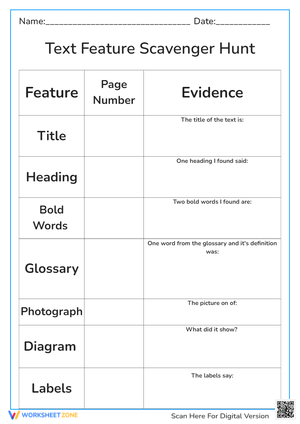
Using text features printable worksheets for 2nd grade gives teachers a concrete way to close one of the more stubborn gaps in early nonfiction reading: students who can decode a passage word-for-word but still can't locate an answer that's sitting directly under a labeled diagram. Each worksheet targets a specific feature — headings, captions, bold print, labeled diagrams, tables of contents, and glossaries — through identifying, labeling, and short-response tasks. The resources fit equally well into small-group rotations, reading workshop independent practice, and quick formative checks at the end of a lesson.
The Specific Skills Targeted
Each worksheet isolates one feature so students work with it directly rather than trying to absorb several unfamiliar concepts at once. The work across the set covers:
- Headings: Students predict section content from a heading, then read to confirm. A separate matching task asks them to pair a set of headings with their corresponding paragraphs.
- Captions: Students write original captions for provided images, then identify what information the caption adds that the image alone does not convey.
- Bold print and glossaries: Students locate bolded terms in a short passage, look them up in a mock glossary, and use each term correctly in a sentence.
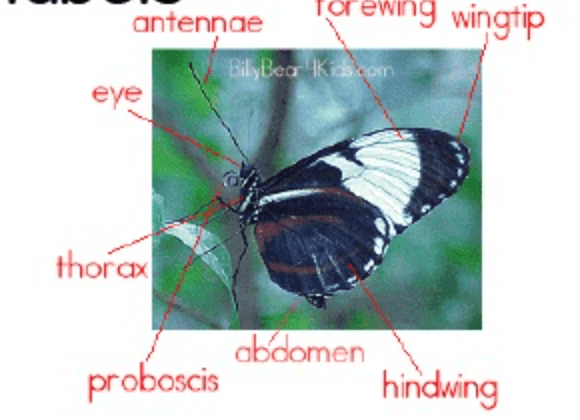
- Labeled diagrams: Students complete partially labeled diagrams and answer questions that require reading the labels — not just describing what the picture looks like.
- Table of contents: Students answer "where would you look to find..." questions, then write a simple contents page for a mock nonfiction book of their own.
The writing tasks embedded throughout using text features printable worksheets for 2nd grade — especially caption writing and the mock contents page — push students past recognition into production. Recognizing a heading is far easier than constructing one, and second graders who have written their own headings become noticeably sharper at using them as readers.
Predictable Errors That Show Up in Student Work
The most consistent mistake involves diagrams. Ask a second grader what a diagram shows, and many will describe what they see visually — "a butterfly with its wings spread open" — without reading a single label. When a question requires a label-specific answer, such as naming the body part connecting the wings to the thorax, these students guess from visual context or leave the item blank. The diagram worksheets address this directly by asking students to read the label first, then draw a connecting line to the correct part — deliberately reversing the instinct to look first and read second.
With headings, a different pattern appears. Students who have just received direct instruction on headings can identify one in isolation with no trouble. But set them loose on a multi-section passage with comprehension questions, and many return to the very beginning and re-read everything, ignoring the headings entirely as navigation tools. It takes several rounds of structured practice — and explicit teacher pointing in the moment — before headings become an automatic resource rather than a feature students notice and immediately forget to use.
Bold vocabulary is another consistent trouble spot. Students treat bold words as random emphasis, the way someone might underline a phrase in a personal notebook. The idea that bold signals "find this in the glossary" is not intuitive at this age. The bold print worksheets build that workflow deliberately: see bold, locate the glossary entry, confirm the meaning, return to the sentence and reread it. That sequence needs to become a habit before it transfers to independent reading.
Fitting These Worksheets Into Your Reading Block Without Overloading the Week
The heading and caption worksheets work well as Monday warm-ups — five minutes at the start of the reading block to activate prior knowledge before moving into a whole-group nonfiction read-aloud. Students complete one short task, the class reviews it briefly together, and you're already into the lesson with context established. The glossary and bold print worksheets, which require more sustained attention, land better during the independent rotation block, where you can pull a small group and walk through the steps alongside students who need more direct support before working on their own.
A move worth trying: use the table of contents worksheet before a new science or social studies unit rather than as a standalone reading lesson. When students spend ten minutes predicting what a unit will cover based on a contents page, they stay better oriented throughout the entire unit and ask sharper questions during read-alouds. Using text features printable worksheets for 2nd grade as a pre-reading tool — rather than as after-the-fact review — consistently produces more purposeful student discussion than using them only as summative practice.
For reading workshop, the diagram worksheet slots into an independent research station cleanly. Students use the labeled diagram to answer four to six text-dependent questions, then sketch and label their own simple diagram of something they read about during the week. The teacher gets an artifact showing not just whether students can read a diagram but whether they can build one — a harder task that surfaces gaps the identification work alone does not reveal.
Standard Alignment
These worksheets align to CCSS.ELA-Literacy.RI.2.5, which asks second graders to know and use various text features — including captions, bold print, subheadings, glossaries, and indexes — to locate key facts or information efficiently. In classroom terms, this standard sits at the intersection of reading comprehension and information literacy: it is not enough for students to read a passage; they must also demonstrate they can use the structural tools the author provided. RI.2.5 appears on district benchmark assessments and state reading tests as early as late second grade, often as multiple-choice questions asking why an author included a specific diagram or what a heading signals to the reader. Students who have practiced regularly with this type of task are far better positioned for those items than students who have only encountered text features incidentally during read-alouds.
Adjusting the Worksheets for a Range of Learners
For students still building reading fluency, the identification tasks — circling a feature, underlining a caption, matching headings to paragraphs — offer entry points that don't require extended writing. These students participate fully in the recognition work without the caption-writing tasks overwhelming the session. Pairing them with a partner for the glossary exercises lets them hear the workflow modeled aloud before trying it independently.
Students who already have the basics need more analytical challenge. Pair the worksheet with a real nonfiction book from the classroom library and ask them to find a second example of the target feature in actual text, then decide whether it works as well as the worksheet example and explain why. That question pushes toward author's purpose thinking — territory that connects directly to RI.2.6 and sets up the critical reading work students will encounter in third grade.
One limitation worth naming honestly: the diagram and table of contents worksheets assume some familiarity with nonfiction book structure. Students who arrived in second grade with limited exposure to nonfiction read-alouds — common in classrooms with high rates of summer learning loss — may struggle to work independently on those tasks right away. A brief five-minute orientation with an actual nonfiction book, pointing to each feature before the worksheet begins, closes that gap quickly and makes the independent work far more productive.
Frequently Asked Questions
Do these worksheets work for students reading below grade level?
Yes, with some targeted adjustments. The identification tasks on each worksheet — circling, underlining, matching — are accessible to below-grade-level readers because they require recognition rather than production. The caption-writing and mock table of contents tasks are more demanding. For students who need support, substitute a sentence frame ("This picture shows _____ because _____") for the open-ended caption task. That structure keeps the concept intact while significantly reducing the writing demand.
Is there a recommended order for introducing the worksheets?
There is no required sequence — each worksheet stands alone — but most teachers start with headings because it's the feature second graders encounter most often and already have some instinct about. Labeled diagrams and the index worksheet tend to come later because they require more deliberate teacher-led instruction before independent practice pays off. The bold print and glossary worksheet pairs naturally with any upcoming content unit where vocabulary is heavy.
Can I use these during a science or social studies unit rather than in the reading block?
That's one of the strongest contexts for this set. Using text features printable worksheets for 2nd grade alongside a science unit — when students are actively reading about habitats, life cycles, or simple machines — gives the skill immediate, relevant context. Students are more motivated to navigate a glossary when the vocabulary belongs to something they're investigating. Teachers who embed the worksheets into content units often notice comprehension gains that don't appear when the skill is practiced in isolation from content.
Are answer keys included?
Answer keys are included for all objective tasks — matching, labeling, identification. For open-ended writing tasks like caption writing and glossary sentences, each worksheet includes sample responses alongside a brief rubric focused on whether the student captured the purpose of the feature, not whether their exact wording matches a predetermined answer. This keeps scoring manageable during independent practice while still giving you meaningful information about where each student's understanding actually stands.












 Interactive Worksheet Maker
 Quiz Maker
 Word Search Maker
 Crossword Puzzle Maker
 Word Scramble Generator
 Sentence Scramble Generator
 Handwriting Worksheet Generator
 Name Tracing Generator
 Fill In The Blank Generator




 BACK TOSCHOOL