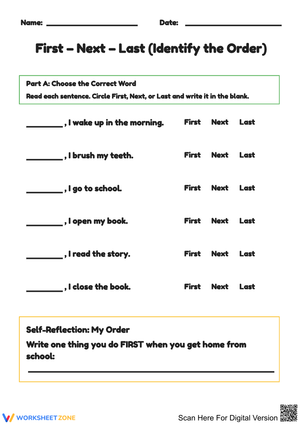
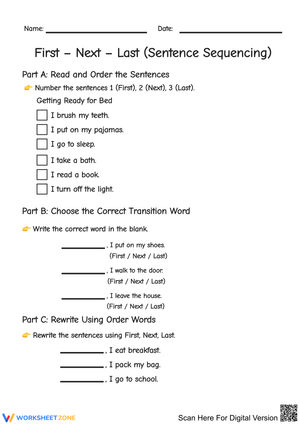
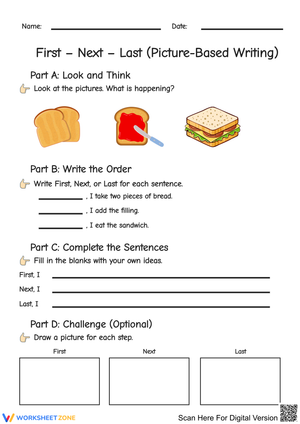
These 2nd grade first next last worksheets give students structured, repeated practice with the three sequencing anchors that second graders need before they can write a coherent narrative or summarize a text they've read. Each worksheet isolates a specific task — cutting and arranging picture cards, completing sentences with the correct transition word, or labeling events in a short reading passage — so students build the skill incrementally rather than confronting all of it at once.
What Students Practice Across the Set
The worksheets move between two skill tracks: reading sequences and producing them. On the reading side, students read a short three-event passage and mark which event happened first, which happened next, and which happened last — a task that requires them to interpret context clues rather than just copy words from the page. The writing side asks students to take three jumbled sentences or images and reconstruct them into a logical order, then write a label or a sentence using the corresponding transition word.
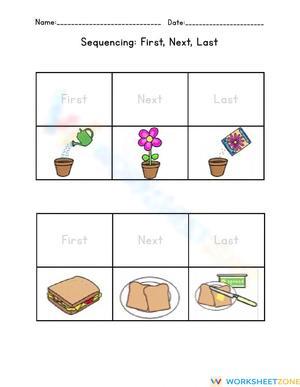
Several worksheets use procedural sequences — tying shoes, watering a plant, making toast — because the inherent logic of those tasks is already familiar. Students can check their own thinking: they know you can't spread jam before the bread is in your hand. That self-verification is harder when the content is fictional, so procedural sequences belong early in the set. Later worksheets use brief narrative passages where the correct order depends on reading for cause and effect rather than real-world knowledge.
Standard Alignment
These worksheets align directly with CCSS.ELA-LITERACY.W.2.3, which requires students to write narratives that recount events using temporal words to signal order. In classroom terms, that standard shows up in every writing workshop where a student needs to move a reader from the beginning of an event to its end. The reading worksheets also support RL.2.3 — describing how characters respond to events — because tracking response requires tracking order. You can't explain why a character felt relieved if you've misread which event came last.
Why This Format Works for Second Graders Specifically
Cognitive load research is useful here. Seven-year-olds who are still developing working memory benefit from constraints. Limiting the sequence to exactly three steps — first, next, last — removes the burden of deciding how many parts a story has, which is a separate, harder task. Once students can reliably place three events, they're ready for "then," "after that," and "finally" — the expanded toolkit of third grade. These worksheets are deliberately not that; they are the floor students need to stand on first.
The W.2.3 standard names temporal words explicitly, but the reason they appear at second grade isn't arbitrary. This is the year most students shift from drawing-heavy journal writing to sentence-based narratives. The jump is harder than it looks — a student who can tell you a story in three sentences while pointing at pictures will still write "I went to the park I played I came home" without any connective tissue. These worksheets address that specific transition, the moment when oral sequencing fluency hasn't yet transferred to print.
Frequent Student Errors Worth Watching For
The most consistent error isn't confusing "first" and "last" — that reversal is actually uncommon. The real trouble spot is the middle. Students anchor confidently at the start and the end, then treat "next" as a leftover slot rather than a meaningful transition. In student writing this shows up as sequences where the middle event could be removed without changing the logic: "First I woke up. Next I brushed my teeth. Last I ate breakfast" versus "First I woke up. Next I ate breakfast. Last I brushed my teeth" — both feel equally valid to a student who isn't reading for cause and effect.
A second pattern appears on picture-sequencing worksheets when the images are ambiguous. If two frames could plausibly follow each other, some students pick an order and defend it confidently even when it's wrong — not because they lack sequencing ability, but because they're filling gaps with their own experience. A worksheet showing a child at a sink, a child with a towel, and a child reaching for soap will generate disagreement about step two and step three, and that's worth treating as a teaching moment rather than a marking error.
How to Work These Worksheets Into Your Lesson Plans
The most efficient slot is the eight to ten minutes after morning meeting and before the first instructional block. Students come in at different times, settle at different speeds, and a sequencing worksheet requires just enough focus to get everyone on the same task without front-loading the day. The picture-ordering worksheets work well in this window because they don't require a teacher prompt to start.
Within a literacy block, these worksheets slot naturally into a gradual-release structure. Model one worksheet as a shared read-aloud with think-aloud narration — read the passage, identify what you know must come first, work backward from "last" — then release students to a partner worksheet before individual practice. The worksheets also work as a formative check at the end of a narrative writing lesson: after students write their own three-event story, ask them to circle the transition words they used. If "next" is absent, the worksheet that isolates that word is the follow-up assignment.
Adjusting the Worksheets for a Range of Learners
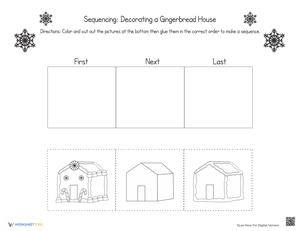
For students who are still developing print fluency, the picture-sequencing and cut-and-paste worksheets carry the cognitive weight without requiring reading. They can demonstrate sequencing understanding while their decoding catches up. Adding a word bank to any sentence-completion worksheet lowers the barrier further — students focus on placement logic rather than spelling.
For students who move through the basic set quickly, the extension is straightforward: ask them to add a fourth step using "then" or "after that," or have them write a second version of the sequence from a different character's perspective. A student who can sequence a story from one character's point of view and then reorder it from another's is working well above the W.2.3 floor. Some worksheets in the set include an optional writing extension line at the bottom for exactly this purpose.
Frequently Asked Questions
Can these worksheets be used in subjects outside of ELA?
Yes, and science is the most natural fit. Sequencing the stages of a butterfly's life cycle or the steps in a seed-germination observation uses the same first-next-last structure against content students are already studying. The worksheets transfer directly — swap the narrative passage for a science procedure, and the skill work is identical. Social studies works too for community or historical processes that have a clear three-step arc.
Why do students struggle more with "next" than with "first" or "last"?
The beginning and end of a sequence have natural salience — "first" is where something starts, "last" is where it resolves. The middle is defined only by what surrounds it. Students who struggle with "next" often haven't learned to test it against both neighbors: does this event make sense after the first step AND before the last? Teaching that two-directional check — rather than just "what comes in the middle" — shifts students from guessing to reasoning.
How many worksheets should students complete before moving to longer sequences?
There's no fixed number, but the reliable signal is whether students can complete a picture-sequencing worksheet and a sentence-based worksheet on the same day without confusing the transition words. When "next" appears consistently and correctly in both formats, they're ready for four-step sequences. If "next" is still being swapped with "last," more practice at this level is the right call — expanding the sequence before the three-step version is solid creates more confusion, not less.
What's the right way to handle disagreements when two students order a sequence differently?
Ask each student to explain why their order makes sense. Sequencing disagreements that come from genuine ambiguity in the worksheet are worth a brief class discussion; disagreements that come from a student not having read carefully are worth redirecting back to the text. The distinction matters because one is a worksheet design issue and the other is a comprehension issue — they need different responses.












 Interactive Worksheet Maker
 Quiz Maker
 Word Search Maker
 Crossword Puzzle Maker
 Word Scramble Generator
 Sentence Scramble Generator
 Handwriting Worksheet Generator
 Name Tracing Generator
 Fill In The Blank Generator




 BACK TOSCHOOL