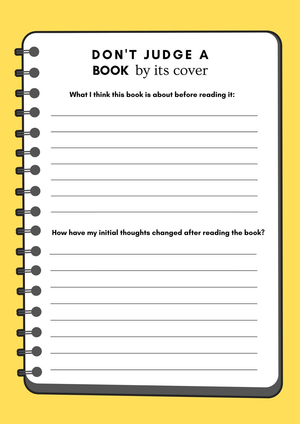
2nd Grade Making Predictions worksheets
These 2nd grade making predictions worksheets give teachers ready-to-use passages and graphic organizers built around the skill second graders most often get backward: guessing first and looking for evidence second, rather than reading closely and then drawing a reasoned conclusion. Each worksheet asks students to examine a short passage or illustration, locate a specific clue, and write a prediction tied to what the text or image actually shows — not what they hope will happen. The set moves through the full prediction cycle, covering before-reading, during-reading, and after-reading tasks so students learn this is a continuous reading habit, not a front-cover activity.
What These Worksheets Ask Students to Do
The earliest worksheets in the set focus entirely on illustration-based predictions. Students examine a picture showing a character's expression, an open refrigerator door, or a muddy pair of boots on the porch, then write what they think happened just before the picture was taken or what is about to happen next. This picture-first approach fits where most second graders begin the school year: they process visual information faster than they decode sentences, and anchoring predictions to visual clues gives every reader an entry point, including students still building fluency.
As the set progresses, worksheets shift to short fiction passages where students underline the sentence or phrase that supports their prediction. That underlining step matters — it requires students to reread deliberately rather than skim, and it produces concrete evidence teachers can scan quickly during a station check. The later worksheets introduce nonfiction passages, where students predict what a section will cover based on a heading or a photograph caption. That is a different cognitive move than predicting plot events, and it catches many students off guard. Students who handle fiction predictions confidently often struggle to adjust their approach for informational text.
- Illustration-based prediction prompts with labeled visual cues
- Short fiction passages with a marked stopping point for mid-story predictions
- Nonfiction passages using headings and captions as prediction clues
- Confirm-or-adjust organizers that require written explanations, not just yes/no responses
- Evidence-circling tasks where students mark the exact text clue that informed their guess
Prediction Errors That Show Up in Nearly Every Second-Grade Class
The most visible problem in early prediction work is not wild guessing — it is wishful thinking wearing the clothes of a prediction. A student who writes "I think Lily will get the puppy" is often expressing what they want the story to do rather than what the clues point toward. When asked to circle their evidence, they look back and find nothing. These 2nd grade making predictions worksheets surface this gap immediately because each one requires a labeled clue alongside the prediction. Students who skip the evidence step leave an empty box rather than a plausible response, and that blank tells you exactly where reteaching needs to happen.
A second persistent error is the summary prediction — restating something that already happened as if it is forward-looking. After reading that a character packed her backpack, a student writes: "I think she will pack her backpack." The response looks structurally correct but describes the past, not the future. Catching this early takes direct modeling. One reliable classroom move: after students write their predictions, ask them to put a finger on the last sentence they read, then ask aloud whether their prediction describes something before that sentence or after it. That single question exposes the error almost every time.
Nonfiction predictions carry their own trap. Students draw on general topic knowledge ("I already know penguins live in Antarctica, so I predict this section will talk about cold weather") instead of reading the heading or caption as the actual clue. The nonfiction worksheets address this directly by asking students to draw a box around the specific part of the text — heading, caption, or image detail — that led to their prediction.
Building These Worksheets Into Your Weekly Reading Routine
The before-reading worksheets work as a focused opener at the start of a read-aloud. Hand students the worksheet, display only the book cover, and give them about sixty seconds to write a prediction and label their clue. That pre-task raises the stakes for the read-aloud that follows — students are now listening to check themselves, which is a different kind of attention than passive story absorption. For guided reading groups, the during-reading worksheets fit naturally at a chapter break or mid-story cliffhanger, giving the small group a writing task while you check in with individual readers. A worksheet with a mid-passage stopping point also translates cleanly to a literacy center: students read to the marked line, flip the sheet face-down, write their prediction, then flip back to finish reading and compare.
The confirm-or-adjust organizers deserve a dedicated slot at the end of a reading lesson rather than being rushed through as a finishing task. When students write out why their prediction shifted — naming the specific sentence that changed their thinking — that is where the real metacognitive work happens. It takes six to eight minutes of genuine writing time to do well, and protecting that time in your schedule is worth it rather than treating the reflection as optional.
Standard Alignment
CCSS ELA-Literacy.RL.2.7 asks second graders to use information from both illustrations and words to demonstrate understanding of a text's characters, setting, or plot. The picture-clue worksheets address the illustration side of that standard directly; the passage-based worksheets address the words side. A completed worksheet — prediction plus cited clue — serves as documented evidence of a student's RL.2.7 performance, which makes these useful for portfolio documentation or reading conference notes. The nonfiction worksheets also connect to RI.2.7, which extends the same illustration-plus-text skill to informational reading. A 2nd grade making predictions worksheets that covers both literary and informational text gives teachers evidence toward both standards through a single, repeatable classroom routine.
Adapting the Set for Different Readers in Your Class
Students who struggle with writing can work through the illustration-based worksheets without modification — drawing an arrow to the clue in the image is a valid evidence response that keeps the focus on reasoning without requiring sentence-level writing. For students who need support forming a written prediction, a sentence-frame card works well alongside any worksheet: I think ___ will ___ because the [picture / text] shows ___. That three-part structure keeps the cognitive load on the prediction itself rather than on generating sentence form from nothing.
Students who move through predictions quickly benefit from being pushed toward competing predictions — writing two possible outcomes supported by two different clues in the same passage, then explaining in a sentence which outcome is more likely and why. That move shifts prediction into early analytical writing and is appropriate for second graders reading above level. The confirm-or-adjust organizers can also be extended for those students: rather than simply noting whether their prediction was correct, they annotate which clue they misread or overlooked, building close-reading habits alongside the comprehension strategy.
Frequently Asked Questions
How is predicting different from inferring at this grade level?
Predictions are forward-looking — students guess what will happen next based on available clues. Inferences are about unstated meaning, often applied to something already in the text. In practice, second graders don't need to distinguish these terms to benefit from prediction practice. Both skills require the same underlying move: find a clue, think beyond it, explain your reasoning. Prediction worksheets build exactly the close-reading habit that inference tasks will later require.
What do I do when a student's prediction is wrong but the reasoning was sound?
A logical prediction supported by genuine text evidence is a successful use of the strategy, even when the author takes the story somewhere unexpected. The goal is not accuracy — it is disciplined reasoning from clues. An incorrect prediction backed by real evidence gives you a strong teaching moment: use the confirm-or-adjust section to have the student write out what new information changed their thinking, which is exactly the metacognitive reflection this strategy is meant to develop.
Can I use these worksheets with students who are still developing their decoding skills?
Yes. The illustration-based worksheets give students full access to the prediction strategy without asking them to process a dense passage. Once a student is reading at a late first-grade level or higher, the shorter passage worksheets become accessible. A 2nd grade making predictions worksheets that spans picture-only and passage-based formats lets you match each reader to the right worksheet without planning separate activities from scratch.
How often should students practice prediction to see lasting results?
Two to three times per week during the weeks you introduce or reinforce the strategy is generally enough. Heavy repetition packed into a short window can turn the skill into a mechanical routine students complete without careful thought. Spaced practice — returning to a prediction worksheet after a few weeks spent on a different comprehension strategy — tends to produce more durable retention than daily work concentrated inside a single unit.