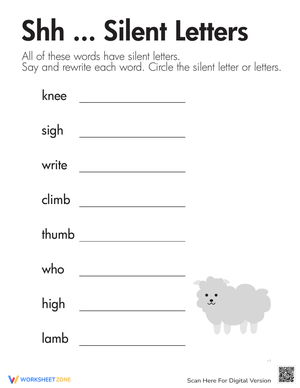
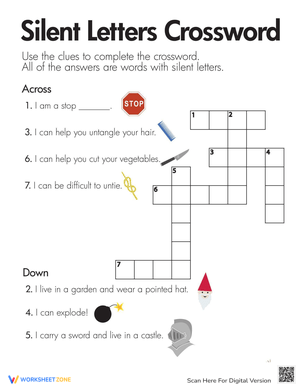
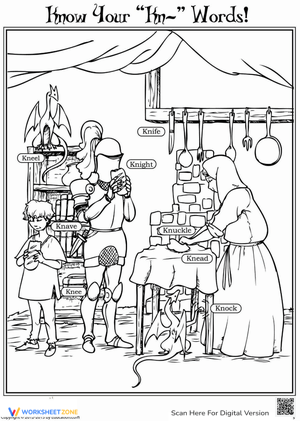
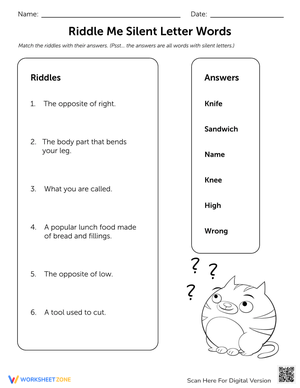
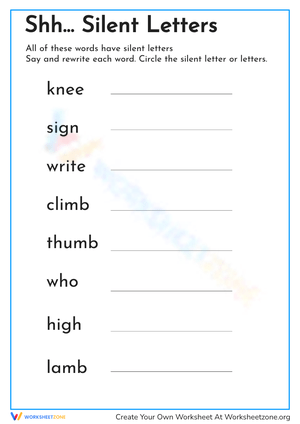
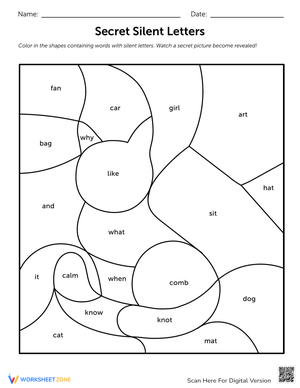
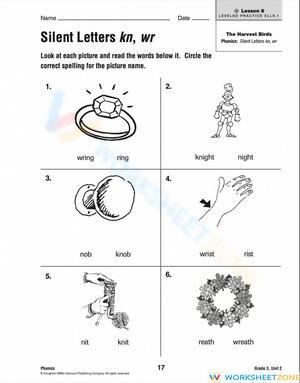
These silent letters printable worksheets for 2nd grade give teachers a focused set of resources for one of phonics instruction's most disorienting moments: when a child who has been reliably decoding CVC words meets knife or climb and the system they trust suddenly stops working. Each worksheet isolates a specific ghost-letter cluster — kn-, wr-, -mb, gn- — and builds toward automatic recognition before 3rd-grade reading demands accelerate.
Patterns Each Worksheet Targets
Each of the silent letters printable worksheets for 2nd grade focuses on one cluster, which means you can introduce kn- in the first week and hold gn- until students are ready — no need to pile every ghost pattern into the same week of instruction. Task formats across the set include underlining the silent letter before reading aloud, sorting words by pattern into labeled columns, picture-to-word matching, and rewriting scrambled letters into correctly spelled words.
- kn- words: know, knee, knock, knight, knit — the most frequently appearing cluster in 2nd-grade leveled texts
- wr- words: write, wrist, wrap, wrong, wreck — comes up constantly during writing workshop conferences when students ask how to spell what they hear as a plain /r/ sound
- -mb words: climb, lamb, thumb, comb, limb — the ending most likely to produce spelling errors long after reading recognition is solid
- gn- words: gnat, gnaw, gnome — less frequent but worth addressing before students encounter it cold in a reading passage and freeze
The sentence-level worksheets deserve a separate mention. Rather than isolated word work, they present a two-to-three-sentence passage where students read, locate each silent letter, and circle it. This format sits closer to what students actually face during independent reading and works well as a mid-unit check to see whether pattern knowledge holds up in context — which is a different thing entirely from circling answers in a word list.
Where Errors Surface and What They Reveal
The most predictable error is pronunciation bleed — students say the silent letter because their decoding reflex fires before their pattern memory kicks in. A student who reads knife as "kuh-NIFE" or wrap as "wuh-RAP" isn't being careless. That student is applying a rule that has worked across hundreds of other words. You'll hear this error most clearly during small-group reading aloud, not in any written response — which is one reason these worksheets pair well with verbal read-aloud tasks during rotations, where you're actually listening.
The -mb ending produces a different error pattern in writing. Students frequently read lamb and comb correctly but drop the b entirely when spelling them in a composition. The gap between reading recognition and spelling production for this cluster is wider than it is for kn-. The worksheets that ask students to sort words and then write them from memory are more diagnostic for -mb than the circle-or-trace formats, because they surface the spelling gap that pure recognition tasks don't catch.
There's also an overgeneralization error worth watching. Once students learn that kn- carries only the /n/ sound, some start applying silent-initial-consonant logic to words that don't follow that pattern — spelling new as knew, or hesitating on whether to voice the n in night. A quick side-by-side whiteboard comparison of night and knight tends to resolve this faster than any additional written practice.
Where These Worksheets Fit in the Week
Most teachers introduce one cluster per week during whole-group phonics, use the first worksheet from that pattern as guided practice the same day, and assign a second worksheet from the same cluster later in the week as independent work. That rhythm provides initial exposure on Monday without front-loading too much, then a low-stakes retrieval check by Thursday or Friday — which is where spaced practice actually builds retention, not the original whole-group lesson.
The sorting worksheets run especially well in small groups, where you can hear students say the words aloud while they categorize them. That's when pronunciation bleed surfaces — in what you hear, not in the circled answers on the paper. A 10-minute small-group sort during a reading rotations block is more diagnostic than a completed worksheet will ever be on its own.
For morning warm-up, the ghost-letter hunt worksheets — where students scan a short passage and mark every silent letter they find — take about 8 minutes and land well right after attendance while the class is still settling in. They also generate genuinely useful disagreement: students will argue about whether the silent letter in sign is the g or whether there even is one, and that argument is exactly the kind of phonics reasoning you want happening out loud in the room.
How to Use These Worksheets Across Different Reading Levels
For students still consolidating basic decoding, begin with only the kn- and -mb patterns before moving to gn-. The first two clusters attach to words students already know by meaning — knee, lamb, thumb — so the phonics pattern is new but the vocabulary isn't. That matters for working memory: students aren't carrying the cognitive load of unfamiliar meaning and unfamiliar spelling at the same time.
For students reading confidently at grade level, the sentence-level and short-passage worksheets shift the goal from identification to fluency. The question stops being "can you find the silent letter" and becomes "does knowing the silent letter slow your reading at all." Those students benefit from timed partner reading with the passage-based worksheets rather than more isolation practice on individual words.
Students whose phonics knowledge outpaces their handwriting fluency — a real and common gap in 2nd grade — get the most from the cut-and-paste and circling formats. Those worksheets let you assess pattern knowledge without handwriting demands interfering with the actual phonics evidence you're trying to collect. Conflating the two skills produces inaccurate pictures of where a student actually is.
Standard Alignment
The silent letters printable worksheets for 2nd grade address CCSS.ELA-LITERACY.RF.2.3, the phonics and word recognition standard requiring 2nd graders to know and apply grade-level phonics and word analysis skills in decoding words. Silent-letter clusters occupy an instructional gray zone within that standard: the patterns are consistent and teachable, so they aren't purely irregular words, but students can't decode them by standard phoneme-grapheme correspondence alone. Most district pacing guides place this instruction in the second semester of 2nd grade — after long-vowel patterns are solid and before multisyllabic word work begins — which is exactly where these worksheets are designed to land.
Frequently Asked Questions
Do all the worksheets need to be used in a specific order?
No. Each worksheet stands alone, and you can pull individual ones to match whatever your class needs right now. If students have already worked through kn- and wr- and only need reinforcement on -mb, pull those and skip the rest. Moving from more frequent patterns to less frequent ones tends to work better than the reverse — kn- before gn-, for instance — but nothing in the set forces a sequence.
Is 2nd grade too early to address silent letters, or should I wait until decoding is stronger overall?
The more common mistake is waiting too long. Once students are reading connected text — even short leveled readers — they encounter know and write whether instruction has addressed those patterns or not. Introducing the most frequent clusters (kn-, wr-, -mb) as soon as students have solid short-vowel and long-vowel foundations means fewer mispronunciations go unaddressed and uncorrected during independent reading time.
How do I know when a student has genuinely internalized a pattern rather than just completing a worksheet correctly?
Transfer is the test. Ask a student who has finished the kn- work to spell knelt or read knob — words that weren't on any worksheet. If the silent letter disappears in the attempt, the pattern isn't solid yet. These silent letters printable worksheets for 2nd grade work best when you treat them as practice toward that transfer goal, not as evidence of mastery in themselves. A completed worksheet tells you the student recognized the pattern under low-stakes conditions; reading or spelling a novel word tells you the pattern has actually transferred.












 Interactive Worksheet Maker
 Quiz Maker
 Word Search Maker
 Crossword Puzzle Maker
 Word Scramble Generator
 Sentence Scramble Generator
 Handwriting Worksheet Generator
 Name Tracing Generator
 Fill In The Blank Generator