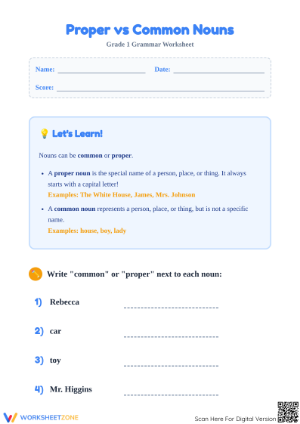
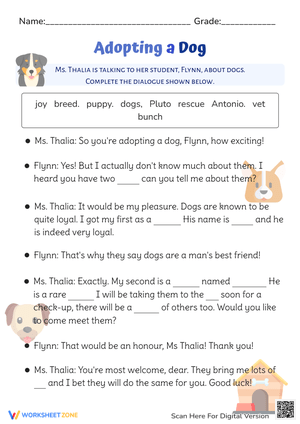
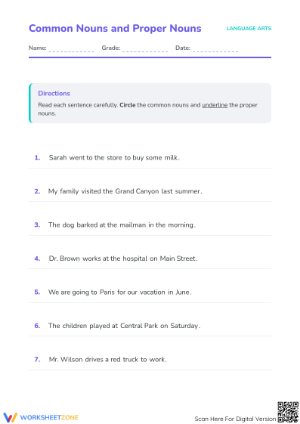
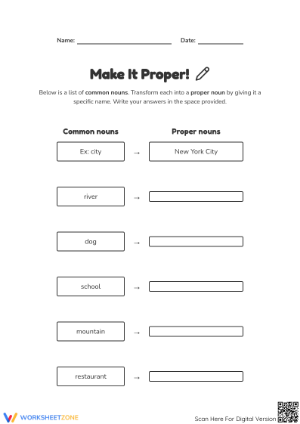
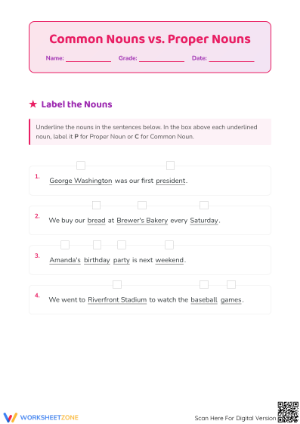
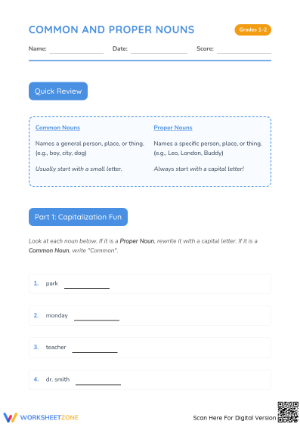
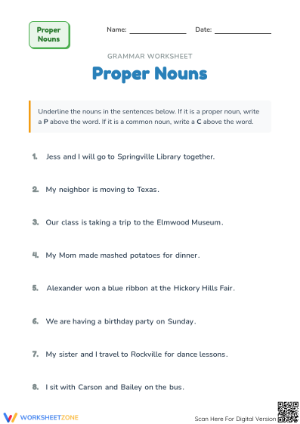
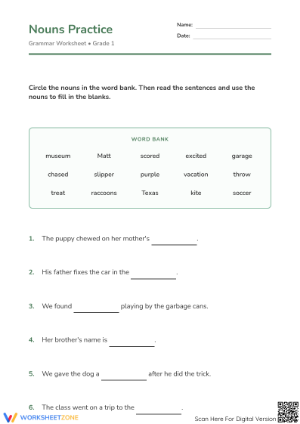
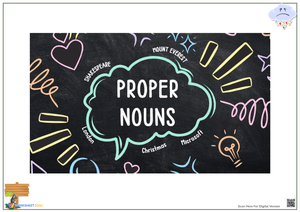
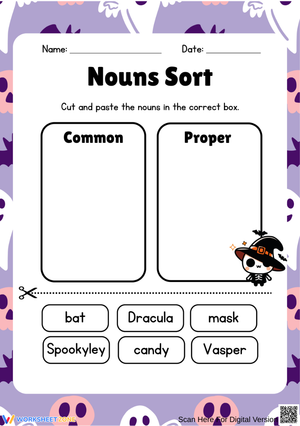
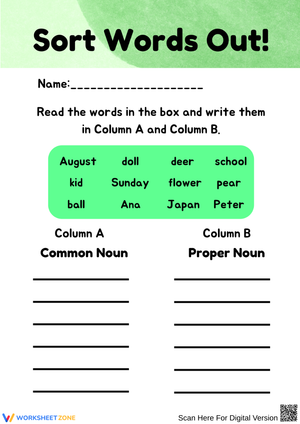
These 2nd grade proper nouns worksheets give teachers a focused set of grammar exercises built around one of the more conceptually demanding mechanics rules at this level: capitalization that isn't tied to where a word sits in a sentence but to what kind of word it is. Students at this age are usually comfortable capitalizing the first word of a sentence — that rule feels mechanical and learnable. But the idea that city stays lowercase while Chicago is always capitalized, regardless of position, requires a different kind of understanding. This set targets that distinction directly through identification, sorting, sentence rewriting, and short writing tasks.
Skills These Worksheets Build
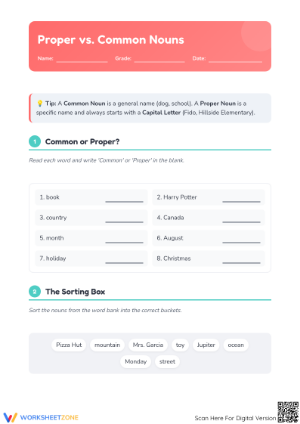
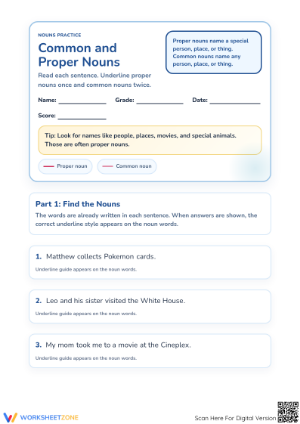
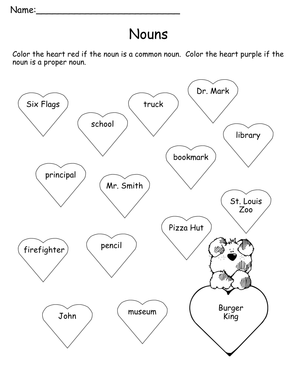
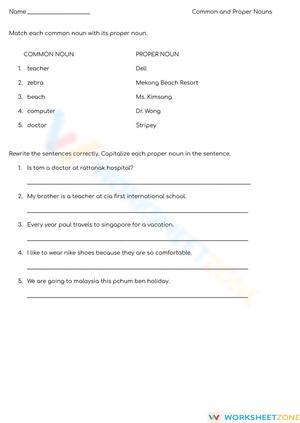
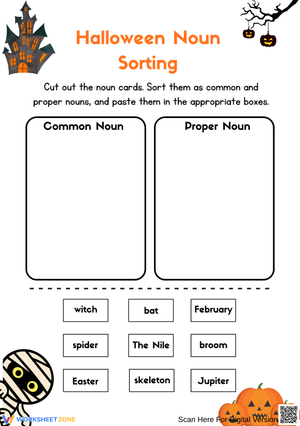
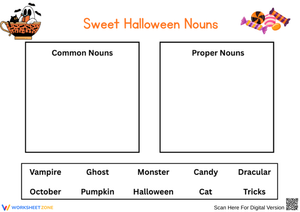
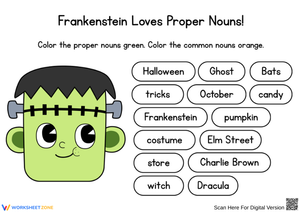
Each worksheet focuses on a specific operation rather than bundling every proper noun task into one activity. Some worksheets ask students to underline proper nouns in a sentence and rewrite the sentence with correct capitalization. Others present word pairs — holiday / Thanksgiving, street / Maple Avenue, dog / Spot — and ask students to sort them into common and proper columns. A third format gives students a partially written sentence with a blank and asks them to supply a real proper noun: their school's name, their city, the brand of crayons they use in class. That last task is the most revealing because it shows whether students can generate proper nouns on demand rather than just recognize them in a list.
The set also includes fix-the-sentence items, which mirror the self-editing process students need to build. A sentence like last tuesday we visited the liberty bell with ms. chen contains four capitalization errors. That's the kind of error density that shows up in actual student writing — not one missed capital, but a cascade of them when students are focused on meaning rather than mechanics.
Mistakes Students Make That These Worksheets Help You Catch
The most consistent pattern across second grade is students who correctly capitalize their own name but still write mrs. johnson in the middle of a sentence. They've absorbed the idea that "my name gets a capital" without extending the rule to other proper nouns. A related gap: students who know that Monday is capitalized will still write easter break or thanksgiving because holidays don't feel like names to them — they feel like events. The fix-the-sentence and sorting exercises address exactly those three categories: holidays, geographic names, and product names, which are where second graders most consistently underperform.
Another pattern worth watching is overcorrection. Once students internalize the rule, some start capitalizing any noun that feels important — Teacher, Lunchroom, Recess. That's not a failure to understand proper nouns; it's a failure to distinguish proper from common. The sorting exercises handle this directly by placing the same concept in two forms — river / the Amazon River, month / September — side by side so students confront the distinction rather than dodge it.
How to Build These Worksheets Into Your Lesson Plans
These resources work well as a Monday morning grammar warm-up during the literacy block — five to eight minutes before moving into read-aloud or writing workshop. That slot works because the tasks are short and concrete enough to refocus students after the weekend without demanding heavy thinking right out of the gate. For small-group instruction, the fix-the-sentence worksheets are especially useful: you can watch exactly where a student hesitates. If they find Tuesday quickly but stall on Crayola, you know the gap is in product-name awareness rather than the capitalization rule itself.
A 2nd grade proper nouns worksheets also adapts well to literacy center rotations. Students working independently can complete a sorting worksheet, then check answers with a partner before the group debriefs. The partner-check step is worth building in deliberately — second graders catch each other's sorting errors faster than they catch their own, which makes the follow-up discussion more concrete than a whole-class review.
Standard Alignment
These worksheets align to CCSS ELA-Literacy L.2.2a, which specifically requires second graders to capitalize holidays, product names, and geographic names. That standard is intentionally narrow — it doesn't ask students to master every category of proper noun at once. In classroom terms, those three categories map directly onto where second graders are actively reading and writing: stories that mention real cities and landmarks, classroom supply labels, and the school calendar. The worksheets address all three categories and generate work samples that serve as concrete documentation of L.2.2a progress for portfolio or report card purposes.
Adjusting the Worksheets for a Range of Learners
Students who need more time with the concept get the most from the identification and sorting worksheets in this 2nd grade proper nouns worksheets — particularly when the proper nouns used are already part of their daily vocabulary. Starting with a student's own name, the school's official name, and the town where they live keeps the vocabulary load low so students can focus entirely on the mechanics rule rather than splitting attention between what a word means and how it's capitalized. Adding a word bank at the top of a worksheet provides similar support without removing the grammar task itself.
Students who have the rule solidly in place benefit more from the sentence-rewriting and short-prompt worksheets. Ask them to write three sentences about a made-up character — using an invented name, a city, and a specific pet name — then swap with a partner to check capitalization. That task requires generating proper nouns, not just recognizing them, and it surfaces errors that identification-only practice won't catch. A further challenge: ask those students to use a holiday name, a geographic feature, and a product name in a single short paragraph, which forces them to manage multiple proper noun categories simultaneously.
Frequently Asked Questions
What types of proper nouns do these worksheets cover?
Each worksheet addresses one or more of the three categories in CCSS L.2.2a: holidays, product names, and geographic names. The set also covers people's names and titles — Dr., Mr., Ms. — since those appear constantly in student writing even when the standard doesn't name them explicitly. Most examples use names and places that students in a typical second-grade classroom will recognize, which reduces the vocabulary barrier and keeps the focus on the capitalization rule where it belongs.
Can these worksheets be used for homework?
The sorting and fix-the-sentence worksheets travel home better than the short-writing-prompt worksheets do. Sorting tasks give families a clear window into what the student is practicing, and the right answer is easy for a parent to verify against a simple rule. Writing-prompt worksheets are better completed in class, where you can monitor whether students are actually applying the rule or writing freely and skipping the self-check entirely.
How does this skill connect to what students work on in third grade?
Third grade introduces possessives, quotation marks, and more layered sentence structures — all of which assume students already have automatic command of capitalization. A 2nd grade proper nouns worksheets builds that automaticity through repeated, low-stakes practice across multiple formats, so third-grade teachers can treat proper noun capitalization as established and spend grammar instruction time on new conventions. When second-grade practice is thin, you see third graders still writing new york city or thanksgiving in lowercase, which means the third-grade teacher has to backtrack rather than move forward.












 Interactive Worksheet Maker
 Quiz Maker
 Word Search Maker
 Crossword Puzzle Maker
 Word Scramble Generator
 Sentence Scramble Generator
 Handwriting Worksheet Generator
 Name Tracing Generator
 Fill In The Blank Generator