Conflict Resolution for Youth: Essential 12th Grade Printable Worksheets
Conflict resolution for youth worksheets printable for 12th grade address a skill gap that shows up clearly in senior year: students who can analyze a literary conflict in AP English often freeze when facing an actual disagreement with a group member, a teacher, or a future employer. This set covers the specific competencies seniors need before they leave — conflict style identification, active listening, assertive communication, and de-escalation — grounded in realistic scenarios that map to their actual lives.
The Specific Skills Each Worksheet Targets
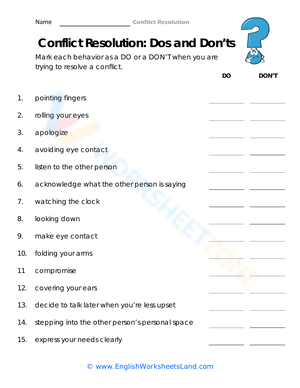
Each worksheet isolates one competency rather than surveying the topic broadly. The set works through the five recognized conflict styles — accommodating, avoiding, collaborating, competing, compromising — and asks students to trace their own default pattern through a recent real disagreement. A separate active listening worksheet uses structured listening logs: students must paraphrase the speaker's main point before they're permitted to write a response, which directly addresses the most common breakdown point in peer disputes. The assertive communication worksheet has students rewrite blame-framed statements into first-person owned ones, comparing how each version lands; "I feel dismissed when my idea is cut off" reads differently than "You never let me finish," and students are often surprised by how frequently their first rewrite still carries embedded blame.
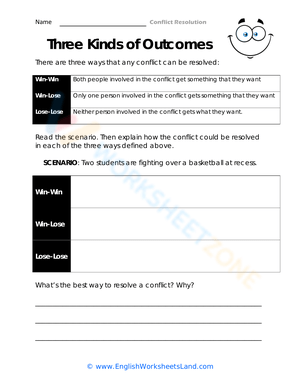
Scenario-based worksheets present senior-year dilemmas with enough specificity to feel real — a group member who disappears two days before a project deadline, a college recommendation conversation that goes sideways, a housing assignment dispute that starts before move-in day. Students map two or three response options before committing to one, giving them a rehearsal structure that carries into actual behavior. The final worksheet in the set is a reflective self-assessment: students name one current situation in their own lives where a different approach could change the outcome.
The Error Patterns That Keep Appearing in Senior Work
The most consistent error is conflating assertiveness with aggression. Students who correctly identify passive-aggressive behavior in a scenario still mark their own communication as assertive when a peer would call it hostile. This surfaces directly in the "I" statement exercise: students produce something like "I feel like you never care about this project" — still a critique, just framed with "I feel." That construction needs direct teacher attention because most students are genuinely surprised it reads as a blame statement.
A second pattern: students who default to the avoiding style mark it as appropriate in nearly every scenario once the worksheet gives them language for it. Avoidance is sometimes the correct call, but seniors need to distinguish between strategic de-escalation and chronic avoidance that lets resentment compound. Naming that distinction aloud — before students work through the scenario worksheets, not after — reduces the confusion significantly.
Practical Entry Points for Using This Set in Class
The most efficient entry point is a Monday advisory warm-up: five to eight minutes, one worksheet, no formal grade. That low-pressure format gets seniors engaging with the material without the resistance that surfaces when social-emotional content feels evaluated. Conflict style identification works best in this slot because it generates natural discussion without requiring personal disclosure.
The conflict resolution for youth worksheets printable for 12th grade that focus on de-escalation planning pair especially well with role-play: assign the written scenario analysis first, then run the live version in class, where a partner's unexpected reaction forces real-time adjustment. The gap between what students planned to say on paper and what they actually say in the room is itself a teaching moment worth pausing on. High school seniors respond to authenticity — teachers who acknowledge that conflict arises in their own professional lives remove the stigma that makes students dismiss this content as abstract.
Standard Alignment
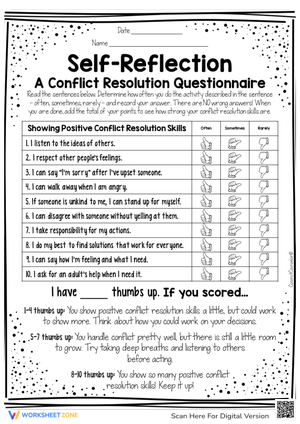
These worksheets align with CASEL's core SEL competencies, specifically Self-Awareness and Relationship Skills. In classroom terms, Self-Awareness maps to the conflict style identification and emotional trigger worksheets — students articulate their own patterns before practicing alternatives. Relationship Skills maps to the active listening and assertive communication exercises, where the measurable outcome is a student who completes the paraphrase step before responding rather than just being told to listen better. Schools operating under PBIS frameworks can slot these worksheets into Tier 1 universal instruction for seniors, particularly in advisory or senior seminar courses. CASEL's research reports that students in structured SEL programs show an average 11-percentile-point gain in academic achievement, which makes a practical case for administrators who question why senior instructional time should include this work.
Adjusting the Work for Students at Both Ends of the Room
For students who already demonstrate strong self-awareness, the scenario worksheets become more demanding when you require them to argue for two different response strategies — and identify the specific tradeoffs of each — before committing to one. That constraint pushes students past the first defensible answer and into the messier territory where actual judgment lives.
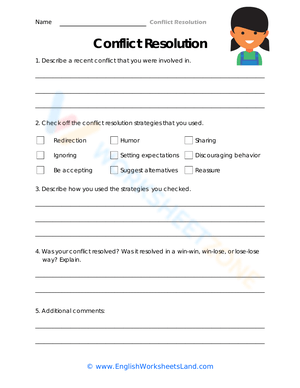
These conflict resolution for youth worksheets printable for 12th grade adapt well for students who find personal disclosure in writing risky. Instead of "describe a conflict you had recently," reframe the prompt as "describe a conflict a character in a film or book faced." The analytical skill is identical; the exposure is different. Once students demonstrate comfort with the third-person frame, the shift to first-person reflection is considerably less threatening. For students with IEPs or 504 accommodations that limit extended writing, the scenario-analysis prompts work as verbal discussion starters rather than written-response tasks.
Frequently Asked Questions
Do these worksheets belong only in advisory, or can subject-area teachers use them?
English and social studies teachers find the most natural fit — the scenario worksheets connect directly to argument analysis, and the "I" statement rewriting exercise pairs well with persuasive writing units. Science and math teachers have also used the conflict style worksheet effectively at the start of collaborative projects. Facilitating these materials does not require a counseling background.
How do I handle a student who uses a worksheet to process a live dispute with a classmate sitting in the same room?
The scenario worksheets use fictional dilemmas precisely to reduce that risk, but it can still happen. If a student's written response is clearly directed at a specific peer, redirect them to a private conversation with you rather than any form of peer sharing. The de-escalation worksheet in particular should be assigned individually and debriefed as a class — not exchanged between students who are currently in conflict with each other.
My seniors dismiss SEL content as elementary. How do I address that resistance?
Reframe the content around professional contexts seniors are already thinking about: college roommate dynamics, workplace communication, negotiating job offers. These conflict resolution for youth worksheets printable for 12th grade land differently when the scenarios sound like next-year problems rather than this-year cafeteria situations. The conflict styles self-assessment, specifically, tends to hook skeptical seniors because it reads more like a professional diagnostic than an emotions exercise.
Clear All