


























Views
Downloads
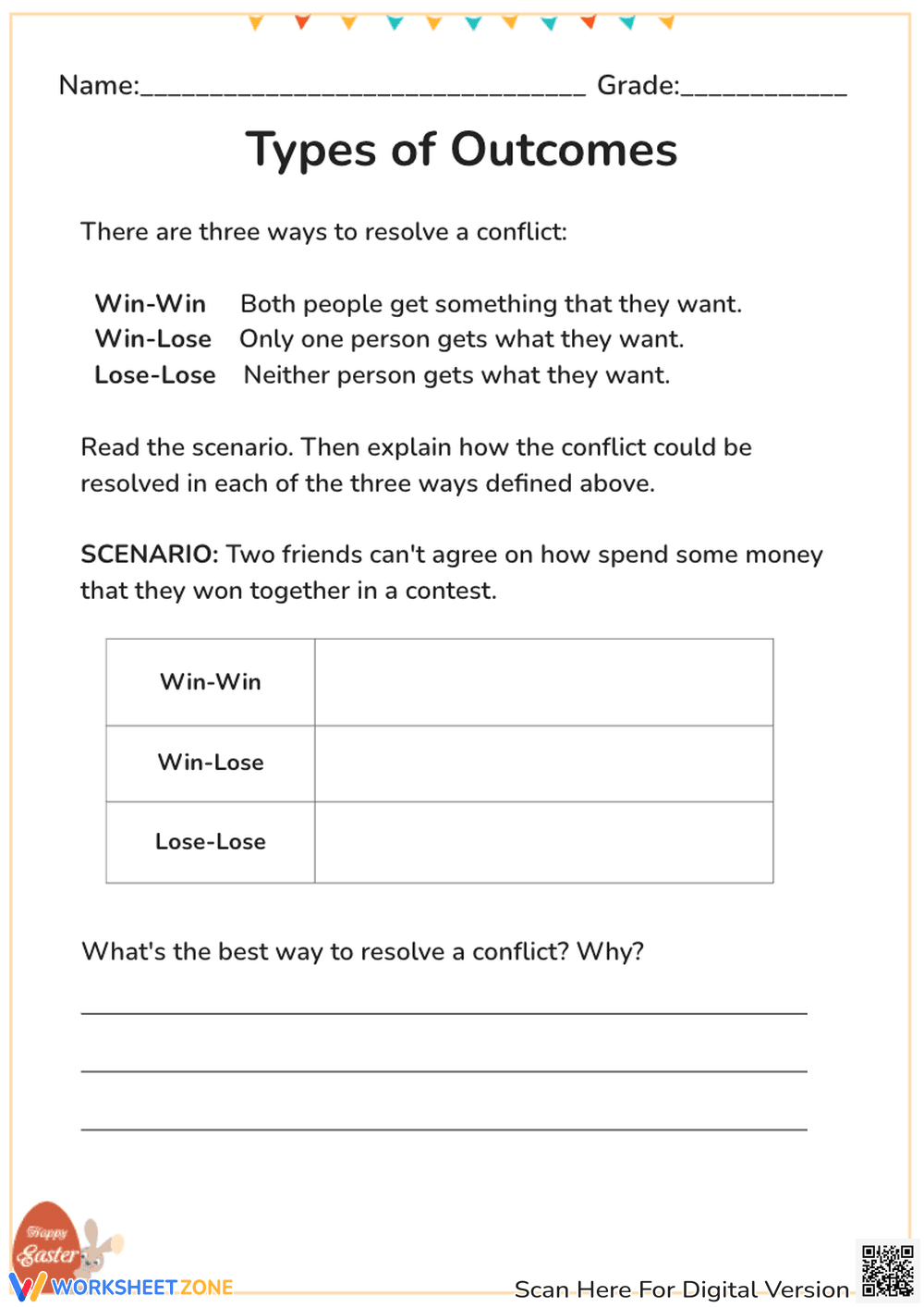

Conflict Resolution Outcomes — Printable Grade 10-12 Sheet
Paste this activity's link or code into your existing LMS (Google Classroom, Canvas, Teams, Schoology, Moodle, etc.).
Students can open and work on the activity right away, with no student login required.
You'll still be able to track student progress and results from your teacher account.
Conflict resolution is a vital life skill for secondary students. This worksheet helps students analyze Win-Win, Win-Lose, and Lose-Lose outcomes through a realistic scenario. Students learn to evaluate the consequences of different negotiation styles to achieve better interpersonal results in social, academic, and future professional settings.
At a Glance
- Grade: 10-12 · Subject: Behavior Worksheets
- Standard:
CCSS.ELA-LITERACY.SL.11-12.1— Resolve contradictions and synthesize comments to reach a consensus or resolution- Skill Focus: Conflict Outcome Analysis
- Format: 1 page · 4 problems · Answer key included · PDF
- Best For: High school SEL or advisory periods
- Time: 15–20 minutes
What's Inside
This single-page PDF features clear definitions of the three primary conflict outcomes: Win-Win, Win-Lose, and Lose-Lose. It includes a practical scenario involving a financial dispute between friends, a structured table for applying each resolution type, and a critical thinking reflection prompt. The layout is clean and distraction-free, specifically designed for the maturity level of older learners in high school.
Zero-Prep Workflow
- Print: Select the single-page PDF and print enough copies for your group (30 seconds).
- Distribute: Hand out to students for independent reflection or paired brainstorming (1 minute).
- Review: Use the reflection question to lead a whole-class discussion on the benefits of Win-Win strategies (5-10 minutes).
Total teacher preparation time is under 2 minutes, making this an ideal resource for sub-plans, bell-ringers, or unexpected advisory sessions.
Standards Alignment
The primary standard CCSS.ELA-LITERACY.SL.11-12.1 requires students to respond thoughtfully to diverse perspectives and resolve contradictions. This worksheet provides the necessary framework for identifying those contradictions and finding paths toward consensus. Both standard codes can be copied directly into lesson plans, IEP goals, or district curriculum mapping tools.
How to Use It
Use this worksheet during a unit on communication or as a reactive intervention after a classroom disagreement. It works best after a brief direct instruction on negotiation styles. Formative assessment tip: Observe if students can articulate why a Win-Win is often harder to achieve than a Win-Lose outcome. Expected completion time ranges from 15 to 20 minutes depending on the depth of the reflection.
Who It's For
Designed for high school students in Grades 10, 11, and 12, this resource is particularly effective for students in social-emotional learning (SEL) programs or those working on specific behavioral goals. It pairs naturally with a classroom anchor chart on active listening or a video case study on mediation and professional diplomacy.
Conflict resolution education in secondary schools is supported by research from Fisher & Frey (2014), which emphasizes the importance of structured scaffolds for collaborative talk. By explicitly defining outcomes like Win-Win and Lose-Lose, students move beyond intuitive reactions toward intentional social strategies. This worksheet aligns with CCSS.ELA-LITERACY.SL.11-12.1, focusing on the plain-English skill of resolving contradictions and synthesizing perspectives to reach a resolution. According to the RAND AIRS 2024 report, explicit SEL instruction in high school improves long-term career readiness and interpersonal stability. This resource provides 4 specific tasks that bridge the gap between theoretical conflict models and practical application. Educators can use this tool to document student progress toward behavioral benchmarks or communication standards in a measurable, evidence-based format. This structured approach ensures that students develop the necessary cognitive flexibility to handle complex social interactions effectively throughout their academic and professional lives.


