


























0
Views
0
Downloads

0.0
0
Save
0 Likes
Share
Effective Communication Skills Worksheet
0 Views
0 Downloads
Paste this activity's link or code into your existing LMS (Google Classroom, Canvas, Teams, Schoology, Moodle, etc.).
Students can open and work on the activity right away, with no student login required.
You'll still be able to track student progress and results from your teacher account.
Information
Description
What It Is:
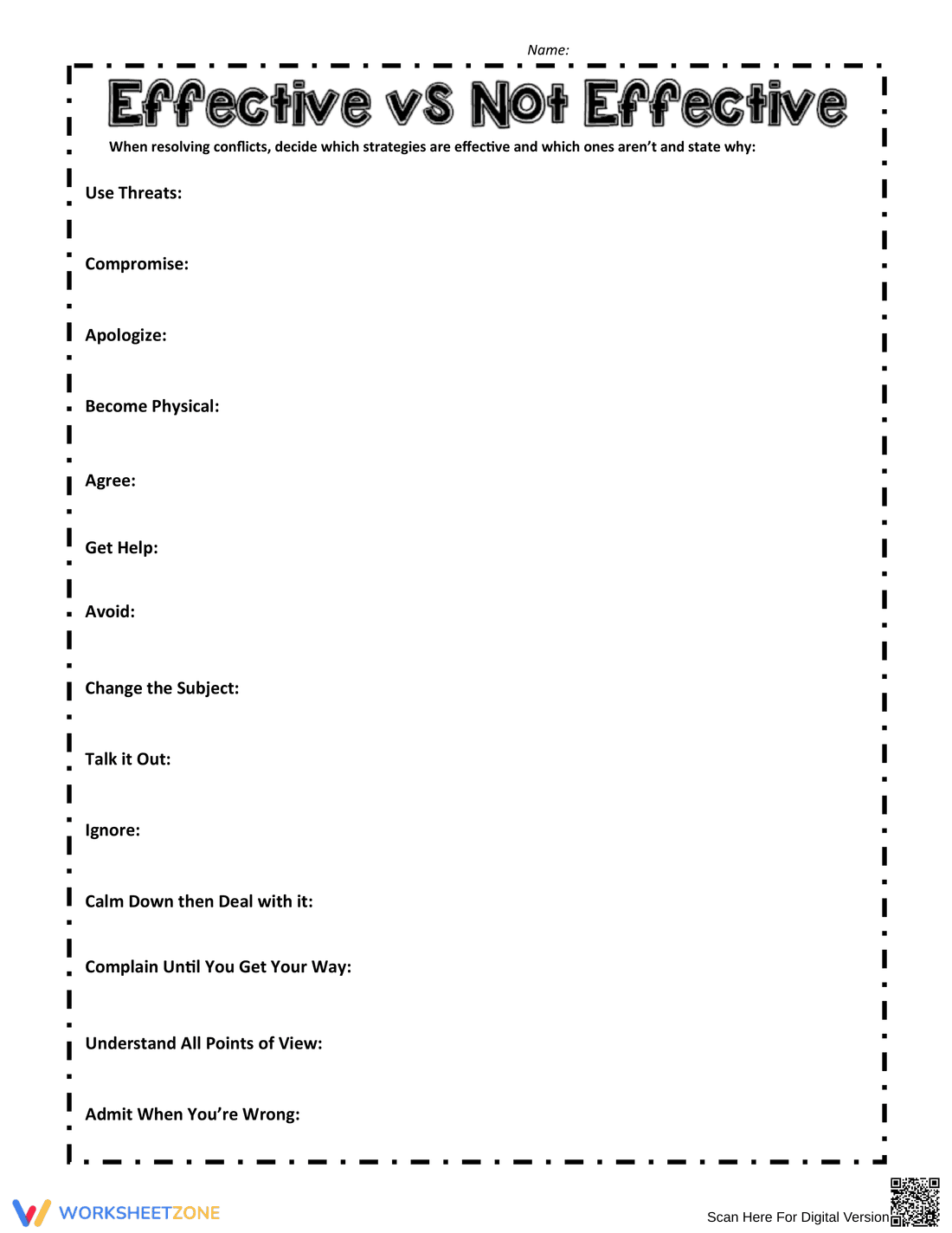
This is a worksheet titled 'Effective vs Not Effective.' It presents a list of conflict resolution strategies such as 'Use Threats,' 'Compromise,' 'Apologize,' 'Become Physical,' 'Agree,' 'Get Help,' 'Avoid,' 'Change the Subject,' 'Talk It Out,' 'Ignore,' 'Calm Down then Deal with it,' 'Complain Until You Get Your Way,' 'Understand All Points of View,' and 'Admit When You're Wrong.' The worksheet instructs the student to decide which strategies are effective and which are not, and to state why.
Grade Level Suitability:
This worksheet is suitable for grades 3-6. The vocabulary is accessible, and the concepts of effective and ineffective conflict resolution are appropriate for this age range. The worksheet encourages critical thinking about social interactions.
Why Use It:
This worksheet helps students develop critical thinking skills regarding conflict resolution. It encourages them to analyze different strategies and determine their effectiveness. It promotes social-emotional learning by helping students understand the consequences of different actions in conflict situations.
How to Use It:
Students should read each conflict resolution strategy and decide whether it is effective or not. Then, they should write a brief explanation of why they believe the strategy is effective or ineffective in the space provided. The worksheet can be used individually, in small groups, or as a class discussion starter.
Target Users:
This worksheet is targeted towards elementary and middle school students learning about conflict resolution, social skills, and emotional intelligence. It's useful for teachers, counselors, and parents who want to help children develop healthy ways to manage disagreements.
This is a worksheet titled 'Effective vs Not Effective.' It presents a list of conflict resolution strategies such as 'Use Threats,' 'Compromise,' 'Apologize,' 'Become Physical,' 'Agree,' 'Get Help,' 'Avoid,' 'Change the Subject,' 'Talk It Out,' 'Ignore,' 'Calm Down then Deal with it,' 'Complain Until You Get Your Way,' 'Understand All Points of View,' and 'Admit When You're Wrong.' The worksheet instructs the student to decide which strategies are effective and which are not, and to state why.
Grade Level Suitability:
This worksheet is suitable for grades 3-6. The vocabulary is accessible, and the concepts of effective and ineffective conflict resolution are appropriate for this age range. The worksheet encourages critical thinking about social interactions.
Why Use It:
This worksheet helps students develop critical thinking skills regarding conflict resolution. It encourages them to analyze different strategies and determine their effectiveness. It promotes social-emotional learning by helping students understand the consequences of different actions in conflict situations.
How to Use It:
Students should read each conflict resolution strategy and decide whether it is effective or not. Then, they should write a brief explanation of why they believe the strategy is effective or ineffective in the space provided. The worksheet can be used individually, in small groups, or as a class discussion starter.
Target Users:
This worksheet is targeted towards elementary and middle school students learning about conflict resolution, social skills, and emotional intelligence. It's useful for teachers, counselors, and parents who want to help children develop healthy ways to manage disagreements.


