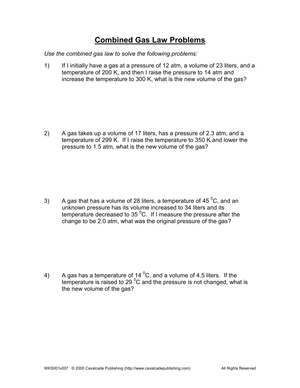
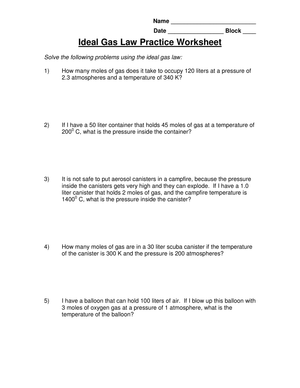
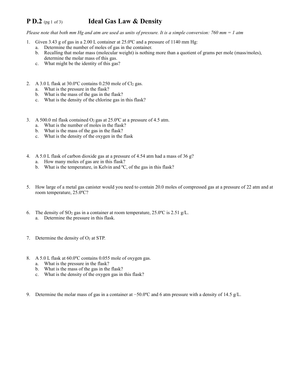
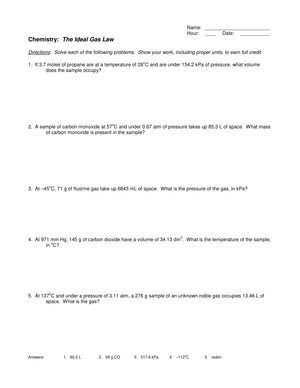
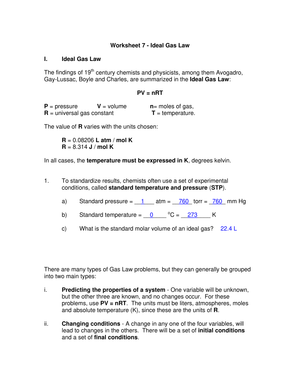
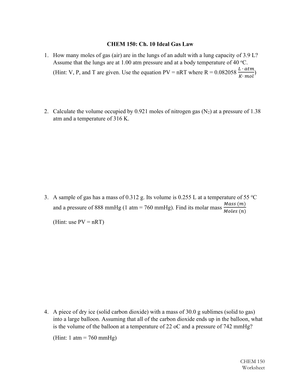
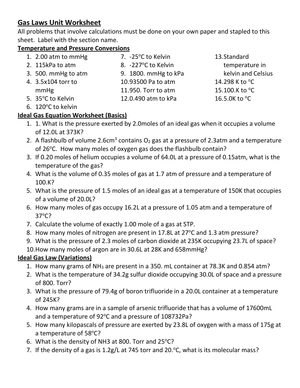
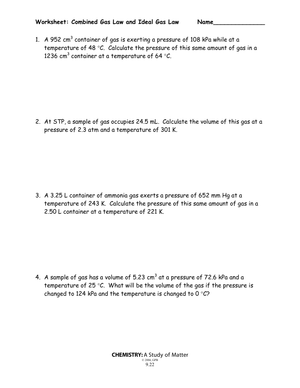
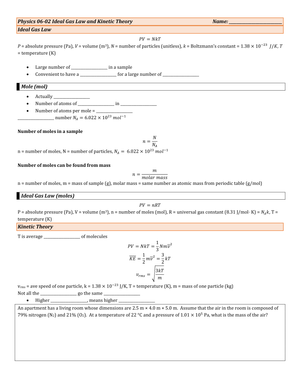
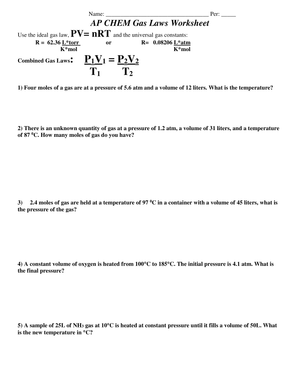
These ideal gas law printable worksheets for 11th grade give students the repeated algebraic practice they need to move from recognizing PV=nRT to applying it with precision — across problem contexts that connect the formula to something physically real. Each worksheet treats the equation as a working tool: students manipulate it to find the pressure inside a compressed gas cylinder, determine the temperature of a cooling sample, or calculate how many moles of gas occupy a given volume at known conditions. The set spans entry-level variable isolation through multi-step problems where unit conversion must happen before any algebra begins.
What the Worksheets Ask Students to Do
The central task across the set is algebraic rearrangement. Given three of the four unknowns — pressure, volume, moles, and temperature — along with the appropriate value of R, students isolate the remaining variable. That sounds simple until P and V trade places in a problem and students suddenly divide where they should multiply. Each worksheet reinforces a deliberate setup procedure: write every known value with its unit, identify the target variable, select the correct form of R, then proceed with the algebra.
The specific skills built across the worksheets include:
- Celsius-to-Kelvin conversion: required in every problem, so the habit forms through repetition rather than a reminder printed at the top
- Selecting the correct R value: problems mix atmospheres and kilopascals, requiring students to choose between 0.0821 L·atm/(mol·K) and 8.314 J/(mol·K) rather than defaulting to one
- Pressure unit conversion: translating between atm, kPa, and mmHg before setting up the equation
- Identifying real vs. ideal behavior: later worksheets ask students to predict which conditions — high pressure, very low temperature — cause gas behavior to deviate meaningfully from the ideal model
- Density and molar mass extensions: advanced worksheets require students to rewrite PV=nRT in terms of mass and molar mass before solving, adding algebraic complexity beyond the core equation
Student Errors Worth Anticipating Before You Assign These
The Celsius-to-Kelvin failure is the most persistent mistake in gas law work, and what makes it hard to catch is that the resulting answer can look plausible. A student given a temperature of 25°C who writes T = 25 into the formula will calculate a volume roughly 12 times smaller than the correct answer — because 298 K divided by 25 gives approximately that ratio. Since gas volumes can span many orders of magnitude depending on conditions, students who skip the reasonableness check accept the number. Building a "units written next to every value" requirement into the setup row of each worksheet helps students catch this before they run the algebra.
The R value mismatch is the second major trap, and it's particularly subtle because the formula still runs — it just produces a wildly incorrect result. Most students encounter 8.314 J/(mol·K) in chemistry and carry it into problems where pressure is in atmospheres. A clean diagnostic: ask whether one mole of gas at STP produces a volume near 22.4 liters. If a student gets 271 liters or 0.27 liters instead, the R mismatch is almost certainly the culprit.
A third pattern that shows up repeatedly: students who correctly rearrange PV=nRT to find n will write n = PV/RT but then misapply the denominator — dividing PV by R first and then dividing that result by T separately, rather than treating RT as a single product. The order-of-operations discipline required here is the same work students need across thermodynamics, and the worksheets give it enough repetition that the habit eventually becomes reliable.
Fitting These Worksheets Into a Unit Sequence That Actually Works
The most effective approach is to treat unit conversion as a separate lesson before students see a full PV=nRT problem. Run one worksheet focused entirely on Celsius-to-Kelvin and kPa-to-atm conversions — roughly 15 minutes of standalone practice. When the algebraic manipulation worksheet arrives the next day, students have one fewer variable to manage mentally, which makes a measurable difference in how cleanly they handle the setup.
These ideal gas law printable worksheets for 11th grade also function well as formative checks during class work periods. Rather than collecting complete problem sets, collect after 10 minutes and look only at the setup rows: are units written next to each value? Was the temperature converted before substitution? Catching setup errors at that stage prevents students from practicing the wrong procedure through the rest of the period.
For review sessions closer to assessment, a partner verification structure works efficiently: one student solves for volume, the partner solves for pressure using that answer as a given, and they check whether the original starting values are recovered. The whole cycle takes about 12 minutes and surfaces arithmetic errors without requiring the teacher to grade anything.
Standard Alignment
The variable-isolation work central to these worksheets aligns directly with CCSS.MATH.CONTENT.HSA-CED.A.4, which asks students to rearrange formulas to highlight a quantity of interest — the mathematical operation students perform every time they isolate a variable in PV=nRT. This gives science and math departments a shared standard to cite when coordinating curriculum. On the science content side, the material connects to the NGSS disciplinary core idea PS3.A (Definitions of Energy), specifically the relationship between temperature and average molecular kinetic energy that underlies the kinetic molecular theory framework. In most 11th grade sequences, the Ideal Gas Law arrives after Boyle's, Charles's, and Gay-Lussac's laws have established the individual variable relationships; these worksheets treat PV=nRT as a unified model and don't revisit the component laws.
Adapting the Worksheets for a Mixed-Readiness Class
Students who struggle with algebraic manipulation need the rearrangement practice isolated before units enter the picture. Assign worksheets that work with variables only — "solve PV=nRT for T, leave in symbolic form" — so students concentrate on the logic of isolating a variable without decimal arithmetic or unit decisions competing for attention. Once that foundation holds, reintroduce numerical problems with consistent units, then add the unit conversion layer as a third stage.
Advanced students are ready for density-form problems — rearranging PV=nRT to express density as PM divided by RT — and for Dalton's Law extensions where students calculate partial pressures in a gas mixture. These worksheets include those as later entries in the set, so teachers can assign them selectively without hunting for separate materials. One honest limitation worth naming: students who rely heavily on formula references struggle when a worksheet presents a variable arrangement they haven't seen before, such as "n is provided as grams of nitrogen, not moles." Those students need a brief verbal walkthrough of the setup before working independently, not simply more time with the worksheet.
Frequently Asked Questions
Which value of R do students use?
The choice depends entirely on the pressure units in the problem. Pressure in atmospheres requires R = 0.0821 L·atm/(mol·K). Pressure in kilopascals requires R = 8.314 J/(mol·K). The ideal gas law printable worksheets for 11th grade in this set deliberately mix both unit systems, so students cannot default to a single value — they have to read the given units for every problem and make an active selection each time.
Why does temperature have to be in Kelvin?
The Ideal Gas Law derives from kinetic molecular theory, which treats temperature as a measure of average molecular kinetic energy. That energy relationship only holds on a scale anchored at absolute zero — the point where molecular motion theoretically stops. The Celsius scale puts its zero at the freezing point of water, a physically arbitrary reference that carries no thermodynamic significance. Substituting 0°C directly into PV=nRT collapses the calculated volume or pressure to zero, which is physically impossible. Adding 273.15 to any Celsius value gives the Kelvin temperature the formula actually requires.
What is STP and why do so many problems reference it?
Standard Temperature and Pressure is defined as 273.15 K and 1 atm (101.325 kPa). At those conditions, one mole of any ideal gas occupies exactly 22.4 liters — a number students can use to check whether an answer is physically reasonable before moving on. STP problems appear frequently on state assessments and AP Chemistry exams, so consistent practice through these ideal gas law printable worksheets for 11th grade reinforces exactly the calculation format students encounter in high-stakes testing contexts.
Can PV=nRT be used for mixtures of gases?
Yes, with one clarification: in a mixture, n represents the total moles of all gases combined, and P is the total pressure. For partial pressures — the contribution of each individual gas component — students apply Dalton's Law, where each partial pressure equals that component's mole fraction multiplied by the total pressure. The extension worksheets in this set introduce Dalton's Law problems, and teachers can include or skip them depending on where the class is in the curriculum sequence.












 Interactive Worksheet Maker
 Quiz Maker
 Word Search Maker
 Crossword Puzzle Maker
 Word Scramble Generator
 Sentence Scramble Generator
 Handwriting Worksheet Generator
 Name Tracing Generator
 Fill In The Blank Generator