


























1 / 4
0
Views
0
Downloads

Save
0 Likes
Share
Updated Ideal Gas Law Worksheet: Practice Problems
0 Views
0 Downloads
Paste this activity's link or code into your existing LMS (Google Classroom, Canvas, Teams, Schoology, Moodle, etc.).
Students can open and work on the activity right away, with no student login required.
You'll still be able to track student progress and results from your teacher account.
Information
Description
What It Is:
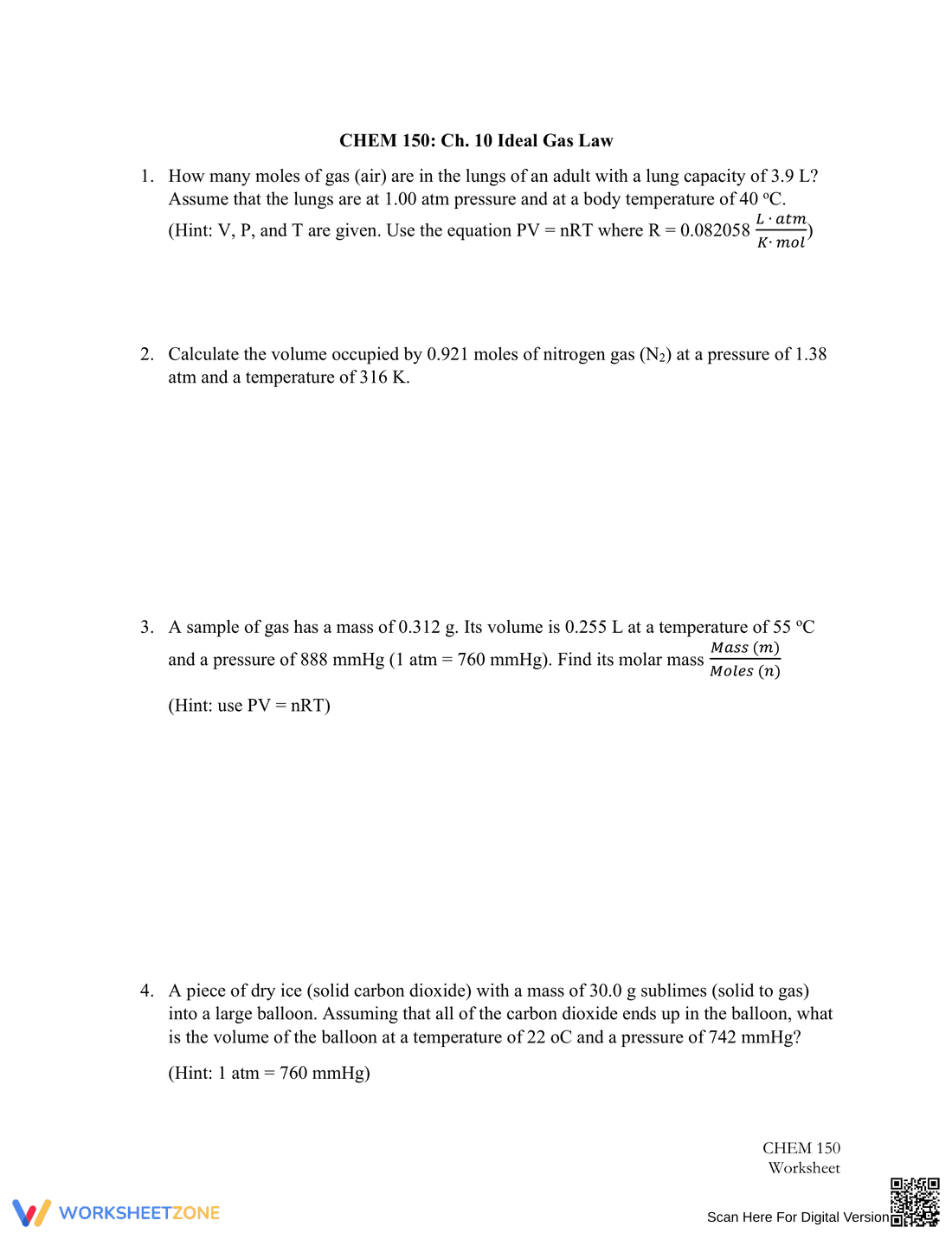
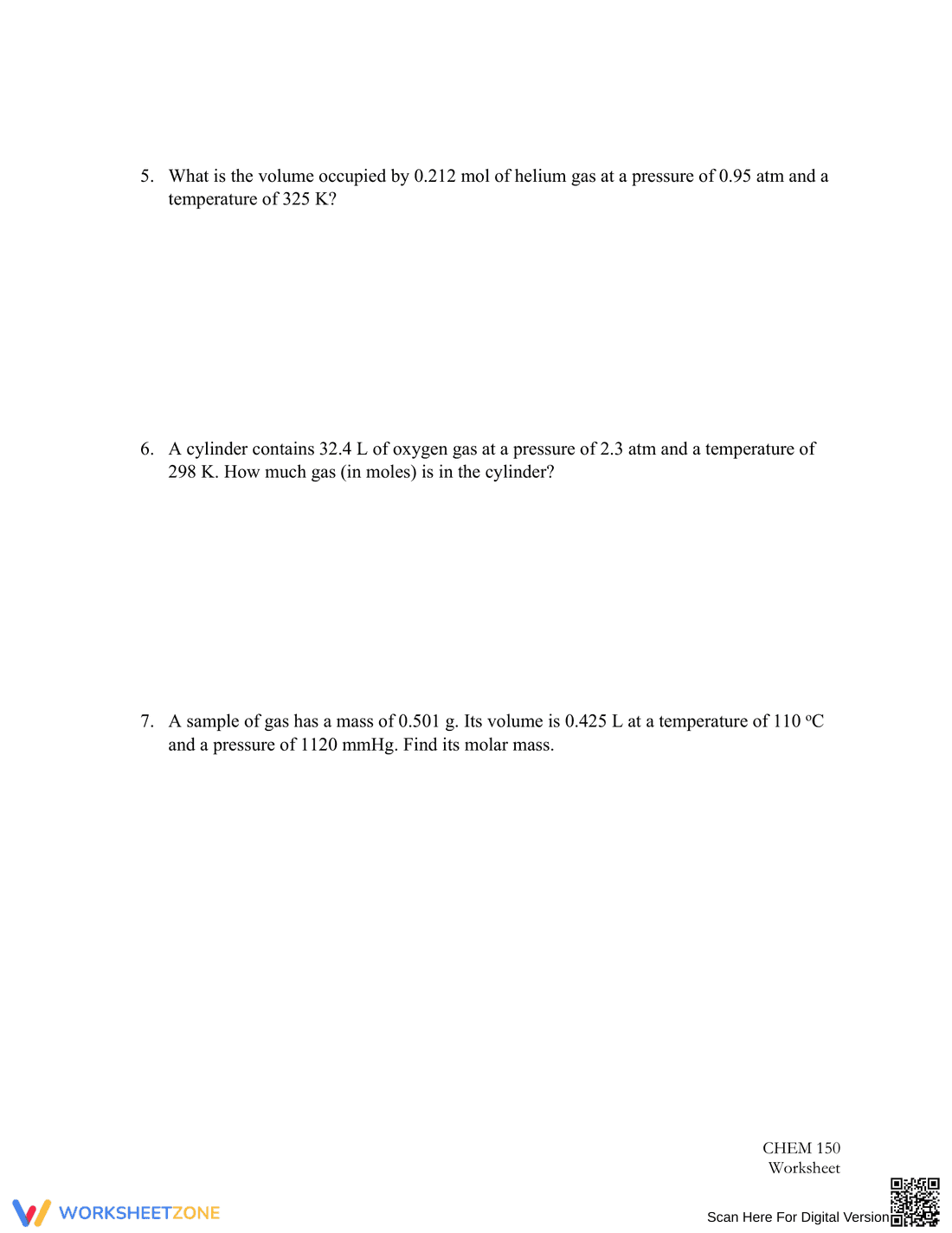
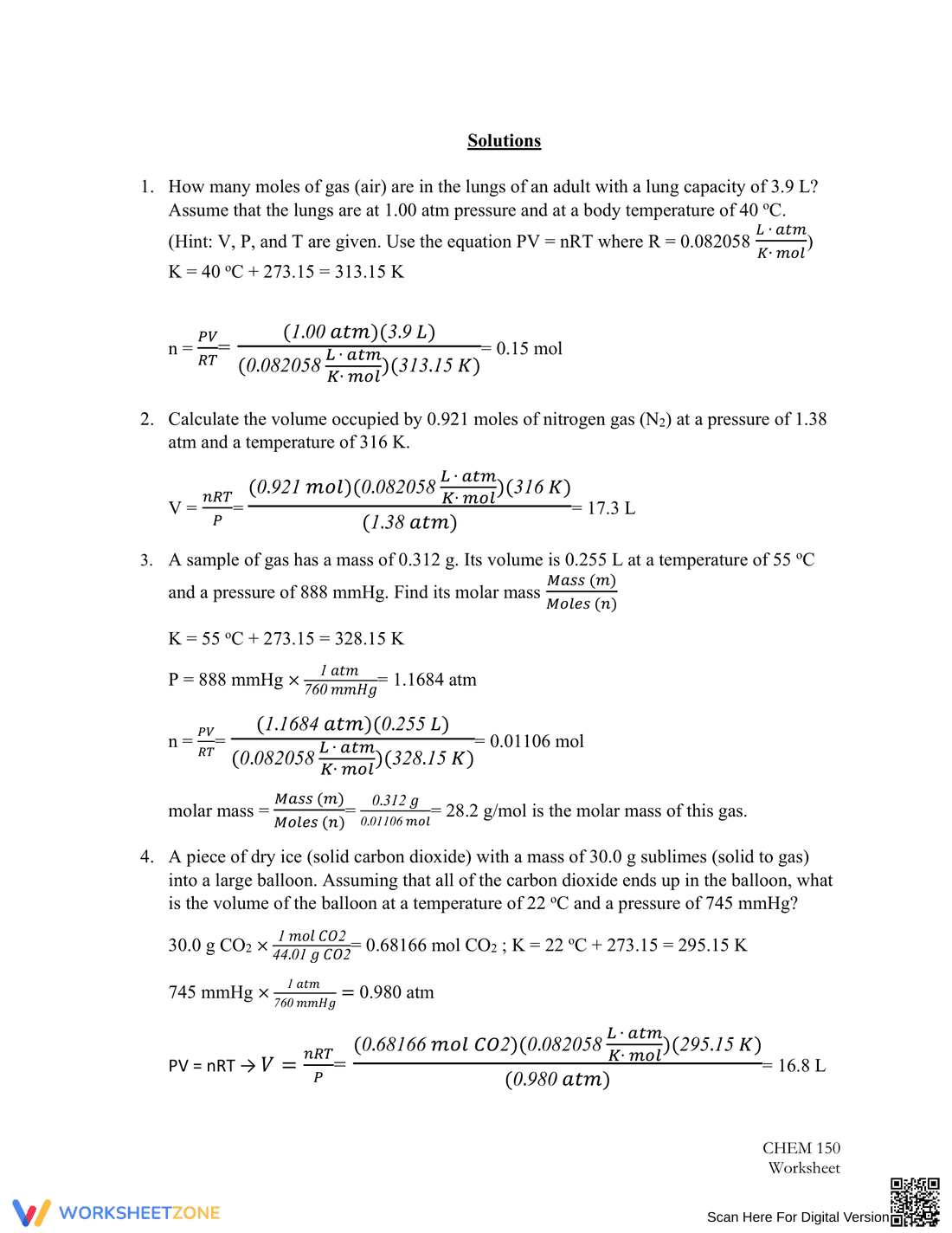
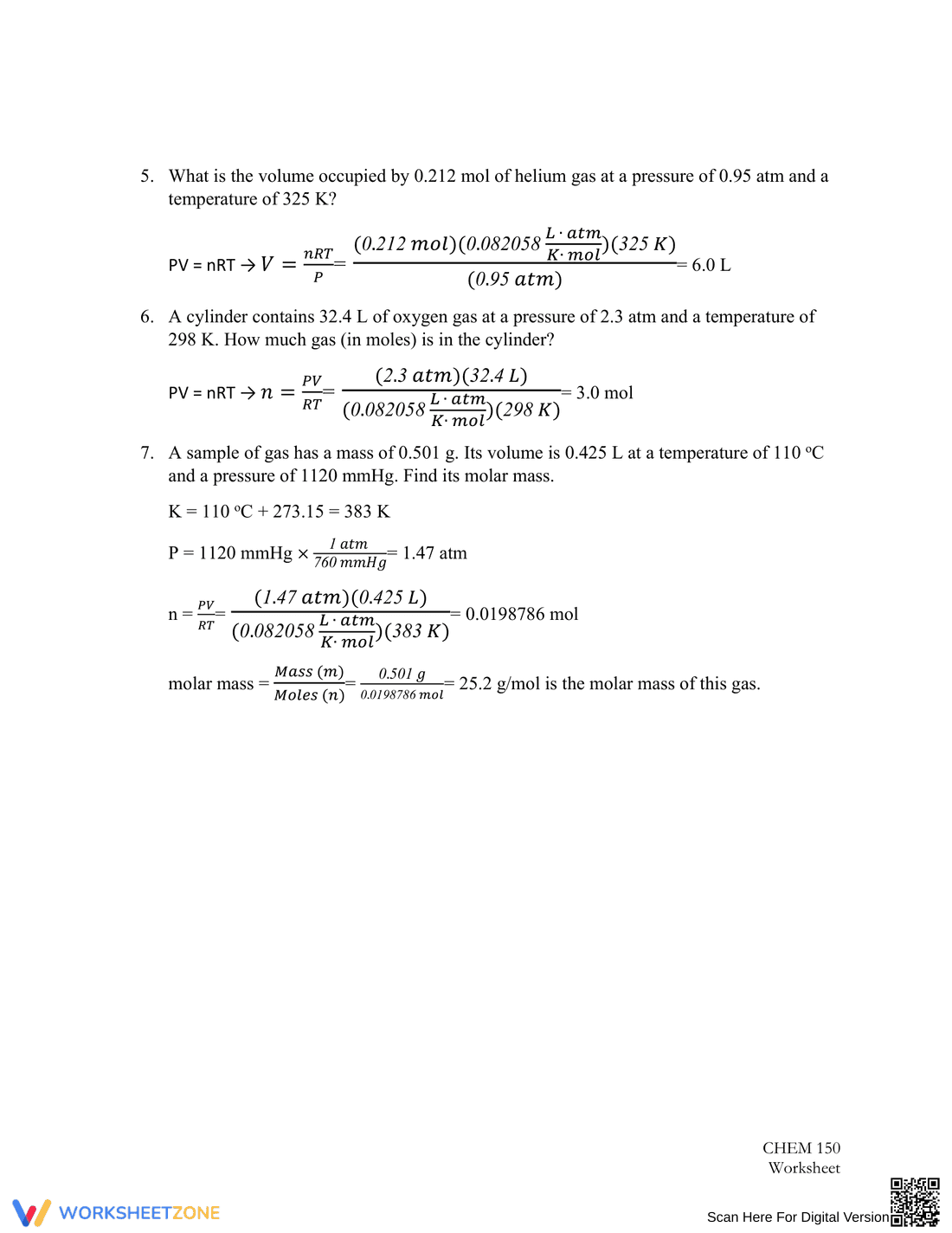
This is a chemistry worksheet focusing on the Ideal Gas Law. It presents four quantitative problems requiring students to apply the formula PV=nRT to calculate moles of gas, volume, and molar mass. The problems involve scenarios like calculating the moles of air in lungs, the volume occupied by nitrogen gas, finding the molar mass of a gas, and determining the volume of a balloon filled with sublimed dry ice. Hints are provided, such as indicating which variables are given and suggesting the use of PV=nRT. Conversions between mmHg and atm are also required.
Grade Level Suitability:
This worksheet is suitable for high school (Grades 11-12) and introductory college-level chemistry courses. It requires a solid understanding of algebraic manipulation and the Ideal Gas Law, making it appropriate for students who have already been introduced to these concepts.
Why Use It:
This worksheet provides practice in applying the Ideal Gas Law to solve quantitative problems. It reinforces the relationship between pressure, volume, temperature, and the number of moles of a gas. The problems are presented in real-world contexts, such as lungs and balloons, which can help students connect the concepts to everyday phenomena.
How to Use It:
Students should use the worksheet to solve the problems independently. They should first identify the known variables and the unknown variable they need to calculate. They should then apply the Ideal Gas Law (PV=nRT), making sure to use consistent units. Hints provided in the worksheet can guide them. Students may need to convert between units like mmHg and atm.
Target Users:
The target users are high school chemistry students, introductory college chemistry students, and anyone studying the Ideal Gas Law. It's suitable for students who need practice applying the formula to solve quantitative problems.
This is a chemistry worksheet focusing on the Ideal Gas Law. It presents four quantitative problems requiring students to apply the formula PV=nRT to calculate moles of gas, volume, and molar mass. The problems involve scenarios like calculating the moles of air in lungs, the volume occupied by nitrogen gas, finding the molar mass of a gas, and determining the volume of a balloon filled with sublimed dry ice. Hints are provided, such as indicating which variables are given and suggesting the use of PV=nRT. Conversions between mmHg and atm are also required.
Grade Level Suitability:
This worksheet is suitable for high school (Grades 11-12) and introductory college-level chemistry courses. It requires a solid understanding of algebraic manipulation and the Ideal Gas Law, making it appropriate for students who have already been introduced to these concepts.
Why Use It:
This worksheet provides practice in applying the Ideal Gas Law to solve quantitative problems. It reinforces the relationship between pressure, volume, temperature, and the number of moles of a gas. The problems are presented in real-world contexts, such as lungs and balloons, which can help students connect the concepts to everyday phenomena.
How to Use It:
Students should use the worksheet to solve the problems independently. They should first identify the known variables and the unknown variable they need to calculate. They should then apply the Ideal Gas Law (PV=nRT), making sure to use consistent units. Hints provided in the worksheet can guide them. Students may need to convert between units like mmHg and atm.
Target Users:
The target users are high school chemistry students, introductory college chemistry students, and anyone studying the Ideal Gas Law. It's suitable for students who need practice applying the formula to solve quantitative problems.


