


























Views
Downloads

Ideal Gas Law Worksheet | Essential Grade 11 Physics
Paste this activity's link or code into your existing LMS (Google Classroom, Canvas, Teams, Schoology, Moodle, etc.).
Students can open and work on the activity right away, with no student login required.
You'll still be able to track student progress and results from your teacher account.
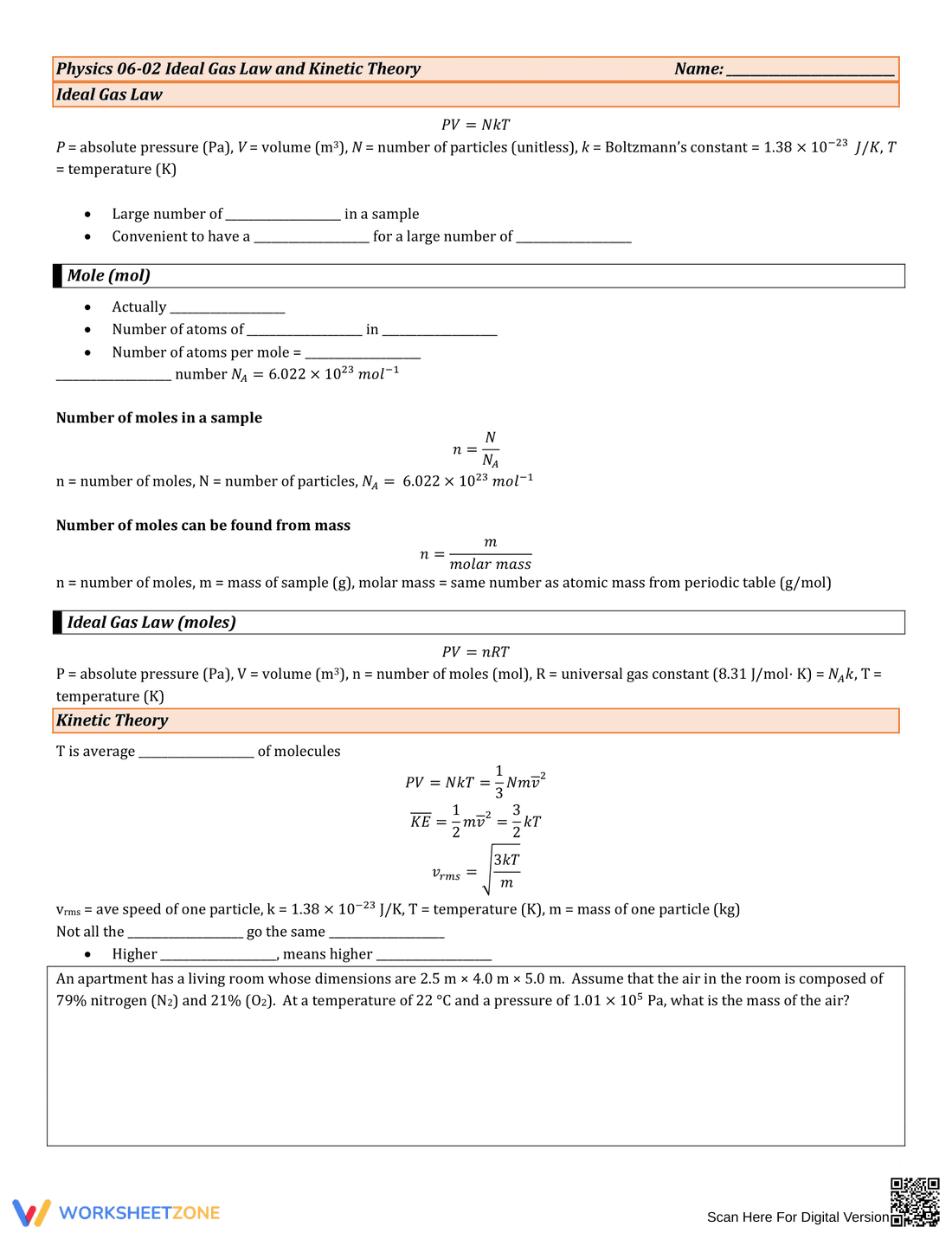
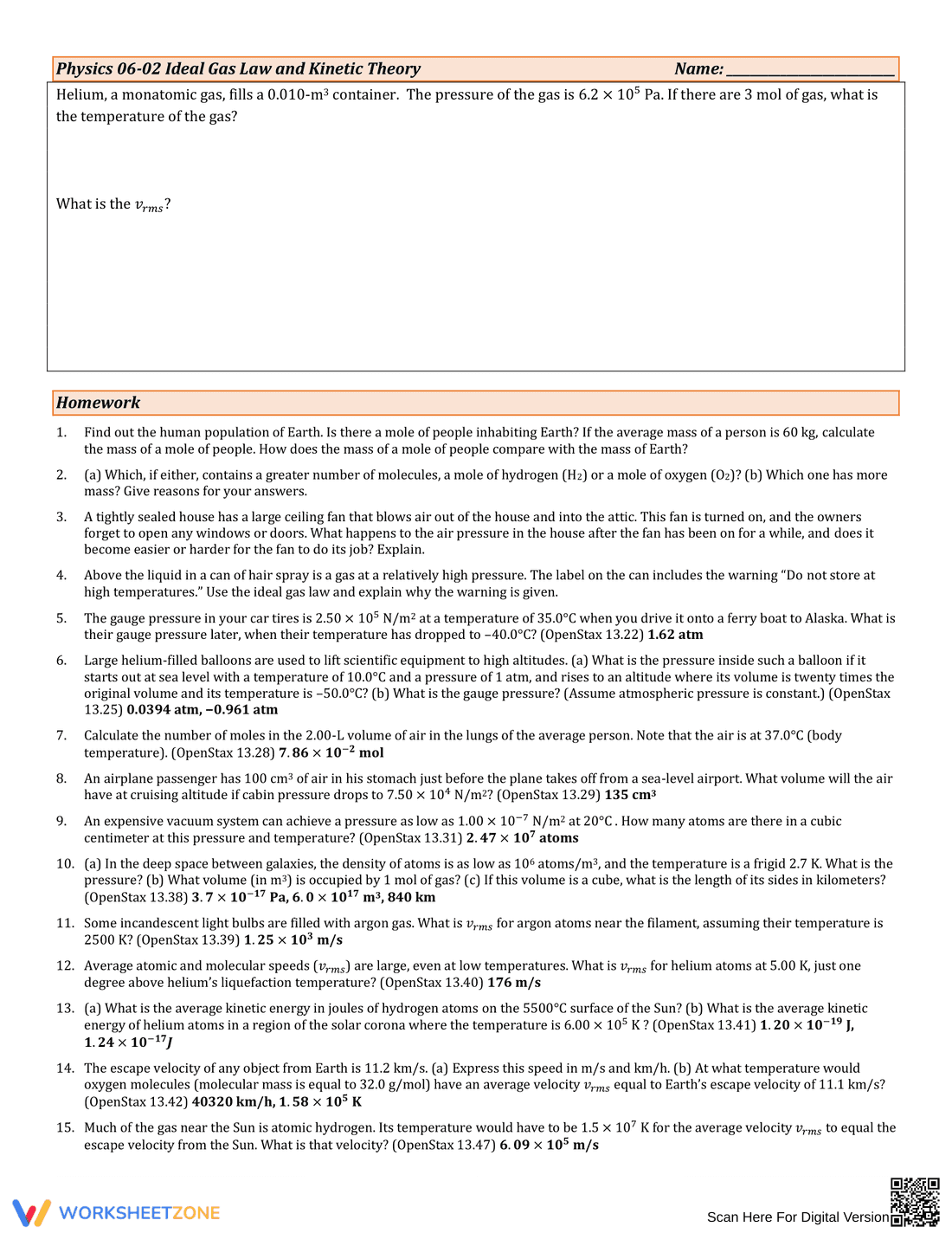
This comprehensive physics worksheet provides students with a structured framework to master the Ideal Gas Law and Kinetic Theory. By combining formula reference blocks with conceptual fill-in-the-blanks and 17 rigorous word problems, students develop the mathematical fluency required to predict gas behavior under varying conditions of pressure, volume, and temperature. The resource ensures students understand the relationship between microscopic particle motion and macroscopic observable properties.
At a Glance
- Grade: 10-12 · Subject: Physics
- Standard:
HS-PS3-2— Illustrate that energy at the macroscopic scale relates to particle motion- Skill Focus: Gas Law Calculations & Kinetic Theory
- Format: 2 pages · 27 problems · Answer key included · PDF
- Best For: Independent practice and homework
- Time: 45–60 minutes
The resource is organized into two distinct pages. The first page serves as a guided reference, featuring the Boltzmann constant, Avogadro’s number, and the universal gas constant. It includes scaffolded fill-in-the-blank sections to reinforce definitions of moles and kinetic energy. The second page transitions into a robust homework section containing 15 multi-part problems that challenge students to apply root-mean-square speed and the ideal gas equation to real-world scenarios, such as airplane cabin pressure and solar hydrogen speeds.
This worksheet is designed for a zero-prep classroom workflow. Teachers can print the double-sided PDF quickly, and the formula headers eliminate the need for students to search through textbooks. Reviewing the 27 tasks is streamlined by the included answer key, making it an ideal sub-plan for high school science because it provides all necessary constants and equations on the page.
Aligned to HS-PS3-2, this resource focuses on mathematical models of energy and particle motion. Students illustrate that macroscopic energy relates to the motion of particles. It also supports HS-PS1-7 by requiring calculations of moles and particles, making it easy to integrate into district curriculum mapping tools.
Use this worksheet as a summative assessment after a lecture on the Kinetic Molecular Theory. It works best during the independent practice phase of gradual release. For formative assessment, observe students during the first five homework problems; if they struggle with unit conversions, such as Celsius to Kelvin, provide a quick 2-minute refresher. Expect completion within a single 60-minute lab period or as an overnight assignment to reinforce classroom learning.
This material is tailored for Grade 10-12 Physics students, including those in Honors or AP tracks who need to solidify their foundational algebra-based gas laws. It pairs naturally with a PhET Gas Properties simulation or a direct instruction lesson on the derivation of the Ideal Gas Law. The inclusion of root-mean-square speed calculations makes it particularly useful for advanced learners preparing for college-level science courses.
The use of scaffolded guided notes combined with independent problem-solving is essential for developing technical literacy. This worksheet implements that approach by providing the HS-PS3-2 standard's required mathematical models alongside conceptual checks. By requiring students to manipulate variables for pressure, volume, and temperature, the resource ensures students move beyond rote memorization toward a functional understanding of kinetic theory. This structured approach reduces cognitive load during complex multi-step physics calculations, allowing students to focus on the relationships between variables. The worksheet serves as a standalone evidence-based tool for physics instruction.


