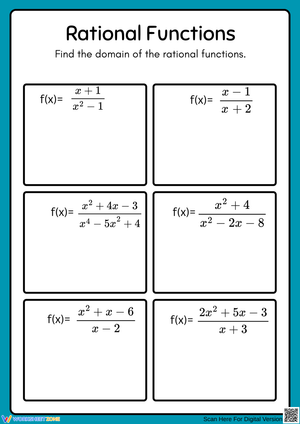
11th Grade Graphing Rational Functions Worksheets PDF
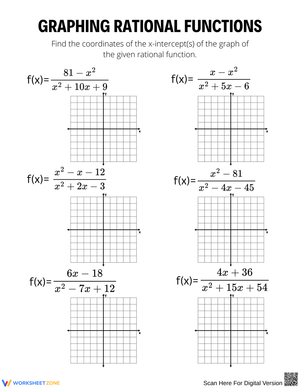
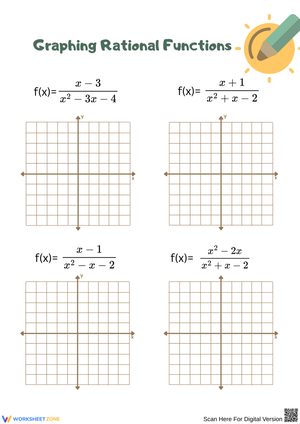
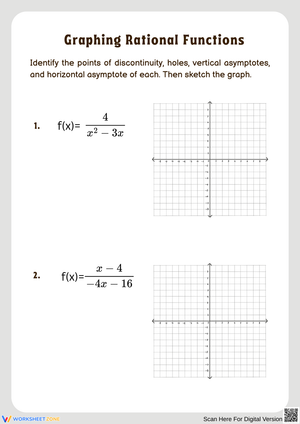
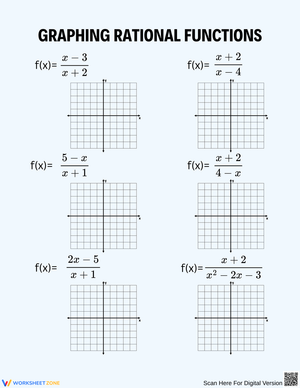
These 11th grade graphing rational functions worksheets pdf resources give precalculus teachers a structured sequence of targeted practice — from factoring rational expressions and identifying discontinuities to completing labeled sketches with accurate asymptote behavior. Each worksheet isolates a distinct phase of the graphing process so students build analytical skills layer by layer before synthesizing them into a full graph.
What Each Worksheet in the Set Targets
Rational function graphing draws on several algebraic skills simultaneously, and the set addresses each one directly. Students factor polynomial numerators and denominators, cancel shared factors to locate removable discontinuities, and apply degree-comparison rules to determine end behavior. The sequence moves from stripped-down expressions — one vertical asymptote, no holes, horizontal asymptote at y = 0 — toward functions where numerator and denominator share factors, degrees differ by exactly one, and an oblique asymptote requires polynomial long division to find.
The skills students work through across the set include:
- Stating the domain and identifying all x-values where the denominator equals zero
- Locating holes by canceling common factors, then substituting to find the y-coordinate of the open circle
- Applying all three cases of the horizontal asymptote rule based on degree comparison
- Using polynomial long division to find oblique asymptotes when the numerator's degree exceeds the denominator's degree by exactly one
- Building a sign chart to determine approach direction on each side of a vertical asymptote
- Plotting x- and y-intercepts and completing a labeled sketch on a coordinate grid
Frequent Student Errors That Reveal Themselves in This Work
The most persistent mistake teachers encounter when assigning 11th grade graphing rational functions worksheets pdf practice is students marking every zero of the denominator as a vertical asymptote before factoring. A student working with (x−2)(x+3) divided by (x−2)(x−5) will draw a vertical asymptote at x = 2 rather than an open circle, because canceling the shared factor demands an analytic step that disappears under time pressure. The worksheets build the factoring-first habit by embedding an explicit cancellation prompt before any asymptote analysis — the sequence is deliberate, not decorative.
Horizontal asymptote rules produce a second consistent problem. When numerator and denominator share the same degree, students often subtract the leading coefficients rather than dividing them. A function where both polynomials carry the leading coefficient 3 produces a horizontal asymptote at y = 1 — not y = 0, which students tend to write after over-applying the "denominator degree wins" outcome from the first case. Oblique asymptotes create a different failure mode entirely: students correctly recognize that no horizontal asymptote exists but stop there, leaving the end behavior completely unaddressed rather than performing polynomial long division to find the slant line.
Getting the Most From These Worksheets in Your Lesson Plans
During initial instruction, run a worked example on the board while students follow along on the corresponding worksheet — the analytical steps come pre-labeled on each worksheet, so student attention stays on the mathematics rather than on organizing their notes. The 11th grade graphing rational functions worksheets pdf set also works well as exit-ticket material: a single-function problem asking students to identify the hole, state the horizontal asymptote, and mark the intercepts gives a fast formative read in the last six minutes of class without requiring separate assessment prep.
Error-analysis problems deserve a deliberate place in the unit. Present a completed graph where a student marked a vertical asymptote at x = 2 instead of an open circle — drawn from a function like (x−2) divided by (x−2)(x+4) that was never factored — and ask the class to locate the mistake in writing before any discussion opens up. This exercise makes the factoring-first habit visible in a way that a correctly worked example never does, because students have to name exactly what step was skipped.
Adapting the Set Across Learner Levels
For students still shaky on polynomial factoring, start with rational functions where the numerator and denominator arrive already fully factored. Removing that first step lets them focus on the graphical logic — where asymptotes appear, how to read degree rules, how to plot intercepts — without compounding the cognitive load. Once the graphing sequence feels automatic, reintroduce unfactored forms and build that algebraic step back in.
Advanced students benefit from problems that layer oblique asymptotes alongside multiple vertical asymptotes and a hole within the same expression. Real-context problems — average cost functions in economics, concentration curves in applied chemistry — generate a different kind of engagement than pure notation problems and are worth including for students who finish standard problems early. The 11th grade graphing rational functions worksheets pdf resources cover this range without requiring teachers to locate supplementary material separately; the later worksheets in the set are built specifically for students ready for that level of complexity.
Standard Alignment
These worksheets align with CCSS.MATH.CONTENT.HSF-IF.C.7.D, which asks students to graph rational functions, identify zeros and asymptotes when suitable factorizations are available, and show end behavior. In instructional terms, this standard typically lands in the second half of a Precalculus unit after students have revisited polynomial long division and practiced factoring more demanding expressions. It expects fluid movement between algebraic analysis and graphical representation — exactly the back-and-forth these worksheets practice. Teachers in non-CCSS states can map the set to equivalent state standards addressing rational function analysis and end behavior; the mathematical content is consistent across most 11th-grade college-preparatory curricula.
Frequently Asked Questions
What is the clearest way to help students distinguish a hole from a vertical asymptote?
A hole — removable discontinuity — occurs when a factor cancels from both the numerator and denominator, leaving a single missing point marked by an open circle. A vertical asymptote occurs when a factor remains in the denominator after full simplification, creating a boundary the curve approaches but never crosses. The most effective classroom move is making complete factoring and cancellation non-negotiable as the first step in every problem. Once that habit is in place, the distinction becomes structurally obvious: whatever cancels becomes a hole; whatever stays in the denominator becomes a vertical asymptote.
Is there a faster method for determining which direction the graph approaches a vertical asymptote?
A sign chart using one test point on each side of the asymptote is faster and more conceptually sound than building a full table of values. Students substitute an x-value slightly less than the asymptote's x-coordinate and note whether the output is positive or negative, then repeat for a value slightly greater. Positive output means the graph rises toward positive infinity on that side; negative output means it falls. Students can complete this check in under a minute once the routine is established, and the reasoning is explicit rather than read off a memorized pattern.
When should oblique asymptotes enter the unit sequence?
After students handle all three horizontal asymptote cases fluently. Oblique asymptotes require polynomial long division, which carries its own cognitive load — introducing it before the horizontal cases are automatic compounds difficulty without adding conceptual clarity. A workable sequence is horizontal asymptote cases across two to three class days, then oblique asymptotes as a distinct lesson once the degree-comparison habit is established. The worksheets follow this order; oblique-asymptote problems appear only in the later portion of the set.
Clear All