11th Grade For Youth Printable Worksheets: Conflict Resolution
These 11th grade for youth printable worksheets on conflict resolution give advisory teachers and school counselors something specific to work with during the most socially pressured year many students have faced yet — college applications, part-time jobs, and long-standing peer tensions all converging at once. Each worksheet targets a distinct conflict management skill, from I-statement construction and active listening to de-escalation recognition and peer mediation structure.
The Specific Skills Each Worksheet Builds
The set addresses five interlocking competencies that surface repeatedly in high school conflicts:
- I-statement construction: Students draft statements that name a feeling, identify the triggering behavior, and explain the impact — moving from "you never listen" to "I feel dismissed when I'm interrupted mid-sentence."
- Active listening: Students read a peer's position and restate it in writing before they're permitted to write their own rebuttal. The written constraint forces genuine engagement rather than waiting to respond.
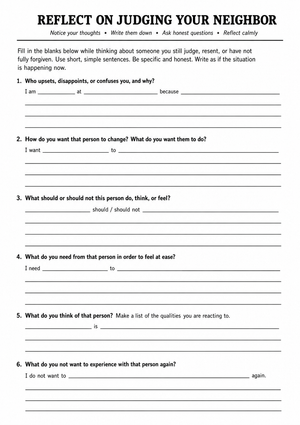
- Perspective rotation: Students take a conflict scenario and write the internal monologue of each party — including the one they'd instinctively oppose.
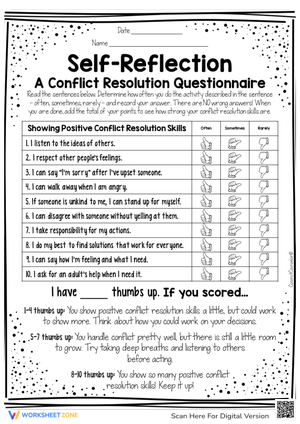
- De-escalation recognition: Students identify their own physical warning signs — clenched jaw, raised voice, the urge to leave the room — and match each to a specific calming strategy.
- Mediation steps: Students work through the structure of a peer mediation session: establishing ground rules, gathering information, identifying the real issue beneath the stated one, and drafting a joint agreement.
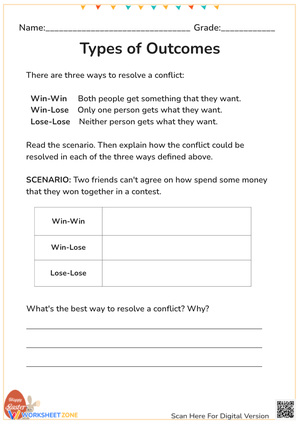
The scenarios are drawn from realistic 11th-grade situations: disagreements over group project credit, social media callouts, perceived favoritism on sports teams, and romantic friction that spills into shared friend groups. These aren't the sanitized examples students dismiss in the first thirty seconds.
Frequent Student Errors Worth Watching For in This Work
The most common mistake isn't forgetting the I-statement format — it's learning the format and immediately corrupting it. A student who knows the template writes, "I feel like you're being manipulative when you do that." Grammatically, it opens with "I feel." Functionally, it's still an accusation. Teachers need to flag this pattern consistently, because students who produce the correct surface structure assume they've finished the task.
Perspective-rotation exercises reveal a different problem. Students who write fluently will produce a detailed, seemingly generous account of the other person's viewpoint — but by the final sentence, that person has acknowledged they were wrong. The internal monologue resolves in the writer's favor. Catching this requires reading past the opening; the telling detail is almost always at the end of the paragraph.
De-escalation work shows something else entirely. Students can list breathing techniques and strategic pauses without difficulty. The harder prompt — "what does it feel like in your body right before you say something you regret?" — produces much shorter, more specific answers, and those are the ones that make the discussion worth having.
How to Fit These Worksheets Into the Week Without Losing the Period
Advisory blocks of fifteen to twenty minutes are the natural home for this work. Introduce one worksheet per week during the first half of the year, before conflict patterns in the grade level harden. Students complete the written portions individually — this matters, because some are working through real, ongoing situations they aren't ready to voice publicly.
11th grade for youth printable worksheets work especially well paired with a silent debate extension. After students finish a perspective-rotation task, post their scenario responses on chart paper around the room. Students rotate silently, reading each other's responses and writing counter-perspectives or alternative solutions directly on the paper — no verbal back-and-forth yet. The silence removes the defensive reflex that usually derails these discussions when students feel put on the spot. When they return to their own worksheet to draft a final resolution strategy, their thinking is visibly more layered than it was twenty minutes earlier.
Keep a small stack accessible in a visible spot in the room, not filed away. When a student comes in visibly rattled, handing them a worksheet without ceremony is more useful than asking what happened.
Standard Alignment
These worksheets address three CASEL core competencies directly. Relationship Skills — specifically the sub-competency of constructive conflict navigation — runs through every worksheet in the set. Social Awareness, particularly cognitive perspective-taking and empathy under pressure, anchors the scenario and rotation tasks. Self-Management, centered on impulse regulation and physical stress response recognition, drives the de-escalation work.
In terms of classroom timing, these competencies land best when introduced before midterm stress peaks in November and again before spring semester, when senior-year anxiety starts filtering down into junior social dynamics. Building the vocabulary early means students have language for their own internal states precisely when they need it most.
Adjusting the Set for a Mixed-Ability Advisory Group
For students who freeze on open-ended written tasks, provide a sentence frame bank for the I-statement and perspective-rotation exercises. The goal is to remove blank-page paralysis without reducing the cognitive demand. Students still do the thinking — they just have a structural entry point.
For students already demonstrating strong interpersonal awareness, 11th grade for youth printable worksheets become more productive when the provided scenarios are replaced with situations the students themselves generate. These students benefit from extending the mediation-steps worksheet into a full written mediation plan they could actually facilitate — identifying the parties, drafting opening statements, and writing a proposed agreement. That level of application moves the work from structured practice into genuine leadership preparation.
A practical caution: students who have experienced trauma connected to interpersonal conflict — a family situation, a history with bullying — may find the more intense scenario work activating in ways that aren't immediately visible. Having a counselor available during the first session with those students is worth the scheduling effort.
Frequently Asked Questions
Can these worksheets be used outside of a formal advisory or SEL block?
Yes. An English teacher can fold the perspective-rotation task into a unit on narrative voice or dramatic monologue — the skill transfers directly. A history teacher running a unit on negotiation, diplomacy, or civil rights strategy can use the mediation-steps worksheet as an analytical companion to primary sources. The content doesn't require an SEL-specific framing to function well.
How do I handle a student who writes dismissive or sarcastic responses?
Sarcastic responses are usually a signal, not defiance. A student who writes "I feel like this is pointless" is telling you something about their current state. Avoid making it a compliance issue the first time. A brief private conversation before the next session goes further than a correction in the moment. Starting that student on the de-escalation warning-signs task first also helps — it's less emotionally exposing than the perspective-rotation work and easier to engage with honestly.
How long does each worksheet take, and do they need to be used in order?
Most students complete each worksheet in twelve to eighteen minutes of focused writing, which fits a standard advisory or homeroom block with time left for a brief discussion. 11th grade for youth printable worksheets are designed as standalone resources, so teachers can pull whichever one fits what's happening in the room that week — there's no required sequence.
Clear All