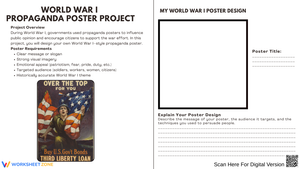
10th Grade World War I Propaganda worksheets
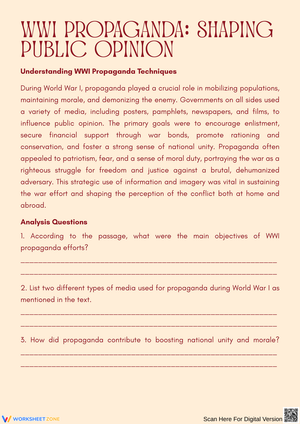
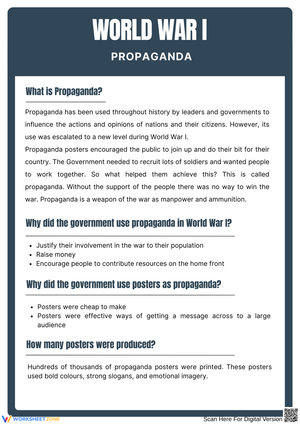
These 10th grade world war i propaganda worksheets resources put students inside the analysis process rather than just beside it — every prompt pushes them to mark specific visual details, name a persuasive technique with evidence, and connect a poster's message to a documented wartime need. Teachers get a set that fits a bell-ringer slot, a partner activity, or a full document-based inquiry without requiring extra preparation time.
What Each Worksheet Asks Students to Do
The analytical sequence runs in a consistent direction: observe first, then interpret, then evaluate. Students begin by recording what they see — figures, colors, text, symbols, scale — before they attempt to name the persuasive technique at work. That order matters. Students who jump straight to labeling ("this is propaganda because it uses fear") skip the observation step and end up with thin, unsupported claims. The prompts in each worksheet slow that down deliberately.
Across the 10th grade world war i propaganda worksheets set, students practice these moves:
- Source identification: country of origin, approximate date, and type of source (recruitment poster, bond drive appeal, home-front message, or enemy depiction)
- Close observation: annotation prompts for color, composition, central figures, text placement, and symbolic objects
- Audience and purpose: naming who the poster targeted and what specific action it was meant to produce
- Technique labeling with evidence: patriotic appeal, guilt, fear, bandwagon, stereotyping — each label must be tied to a specific image element or phrase
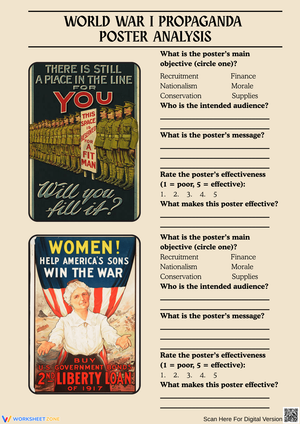
- Contextual connection: linking the poster's purpose to documented wartime pressures like enlistment shortfalls, Liberty Bond drives, or food rationing campaigns
- Written response: a short evidence-based paragraph using image details as textual support
Vocabulary terms — bias, point of view, audience, persuasion, primary source — appear embedded in the prompts so students encounter them in context rather than on a separate word list they ignore.
Selecting Posters That Hold Up to Classroom Analysis
Not every WWI poster works equally well with 10th graders. The most reliable choices have a clear central figure, readable text, and a single dominant message. Posters with dense allegorical imagery can work as extension tasks, but for initial practice they create decoding problems that pull students away from analysis and toward guessing.
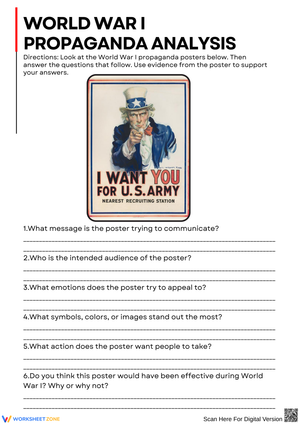
A productive four-poster set might include one American recruitment piece (the Flagg "Uncle Sam" series holds up particularly well), one British parliamentary recruiting appeal, one German home-front image to show another nation's framing of the same war, and one Liberty Bond or War Loan poster so students can trace how economic messaging differed from military appeals. The Library of Congress Prints and Photographs Division, the National WWI Museum and Memorial digital collection, and Imperial War Museums all provide high-resolution images with cataloging information teachers can paste directly into the source-identification section of the worksheet.
Errors in Visual Analysis That Show Up Repeatedly
The most consistent mistake is summary instead of analysis. A student will write "the poster shows a soldier asking people to join the army" and consider the prompt answered. That describes what is visible — it does not explain how the image creates urgency or why a viewer in 1917 would have felt compelled to act. Each worksheet addresses this by placing "what I see" and "what effect this creates" in adjacent response boxes, making the gap between description and inference hard to ignore.
A second pattern: students apply every technique from the word bank to a single poster, reasoning that more labels signal a more thorough answer. A poster built around patriotic guilt — a mother's steady gaze, a question about what you did in the war — reads very differently from one that uses enemy stereotyping and fear. Requiring students to defend one primary technique with two specific image details cuts that scattershot labeling quickly.
The subtler problem is anachronistic judgment. Students evaluate whether a poster's tactics were ethical by today's standards rather than analyzing what the poster accomplished in its historical moment. One classroom move that resets this is asking students to answer the worksheet twice: once from the perspective of a historian examining an artifact, and once from the perspective of a working-class viewer in Britain or the United States seeing this image on a city wall in 1915 or 1916. That doubling sharpens their ability to separate historical context from present-day reaction, which directly improves the quality of written claims.
Building These Worksheets Into Your Unit Plan
In a standard WWI unit, propaganda analysis fits most naturally after students have basic context on the war's outbreak and major belligerents but before they reach the home-front or turning-point lessons. That placement gives students enough historical grounding to read a poster accurately without waiting until the unit is nearly finished to introduce primary-source work.
- Bell-ringer (8–10 minutes): Project one poster and assign the observation and technique sections only. Debrief takes three minutes when students already have their annotations in front of them.
- Partner analysis: Each pair receives a different poster and completes one worksheet together, then reports out using a sentence frame: "Our poster targeted ___ by using ___ in order to ___."
- Station rotation: Four posters, four stations, one worksheet per student with a comparison column. Students flag the technique they see most consistently across all four.
- DBQ preparation: Pair three posters with a brief background note on wartime mobilization. Students complete the written-response section as a pre-write for a longer argument about how governments built civilian support.
These 10th grade world war i propaganda worksheets resources are flexible enough to appear at multiple points across a two-week unit — as a day-one entry point, a mid-unit formative check, or a pre-assessment before a more formal document-based question task.
Standard Alignment
The analysis sequence in each worksheet directly addresses CCSS.ELA-LITERACY.RH.9-10.6, which asks students to compare the point of view of two or more authors and analyze how they address similar themes or problems, and CCSS.ELA-LITERACY.RH.9-10.8, which requires students to assess whether the reasoning and evidence in a text support the author's claims. Both standards apply when students examine a poster's technique against actual visual evidence rather than simply accepting the message at face value. The written-response prompts also build toward CCSS.ELA-LITERACY.RH.9-10.1, specifically the expectation that students cite specific visual and textual evidence when analyzing a primary source.
For C3 Framework alignment, the worksheets support D2.His.5.9-12 (analyzing how and why perspectives of people changed over time) and D2.His.11.9-12 (evaluating the credibility and relevance of a historical source). In classroom terms, a student who completes one of these worksheets has practiced the same source-interrogation habits that appear on AP World History document analysis rubrics and state-level constructed-response assessments in social studies.
Adjusting the Work for Different Readers and Writers
For students who struggle with open-ended analysis prompts, two adjustments help most: a technique word bank with brief definitions printed directly on the worksheet, and sentence starters for the written-response section ("The poster targets ___ because ___" or "The creator uses ___ to make viewers feel ___"). Those structures give students something to fill in rather than a blank page to generate from scratch, which cuts the freezing-up problem without reducing the historical thinking the task requires.
Pre-selecting the poster also matters for students with reading challenges. Posters that rely more heavily on imagery and less on dense printed text — the Flagg recruitment series, the British "Women of Britain Say — Go!" poster — reduce the decoding load without reducing the analytical demand.
For students ready to push further, the comparison extension is the most productive move: ask them to rank three posters by persuasive effectiveness, defend the ranking with specific evidence from each, and identify which technique the highest-ranked poster deploys most effectively and why a wartime civilian audience would have responded to it. That task produces exactly the kind of evidence-based argument that shows up in DBQ scoring guides.
Frequently Asked Questions
What primary sources work best alongside these worksheets?
Posters with a clear central figure and a single readable message work best for initial practice. The Library of Congress Prints and Photographs Division and the National WWI Museum's digital holdings both provide high-resolution images with reliable source metadata. For a first lesson, one recruitment poster and one home-front poster give students enough contrast to notice how purpose shapes persuasive technique without overloading them with competing messages.
How do these worksheets support DBQ or document-based writing tasks?
The written-response section of each worksheet functions as a document analysis paragraph in miniature — students make a claim, cite visual evidence, and explain the connection. That habit transfers directly to DBQ tasks. These 10th grade world war i propaganda worksheets resources work especially well as pre-writes: students complete the worksheet independently, then use their annotations as the evidence bank for a longer argument about wartime persuasion.
Can these worksheets connect to modern media literacy instruction?
Yes. The technique analysis transfers cleanly. When students identify exaggerated enemy imagery or selective presentation of facts in a 1917 poster, they apply the same source-interrogation habits that media literacy frameworks expect students to use on contemporary sources. The wartime context makes the persuasive purpose harder to dispute, which often helps students articulate what propaganda actually does before they apply that thinking to more contested modern examples.
How long does completing one worksheet typically take?
The observation and technique sections take most students 10 to 12 minutes when working independently with one poster. The written-response section adds another 8 to 10 minutes, putting full completion at roughly 20 minutes. That fits a 45-minute period alongside a brief mini-lesson and class debrief, or it fits a bell-ringer format when you assign only the first two sections and save the written response for homework or the following day.
Clear All