10th Grade World War I Causes PDF Worksheets
These 10th grade world war i causes pdf worksheets give history teachers a direct route through one of the most conceptually demanding units in a sophomore course — why a regional assassination in the Balkans triggered a four-year global war. Students typically arrive knowing that Archduke Franz Ferdinand was shot; these worksheets push well past that starting point into the structural conditions that made escalation almost certain, and into the specific diplomatic failures that turned "almost" into "inevitable."
What the Worksheets Cover
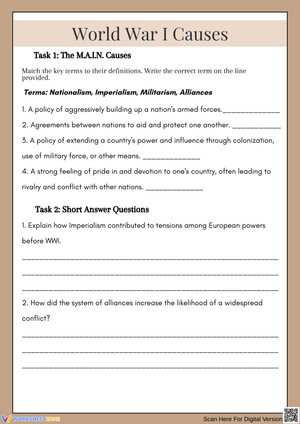
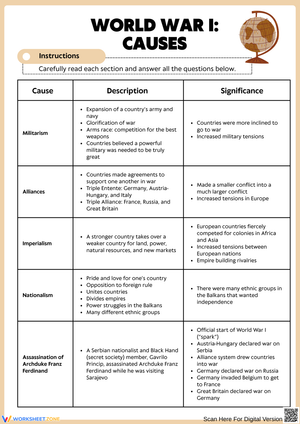
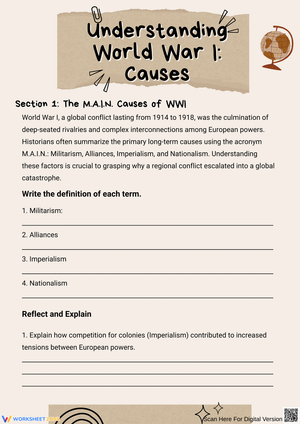
The materials work through two interlocking layers of causation. The first is structural: the M.A.I.N. framework — Militarism, Alliances, Imperialism, Nationalism — with each concept addressed in its own worksheet. The militarism worksheet asks students to examine British and German military spending figures from 1900 to 1914, then write a brief explanation of why an arms race generates instability even when neither side intends to fire first. That's a harder analytical move than it looks; students who can read a bar chart still struggle to articulate the logic of deterrence gone wrong.
The alliances worksheet centers on a map exercise where students color-code the Triple Entente and Triple Alliance, then use arrows to show how mutual defense obligations activated during the July Crisis. The nationalism worksheet pairs an Austro-Hungarian propaganda excerpt with a Serbian nationalist text, and students annotate both for emotional appeals and identity claims. The imperialism worksheet uses document-based questions to connect colonial rivalry in Africa and Asia to growing diplomatic friction between European powers closer to home.
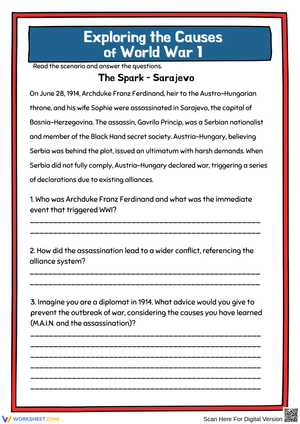
The second layer covers the immediate trigger — the assassination in Sarajevo on June 28, 1914, and the five-week sequence of ultimatums, mobilizations, and declarations that followed. A July Crisis timeline worksheet asks students to sequence twelve events from June 28 through August 4, then identify three points where a different decision might have altered the outcome. That last question pushes the task from chronology into actual historical reasoning.
Errors Students Make That These Worksheets Surface
The most consistent problem across this unit is treating M.A.I.N. as a list to recite rather than a system of interacting causes. Students write "nationalism was a cause" and stop — no mechanism, no explanation of why Serbian nationalism threatened Austria-Hungary's internal stability, no link to why that threat activated the alliance system. Each M.A.I.N. worksheet includes a graphic organizer that asks students to draw arrows between causes and label the relationship. That single requirement changes the cognitive task from naming to explaining.
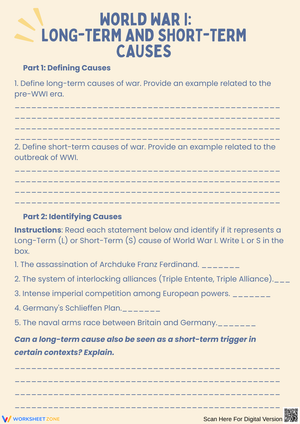
A second error shows up on the alliances worksheet: students write that "the alliances caused World War I," which mistakes a structural condition for a triggering event. One task asks students to distinguish long-term causes from short-term catalysts and defend the distinction in two sentences. Teachers have explained that difference verbally a dozen times before students write it — and writing it forces them to actually hold it.
The timeline worksheet surfaces a chronological error that appears almost universally the first time students encounter the July Crisis: they place British entry before French mobilization. That inversion reveals a shaky grasp of why Britain entered at all. Catching it on a worksheet is far better than finding it buried in an essay two weeks later.
How to Work These Worksheets Into Your Unit Plan
Spreading the M.A.I.N. worksheets across the first three days works better than stacking them all on day one. Militarism and imperialism, which require industrial and economic context, land well after a brief direct instruction segment on the Industrial Revolution's role in European power shifts. Nationalism and alliances pair with a projected map discussion while students simultaneously complete the mapping exercise on their own worksheet — the two activities reinforce each other rather than competing for attention.
The July Crisis timeline works well as a jigsaw. Assign groups to Austria-Hungary, Serbia, Russia, Germany, France, and Britain. Each group tracks only their assigned country's decisions through the twelve-event sequence. When groups compare notes, students reconstruct the chain reaction from six national perspectives at once. That's when the phrase "alliance system as tripwire" stops being a definition and becomes something students actually feel — because they've just watched it unfold from inside each country's position.
Reserve the primary source comparison — the Austro-Hungarian ultimatum paired with a contemporary newspaper account — for the end of the unit. Tenth graders tend to read primary sources at face value early in a unit, before they have enough context to notice what a document omits. Coming back to the same text after the full unit teaches them what it means to read with contextual knowledge, not just for surface content.
Standard Alignment
These 10th grade world war i causes pdf worksheets align to the C3 Framework for Social Studies, specifically D2.His.1 through D2.His.3, which ask students to analyze change and continuity, explain how historical context shapes events, and evaluate the role of individuals and institutions in historical outcomes. The primary source worksheet addresses D2.His.9 — sourcing, contextualization, and corroboration — the three moves at the center of document-based historical inquiry.
Teachers in states using Common Core Literacy Standards for History and Social Studies will find the document analysis tasks aligned to RH.9-10.6 (assessing an author's point of view and purpose) and RH.9-10.8 (evaluating whether evidence supports an author's claims). Both standards appear on most state social studies assessments at the 9-10 grade band, making the resources directly usable for pre-assessment and targeted review.
Differentiating the Set Across Student Levels
Students who need more support with M.A.I.N. benefit from taking the four causes in two sittings rather than one. Start with militarism and nationalism — both connect to feelings students already recognize, like pride, fear, and competition — then introduce alliances and imperialism once those first two are grounded. Using the graphic organizer as a whole-class reference during discussion, before students complete it independently, gives those students a working model rather than a blank page and a concept they haven't yet processed.
Students ready for extension can turn the primary source worksheet into a three-source comparison by locating the German blank check — the assurance Berlin gave Vienna before the ultimatum was issued — and adding it as a third document. Writing a paragraph that synthesizes all three texts and identifies where accounts converge and diverge is genuine historiographical work. When 10th grade world war i causes pdf worksheets include that kind of open-ended extension, the same materials serve a student who needs a step-by-step structure and one who's ready to reason like a historian.
The July Crisis timeline is a natural entry point for students who freeze on interpretive tasks. Getting the sequence right first gives them a concrete factual foundation before they engage with the harder question of causation and responsibility — a sequence that follows how historians actually approach the problem.
Frequently Asked Questions
Do the worksheets include answer keys?
Yes. Each worksheet comes with an answer key that includes explanatory notes alongside correct responses — particularly useful for the graphic organizer sections, where student answers legitimately vary in how they draw connections between the M.A.I.N. causes.
How long does each worksheet take to complete?
Most worksheets in the set run 20 to 35 minutes for students working independently. The July Crisis timeline and the primary source comparison worksheet run closer to 40 minutes when students annotate and respond in writing. Both work well as full-period activities with time left for class debrief.
Can these be assigned in a digital classroom?
The PDF format works for both print and screen. Teachers have assigned these 10th grade world war i causes pdf worksheets through Google Classroom by uploading the file directly or converting to a fillable form. The map exercise in the alliances worksheet works best printed — students color-code by hand, and that physical step tends to help the geographic relationships stick in a way that clicking through a digital version rarely matches.
Clear All