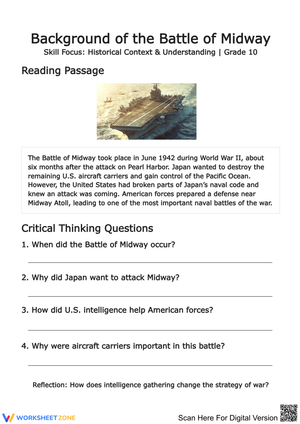
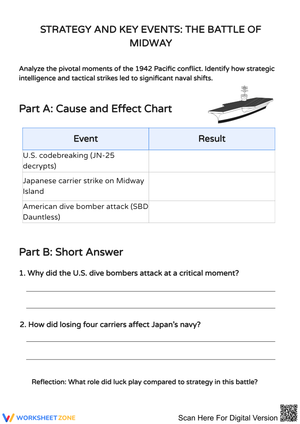
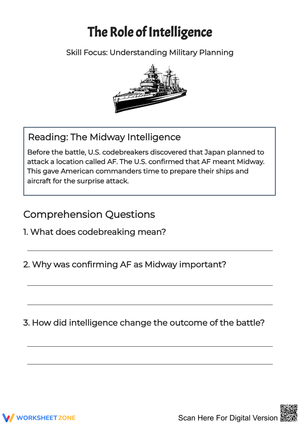
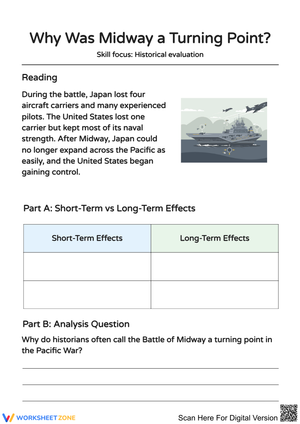
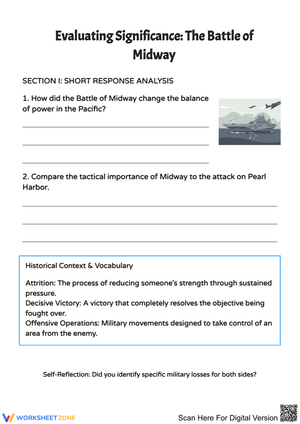
These battle of midway worksheets for 10th grade hand teachers a set of standalone activities built around the four days in June 1942 that flipped the Pacific war. Each worksheet pushes past the date-and-outcome summary students memorize and instead asks them to work with maps, intercepted messages, and conflicting after-action reports the way a historian would.
What Students Actually Work Through
The set moves across the three big stories of Midway: the intelligence breakthrough at Station HYPO, the carrier duel itself, and the strategic shift that opened the door to island hopping. On one worksheet students plot the Pacific Theater and measure the distances between Pearl Harbor, the Midway Atoll, and the Japanese home islands, which is the only way most tenth graders finally understand why a speck of coral mattered so much to both navies.
Other worksheets in the collection ask students to do specific analytical jobs rather than recall facts:
- Trace the JN-25 code-breaking timeline and mark where each intercepted message changed what Admiral Nimitz knew
- Compare American and Japanese naval doctrine, naming why carrier aviation made battleship strategy obsolete
- Account for the four lost Japanese carriers — Akagi, Kaga, Soryu, Hiryu — and weigh that against the loss of the Yorktown
- Build a cause-and-effect chain from the victory at Midway to the amphibious campaigns that followed
The Intelligence Story Carries the Unit
Tenth graders expect a war battle to be about firepower, so the code-breaking angle reliably grabs them. The cryptanalysts at Station HYPO cracked enough of the Japanese naval code to hand Nimitz the date, the target, and the rough order of battle before a single plane launched. When a worksheet walks students through that sequence of intercepts and then asks them to evaluate how the information shaped command decisions, they start to see that information superiority and deception decided the fight as much as the dive bombers did. That shift in thinking is the point — wars turn on what one side knows that the other doesn't.
How to Build These Into a Week of Instruction
Lead with geography. Run the map activity first so students fix the location and value of Midway Atoll in their heads, then move into the primary-source analysis once they have a mental picture to hang it on. A battle of midway worksheets for 10th grade fits cleanly into a three-day sequence: mapping on day one, the intelligence and carrier-battle analysis on day two, and the consequences worksheet on day three as students argue why this counts as the turning point.
The strongest classroom moment comes from the dual-perspective reconstruction. Put students in small groups and have them rebuild the timeline of June 4 from both the American and Japanese command reports. When the two accounts don't line up, students stop treating the outcome as inevitable and start seeing the confusion, the bad luck, and the five minutes when American dive bombers caught three carriers with their decks full of fuel and ordnance. That fog-of-war realization is hard to lecture into students; they have to find the discrepancies themselves.
The worksheets also work as quick formative checks. After a reading or a lecture, one targeted sheet on the JN-25 intercept or the carrier losses tells you fast whether students grasped the mechanism behind the victory or just copied down the result. Because the resources print and distribute easily, they hold up the same whether students complete them in class or take them home.
Mistakes Students Make That These Worksheets Help You Catch
The most common error is treating Midway as a foregone conclusion — students write that the Americans "obviously" won because they had broken the code, ignoring how thin the margin actually was. The dual-perspective timeline corrects this directly. A second recurring problem: students confuse Midway with Pearl Harbor or the Coral Sea, blending three 1942 events into one fuzzy memory, so the mapping and chronology activities force them to separate the events in time and space. A third issue shows up in their writing about naval combat. Many assume the ships shot at each other, and they're genuinely surprised to learn this was the first major naval battle where the opposing surface fleets never saw one another. Naming that fact early, then having them explain it on a worksheet, locks it in before it muddles their essays.
Adapting the Set for a Range of Learners
For students who struggle with dense text, shorten the primary-source excerpts and give them a partially completed timeline so they slot in the missing events rather than building the whole sequence cold. Stronger readers can take the full command reports and write a short argument about which factor — intelligence, doctrine, or luck — mattered most, with evidence drawn from the documents. The map activity adapts the same way: some students label a provided base map while others construct theirs from coordinates. Pulling a battle of midway worksheets for 10th grade into a mixed-ability room works because the same historical question can be answered at several depths without splitting the class into different topics.
Standard Alignment
The activities follow the C3 Framework for Social Studies State Standards, which organizes inquiry around developing questions, applying disciplinary concepts, evaluating sources, and communicating conclusions. A battle of midway worksheets for 10th grade lets students move through that inquiry arc on a single event — they pose questions about Nimitz's decisions, weigh primary sources from the Naval History and Heritage Command, and construct an argument for why Midway is named the turning point of the Pacific war. That kind of source-based reasoning is exactly what the framework expects of secondary students preparing for college-level history.
Frequently Asked Questions
Why is Midway called the turning point of the Pacific war?
The battle stopped Japanese expansion cold. Destroying four fleet carriers gutted Japan's offensive naval power and let the United States move from defense to offense, which set up the island-hopping campaigns that followed.
How did code-breaking give the US Navy its edge?
Cryptanalysts at Station HYPO read enough of the JN-25 naval code to learn the date, location, and makeup of the planned attack. Instead of being ambushed, the Americans set the trap and positioned their carriers to strike first.
How lopsided were the losses?
Japan lost four fleet carriers — Akagi, Kaga, Soryu, and Hiryu — plus a heavy cruiser and a large number of veteran pilots who could not be replaced. The United States lost one carrier, the USS Yorktown, and one destroyer. The imbalance is what shifted the balance of naval power in the Pacific.
What's the best way to use these worksheets with tenth graders?
They work for primary-source analysis, mapping exercises, and timeline reconstruction, and they fit independent study, group work, or a quick formative check just as well. Lead with the geography, then layer in the intelligence and consequences activities once students have the map in their heads.












 Interactive Worksheet Maker
 Quiz Maker
 Word Search Maker
 Crossword Puzzle Maker
 Word Scramble Generator
 Sentence Scramble Generator
 Handwriting Worksheet Generator
 Name Tracing Generator
 Fill In The Blank Generator




 BACK TOSCHOOL