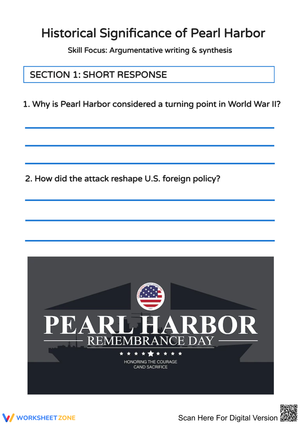
These 10th grade attack on Pearl Harbor worksheets give US History teachers a focused entry point into one of the most consequential events of the twentieth century — not as a date to memorize, but as a case study in how a single military action reshapes foreign policy, public sentiment, and national identity. Each worksheet addresses a distinct layer of the event, so teachers can build a coherent lesson sequence or pull individual tasks depending on where students are in the unit.
What Each Worksheet Targets
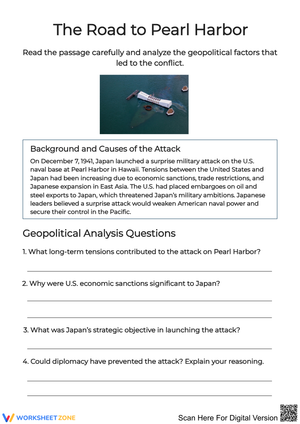
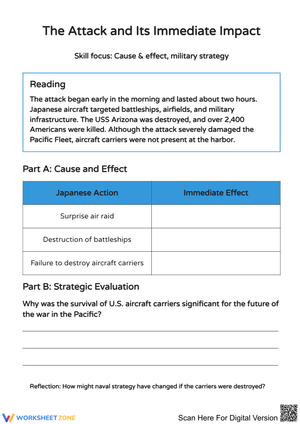
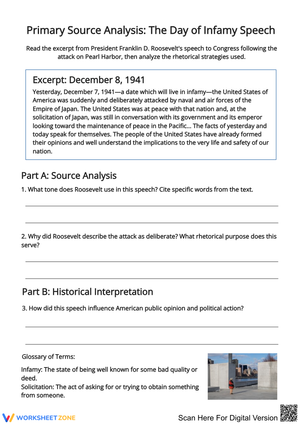
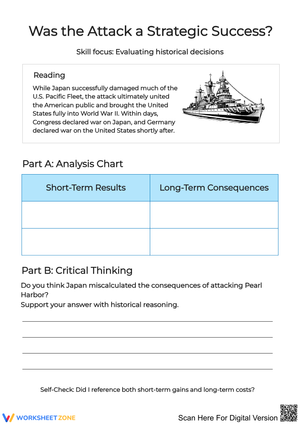
The set moves students through three phases: understanding what happened on December 7, 1941, analyzing why it happened in the context of Pacific tensions, and evaluating what changed for the United States immediately after. Within those phases, the specific tasks include annotating a background reading on Japan's targeting of the U.S. Pacific Fleet at Pearl Harbor, completing a cause-and-effect organizer that traces Japanese foreign policy decisions through the attack to Roosevelt's declaration of war request, locating Pearl Harbor on a Pacific map and explaining why that geography mattered to U.S. military planners, building a chronology of events from the morning of the attack through December 8, and analyzing a short excerpt from Roosevelt's Day of Infamy speech for tone, word choice, and intended audience. A final short-answer prompt asks students to construct a paragraph argument about Pearl Harbor's significance as a turning point — a task that pulls from everything completed in the earlier worksheets.
Smart Ways to Use These Worksheets Into Your Week
Most teachers use the full sequence across two class periods. On day one, students complete the background reading with annotation, the vocabulary section, and the map activity. The last ten minutes of that period work well for the timeline, which primes students for the trickier interpretation questions by giving them a concrete sequence to reference. On day two, the cause-and-effect worksheet and the Roosevelt speech analysis carry the analytical load, and the short writing task closes the lesson. Teachers who need a one-period version can pull the reading, the cause-and-effect organizer, and the exit-ticket writing prompt and get a complete, defensible lesson from those three pieces alone.
The set also functions reliably as sub plans. The task structure is explicit enough that students can work through it without teacher scaffolding, and the chronology activity gives a clear anchor for students who lose their footing in the reading. For review days near a unit exam, the cause-and-effect worksheet and the speech excerpt stand alone as effective retrieval practice without requiring students to re-read the full background passage.
Mistakes Students Make That These Worksheets Help You Catch
The most persistent error at this grade level is collapsing cause and effect into sequence. Students will write that Pearl Harbor "caused" World War II — full stop — rather than recognizing that the attack caused U.S. entry into a war already underway. That distinction appears directly on many state assessments, and the cause-and-effect worksheet is structured to force the more precise phrasing: students have to distinguish Japan's strategic motivations from the immediate trigger of the attack, then identify U.S. entry into the war as an outcome rather than the war's origin.
A second pattern shows up in the speech analysis. Students who are new to primary-source work will summarize what Roosevelt said rather than analyze how he said it. They write "Roosevelt told Congress that Japan attacked us" instead of examining why Roosevelt used the phrase "a date which will live in infamy" in the opening line rather than in the conclusion — a deliberate rhetorical choice that frames congressional and public response before any facts are presented. The guided questions on that worksheet specifically redirect students toward word-level choices rather than content summary.
Adapting These Worksheets for Different Student Levels
For students who struggle with dense historical reading, the background passage can be chunked: assign the first half through the attack itself, check for understanding with two or three comprehension questions, then distribute the second half covering immediate U.S. response. Breaking the reading at a natural narrative seam reduces cognitive load without watering down the content. The cause-and-effect organizer also works well as a partially completed scaffold — filling in two of the five boxes and asking students to complete the rest lowers the entry point while preserving the analytical demand.
Advanced students ready for a longer response can be given the DBQ-style extension prompt, which asks them to synthesize the map evidence, the timeline, and the speech excerpt into a multi-paragraph argument about why Pearl Harbor represented a decisive shift in U.S. foreign policy rather than simply a military attack. That task aligns with the kind of document-based reasoning students encounter in AP US History and state end-of-course assessments. Both versions run from the same worksheets — no separate materials needed.
Frequently Asked Questions
Do these worksheets work as a standalone lesson, or do they need to be part of a larger World War II unit?
They work both ways. As a standalone lesson, the background reading provides enough context for students with no prior exposure to the event. As part of a unit, teachers typically slot these worksheets after an introductory lesson on pre-war Pacific tensions, which lets students arrive at the cause-and-effect organizer with some prior knowledge and produce more nuanced responses.
How long does the Roosevelt speech analysis take for a typical 10th grader?
Most students need about fifteen minutes for the excerpt and guided questions, assuming the excerpt is limited to the first two paragraphs of the speech. Teachers who push beyond that length will find the annotation phase stretches past what a single period supports. The two-paragraph version generates plenty of discussion and keeps the written response achievable within the period.
Is there a version of the cause-and-effect worksheet that works for struggling readers?
The scaffolded approach described above — completing two boxes and leaving three for students — works well for most students who need reading support. For students significantly below grade level, pairing the organizer with a brief read-aloud of the background passage allows them to engage with the analytical structure even when independent reading of the text is a barrier.
Can these worksheets be used for homework rather than in-class work?
The background reading, vocabulary section, and comprehension questions are straightforward enough for homework. The map activity and the speech analysis tend to produce stronger results when done in class, where students can ask questions about unfamiliar vocabulary in the speech and where the teacher can redirect the common error of summarizing instead of analyzing.












 Interactive Worksheet Maker
 Quiz Maker
 Word Search Maker
 Crossword Puzzle Maker
 Word Scramble Generator
 Sentence Scramble Generator
 Handwriting Worksheet Generator
 Name Tracing Generator
 Fill In The Blank Generator




 BACK TOSCHOOL