


























1 / 2
0
Views
0
Downloads


0.0
0
Save
0 Likes
Share
Molecular Biology: Transcription and Translation Worksheet
0 Views
0 Downloads
Paste this activity's link or code into your existing LMS (Google Classroom, Canvas, Teams, Schoology, Moodle, etc.).
Students can open and work on the activity right away, with no student login required.
You'll still be able to track student progress and results from your teacher account.
Information
Description
What It Is:
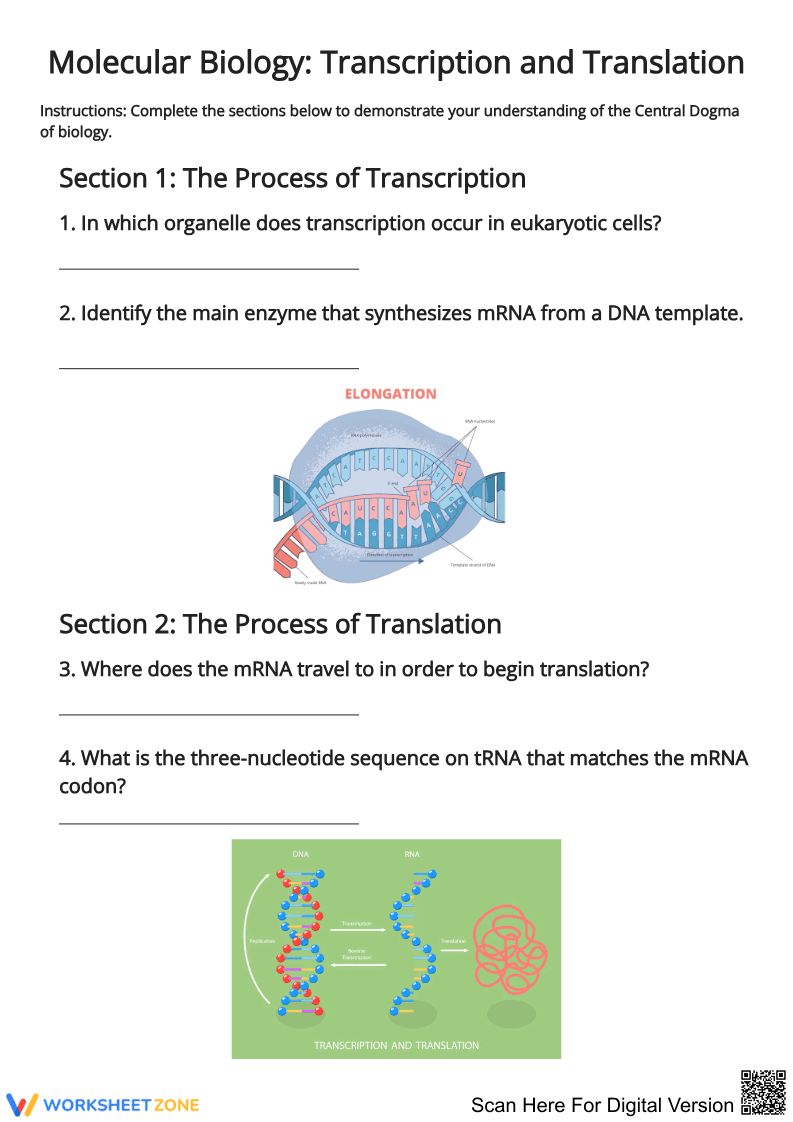
This worksheet focuses on the processes of transcription and translation within the central dogma of molecular biology. Students answer questions about organelles, enzymes, ribosomes, and anticodons involved in gene expression.
Why Use It:
It reinforces understanding of how genetic information is transcribed into mRNA and translated into proteins. The targeted questions strengthen knowledge of key terms such as nucleus, RNA polymerase, ribosome, and anticodon.
How to Use It:
• Identify the organelle where transcription occurs in eukaryotic cells.
• Name the enzyme responsible for synthesizing mRNA.
• Explain where mRNA travels to begin translation.
• Define the three-base sequence on tRNA that matches a codon.
Grade Suitability:
Best suited for Grades 8–11.
• Middle school advanced life science units on genetics.
• High school biology lessons on gene expression and protein synthesis.
Target Users:
Science teachers, homeschool educators, tutors, and students studying genetics and molecular biology fundamentals.
This worksheet focuses on the processes of transcription and translation within the central dogma of molecular biology. Students answer questions about organelles, enzymes, ribosomes, and anticodons involved in gene expression.
Why Use It:
It reinforces understanding of how genetic information is transcribed into mRNA and translated into proteins. The targeted questions strengthen knowledge of key terms such as nucleus, RNA polymerase, ribosome, and anticodon.
How to Use It:
• Identify the organelle where transcription occurs in eukaryotic cells.
• Name the enzyme responsible for synthesizing mRNA.
• Explain where mRNA travels to begin translation.
• Define the three-base sequence on tRNA that matches a codon.
Grade Suitability:
Best suited for Grades 8–11.
• Middle school advanced life science units on genetics.
• High school biology lessons on gene expression and protein synthesis.
Target Users:
Science teachers, homeschool educators, tutors, and students studying genetics and molecular biology fundamentals.


