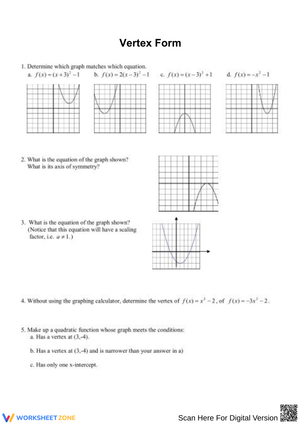
10th Grade Quadratic Transformations Worksheets
These 10th grade quadratic transformations worksheets give algebra teachers targeted practice material for one of the most conceptually dense topics in the sophomore curriculum — reading vertex form and predicting graph behavior without tabulating every point. Each worksheet isolates specific components of y = a(x - h)^2 + k, and the set builds toward problems where all three variables interact simultaneously.
Skills These Worksheets Build
The set moves through four interrelated skill areas:
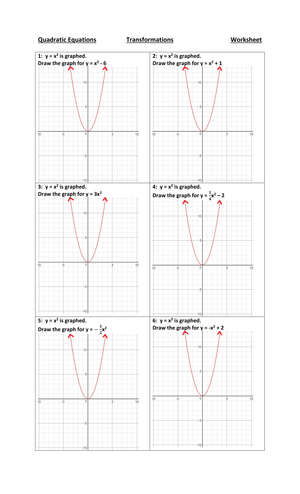
- Vertical translations: students identify the k value, state the direction and magnitude of the shift, and sketch the result alongside the parent function f(x) = x^2
- Horizontal translations: the most instruction-intensive part of the set, requiring deliberate attention to why (x - h) moves the vertex in the direction that seems counterintuitive
- The a coefficient: vertical stretch when its absolute value is greater than 1, compression when it falls between 0 and 1, and reflection when it is negative
- Combined transformations: problems where all three components interact, asking students to work through the full vertex form before or during graphing
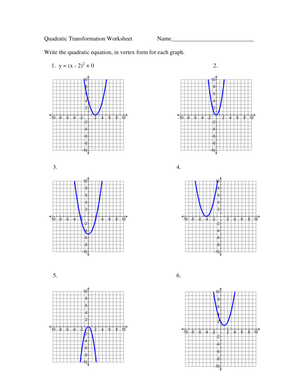
What makes the bidirectional format consequential is that every worksheet runs in both directions — given the equation, produce the graph, and given the graph, write the equation. These are not equivalent tasks. A student who graphs y = -2(x + 3)^2 + 5 correctly by stepping through vertex form can fail to write that same equation when shown the parabola on a grid. Running both directions in the same session surfaces that asymmetry before it appears on a unit test.
Mistakes Students Make That These Worksheets Help You Catch
The horizontal shift sign error is nearly universal on first exposure. Students see (x + 4) in the equation, register the positive 4, and move the vertex to the right. The vertex in y = (x + 4)^2 is at (-4, 0) — but most students will mark it at (4, 0) until corrected. The most durable explanation doesn't frame this as a sign reversal; it asks what value of x makes the expression inside the parentheses equal zero. In (x + 4), that's x = -4, and that is where the vertex lands. Once students apply that question habitually, sign errors drop sharply. These worksheets include enough horizontal-shift problems in the early sections that this correction happens during practice, not during a test.
A second error pattern surfaces with negative a values paired with negative vertical shifts. In y = -x^2 - 6, a consistent number of students anchor to the 6 and place the vertex at (0, 6) — reading the 6 as a positive distance from the origin rather than reading k = -6. This is a surface-feature reading error: the student sees the numeral 6 and attaches to it without parsing the sign. Including sign-varied examples across multiple worksheets, rather than clustering the harder cases at the end, is what gradually moves students toward structural reading.
Lesson-Planning Strategies to Get the Most From These Worksheets
10th grade quadratic transformations worksheets pair naturally with a short Desmos slider exploration at the start of class. The sequence that tends to work: ten minutes with the Desmos transformation graphing activity, where students move the h, k, and a sliders individually and watch the graph respond. Then close the devices and hand out the first worksheet while that visual is still active. Students who have watched the graph shift as they adjusted h carry a corrective mental image into the paper problems — the worksheet then converts that intuition into precise symbolic reading.
The "equation from graph" problems make unusually useful exit tickets. A single problem — here is a parabola with vertex at (-2, 5), opening downward, stretched vertically by a factor of 3, write the equation — takes about three minutes and shows exactly who has absorbed the vertex-form structure and who is still guessing at signs. Sort those slips into two groups before the next class and you have a natural basis for differentiated follow-up.
For Monday warm-ups after a weekend gap, the translation-only problems benefit from the spacing effect: returning to horizontal and vertical shift identification two or three days after initial instruction solidifies retention in a way that massed same-day practice does not. Three or four items from an early worksheet projected at the start of class is a low-overhead, high-yield opener.
Adapting the Set for a Range of Learners
Students who are shaky on the parent function benefit from having f(x) = x^2 pre-graphed on the coordinate plane. That removes the requirement to construct the baseline curve from scratch and frees working memory for the transformation itself. For students who are ready, a blank grid removes that reference and asks them to carry the parent function mentally — a useful step toward the kind of graph reading that appears on standardized assessments.
For advanced students, a productive extension is to expand the vertex-form equation into standard form after solving the main problem. That is not a separate worksheet requirement; it works as a margin instruction — "now expand and simplify" — that connects the two algebraic representations and previews completing the square. On the other end, students who lose track of one transformation when several are combined respond well to a step-labeling approach: write out each change as a separate line (identify the vertex, determine the direction of opening, determine stretch or compression) before drawing a single point on the graph. Writing the steps explicitly reduces the chance of skipping one.
Standard Alignment
These 10th grade quadratic transformations worksheets address CCSS HSF.BF.B.3, which requires students to identify the effect on a function's graph of replacing f(x) with f(x) + k, k·f(x), f(kx), and f(x + k) for specific values of k. In classroom terms, that maps directly to the vertex-form tasks here: isolate each component of the equation, name the transformation, and interpret or produce the corresponding graph. This standard is placed in 10th grade because it assumes students already have enough fluency with quadratic expressions to examine them structurally — they are not learning what a parabola is; they are learning to read an equation as a precise description of where the parabola lives and how it is shaped.
Frequently Asked Questions
Why do these worksheets use vertex form rather than standard form?
Standard form — y = ax^2 + bx + c — conceals the vertex. Finding it requires completing the square or applying the vertex formula, which adds computational steps that divert attention from the transformation logic. Vertex form puts the vertex coordinates directly into the equation as h and k, so students read the structure rather than computing through it. For a unit specifically about transformations, that directness is the point.
Do these work as assessment tools, or mainly for guided practice?
The 10th grade quadratic transformations worksheets in this set function at both ends of the assessment spectrum. A two- or three-problem excerpt from an early worksheet — translation-only, equation to graph — makes a clear exit ticket. A later combined-transformation worksheet with both graphing and equation-writing directions has enough range to serve as a quiz. The bidirectional format is what makes these assessment-ready: a student who scores well on graphing but poorly on equation-writing reveals a specific, addressable gap rather than a general one.
What should teachers do when students confuse vertical stretch with horizontal compression?
For parabolas, the confusion is defensible — a vertical stretch by factor 2 and a horizontal compression by the square root of 2 produce the same graph. The practical solution is to fix the language from the first day of the unit: all changes driven by the a coefficient are vertical. When the absolute value of a is greater than 1, the parabola is vertically stretched and looks narrower. When the absolute value of a falls between 0 and 1, it is vertically compressed and looks wider. Introducing horizontal compression language at this stage adds ambiguity that the standard does not require and that most 10th graders do not benefit from yet.
Can these worksheets be used without a technology component?
Yes, though the horizontal shift misconception tends to persist longer in purely paper-based instruction. Students who have watched a slider pull the parabola left as they increased a positive h value carry a corrective mental image into the paper problems. Without that, the sign reversal feels purely abstract and requires more correction cycles. If Desmos or a similar tool is not available, three teacher-drawn graphs on the board — parent function, then one shift right, then one shift left — accomplish similar work before students open the first worksheet. The visual orientation matters most for the h component; vertical shifts and a-coefficient effects are usually legible from the equations alone.
Clear All