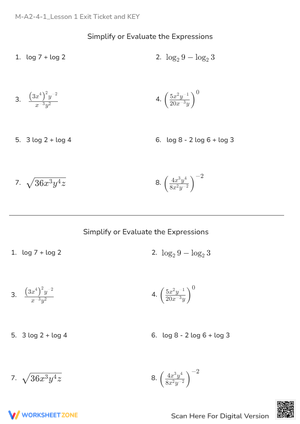
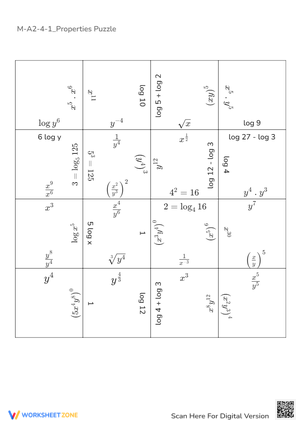
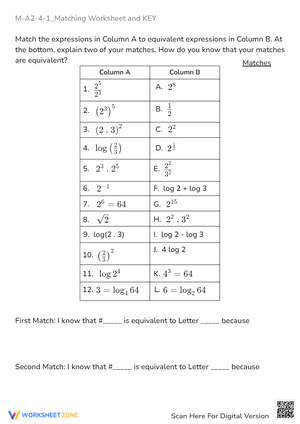
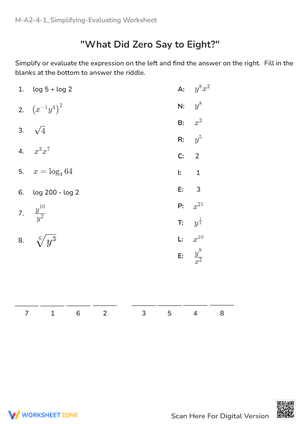
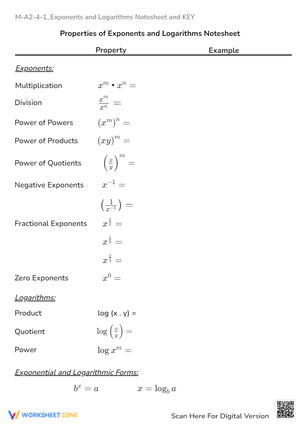
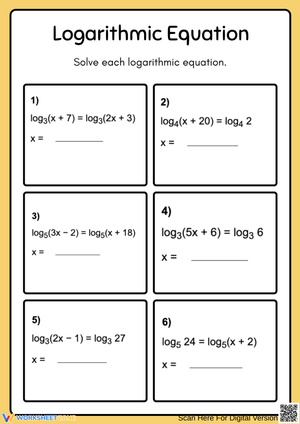
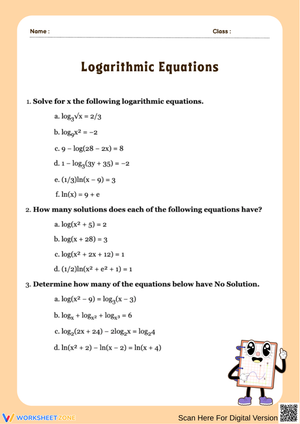
These 10th grade properties of logarithms printable worksheets cover the product, quotient, and power properties along with the change of base formula — the four algebraic tools Algebra 2 students use to expand, condense, and evaluate logarithmic expressions. The earlier worksheets each target one rule; the set builds toward mixed expansion and condensation problems that require students to choose which property applies without being told.
What Each Worksheet Targets
The product property worksheet moves students in both directions: expanding log(5x²) into a sum and rebuilding something like 3·log(2) + log(y) back into a single expression. The quotient property worksheet focuses entirely on expressions involving a fraction inside the log, with deliberate attention to subtraction order — which term carries the minus sign matters, and enough repetition here makes that placement automatic. The power property worksheet asks students to move exponents to the front as coefficients and return them to the argument, with a substantial share of problems built around radicals. A separate worksheet isolates the change of base formula, asking students to convert non-standard base logarithms to base 10 or base e and verify results with a calculator. The final worksheets in the set present mixed problems where students must apply multiple properties in sequence without labels telling them which rule to use first.
The Two Directions Students Must Master: Expanding and Condensing
Expansion and condensation are not simply opposite tasks — they carry different procedural requirements. When expanding, students work outward: one complex expression becomes several simpler terms, and any applicable property can be applied as soon as it fits. When condensing, the order is fixed. The power property must come first: any coefficient sitting in front of a log must become an exponent on that term's argument before the product or quotient property can merge two terms. Students who skip this step try to combine terms with coefficients still attached, producing errors that are hard to self-diagnose because the work looks nearly correct.
A procedural habit worth establishing before any expansion work begins: convert every radical in the argument to a fractional exponent immediately. A student who sees log(√(x³)) and tries to expand it without rewriting the radical will almost always lose the (1/2) coefficient. Writing it as log(x^(3/2)) first — then applying the power property to get (3/2)·log(x) — turns what could be a two-step mistake into a clean single move. Students who build this habit before tackling the worksheets produce significantly fewer errors on multi-step problems.
Mistakes Students Make That Experienced Teachers Anticipate
The most persistent misconception in this unit is the additive fallacy: students believe log(x) + log(y) equals log(x + y). What makes this dangerous is that it occasionally produces a clean-looking result. A student working with log₃(4) + log₃(5) who incorrectly collapses the expression to log₃(9) arrives at the answer 2 — a tidy integer that inspires false confidence. The correct answer, log₃(20), is irrational and produces an awkward decimal. That gap between a clean wrong answer and a messier right one is worth naming in class before students encounter it in a problem set.
Subtraction order in the quotient property produces a second reliable pattern of errors. Students apply the rule but subtract in the wrong direction, writing the denominator's log first. One technique that consistently reduces this: ask students to circle the numerator expression before writing anything down. That three-second step confirms which term belongs first and eliminates most of these mistakes in practice. A third pattern appears during condensation — students correctly apply the product and quotient properties but forget to handle coefficients first. They condense log(x) + 2·log(y) as log(2xy) instead of log(xy²), treating the coefficient as a multiplier inside the argument rather than as an exponent the power property must address first.
Fitting These Worksheets Into Your Algebra 2 Unit Plan
Most teachers introduce one property per class meeting, using each 10th grade properties of logarithms printable worksheets as the closure activity for that lesson — fifteen minutes of focused practice while the instruction is fresh, followed by a quick whole-class check. The change of base worksheet fits differently: it works best in a lesson that also involves a graphing task. Asking students to use the formula to verify a specific point on a logarithmic function graph, rather than simply produce a decimal, ties the formula to something visible and gives it a purpose beyond calculator procedure.
The mixed-practice worksheets work well as partner activities in the second week of the unit. Comparing steps — not just final answers — forces students to articulate why a particular property applied at a given moment and why the order mattered. For classes where solving exponential equations follows immediately after, these worksheets can serve as review just before students need the properties analytically, creating a reinforcement cycle rather than a separate review lesson.
Standard Alignment
These worksheets align to CCSS.MATH.CONTENT.HSF.BF.B.5, which requires students to understand the inverse relationship between exponential and logarithmic functions and apply that understanding to solve problems. The properties practiced here are the algebraic mechanism through which students work with that inverse relationship. In standard Algebra 2 sequencing, this standard appears in the second semester, after students have developed fluency with exponential functions and learned to convert between logarithmic and exponential form. The logarithm properties unit is the bridge from knowing what a log is to solving exponential equations analytically — and every exercise in this set supports that transition.
Adjusting the Worksheets for Different Levels of Student Readiness
Students who are still uncertain about exponent rules will struggle with logarithm properties because each property is a direct translation of an exponent rule. The most effective adjustment for those students is asking them to write the corresponding exponent rule beside each log property before applying it. That side-by-side placement turns the log property into something recognizable rather than something entirely new — the worksheet problems stay exactly the same, but the written parallel reduces confusion without removing the mathematical demand.
For students who move through the core problems quickly, the expansion and condensation worksheets extend naturally: require all radicals to be converted to fractional exponents before any other step, and present condensation problems that mix rational and integer exponents in the same expression. Teachers working through 10th grade properties of logarithms printable worksheets with mixed-readiness classes can run both groups simultaneously — on-level students completing the standard problems while advanced students apply the same rules to more demanding starting expressions — without needing separate materials.
Frequently Asked Questions
Do the product and quotient properties apply to any base, or only base 10?
They apply to any valid base — base 10, base e, or any positive base other than 1 — as long as all log terms in the expression share the same base. If two terms have different bases, the properties do not apply directly. Students must first use the change of base formula to convert both terms to a common base before combining them.
When condensing, does the order in which properties are applied matter?
Yes, and this is where most graded errors appear. The power property must come first: any coefficient in front of a log must become an exponent on that term's argument before the product or quotient property merges terms. Applying the product or quotient property first, while coefficients are still sitting outside the log, produces an expression that looks plausible but represents a different value than intended.
How should students approach a logarithm whose argument contains a square root or cube root?
The most reliable approach is converting the radical to a fractional exponent before any other step — square roots become an exponent of 1/2, cube roots become 1/3. Once the argument is in exponential form, the power property moves the fraction out front as a coefficient. Students who work directly with radical notation regularly drop that fractional coefficient in the final answer. On these 10th grade properties of logarithms printable worksheets, that specific error appears often enough that it is worth addressing directly before students begin the power property problems.
What should students know before starting these worksheets?
Students need to convert between logarithmic and exponential form fluently — if moving between log_b(a) = c and b^c = a requires significant effort, intermediate steps during property practice will stall the work. Students also need reliable recall of exponent rules for products, quotients, and powers, since each log property is a direct translation of one of those rules. A focused review session on both skills before introducing the properties removes the bottlenecks that most often slow down practice.













 Interactive Worksheet Maker
 Quiz Maker
 Word Search Maker
 Crossword Puzzle Maker
 Word Scramble Generator
 Sentence Scramble Generator
 Handwriting Worksheet Generator
 Name Tracing Generator
 Fill In The Blank Generator