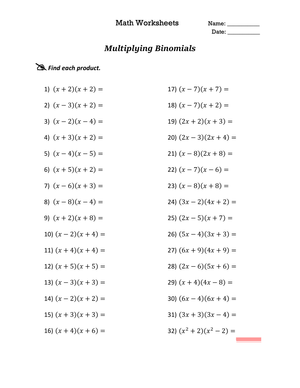
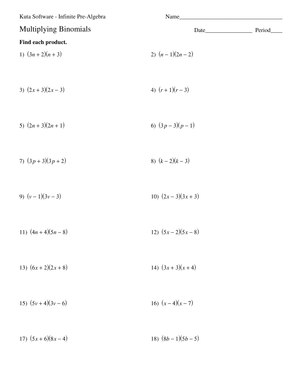
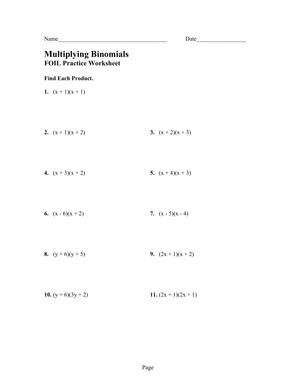
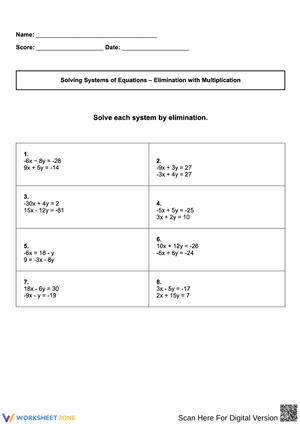
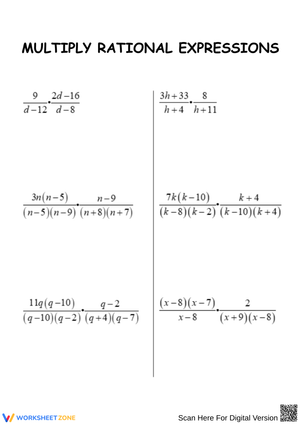
Multiplication worksheets for 10th grade cover a very different territory than the timed fact sheets from earlier grades — at this level, the multiplication is algebraic, and the skills range from multiplying monomials using exponent rules to binomial products, special product patterns, and multiplying radical expressions. Teachers searching for these materials are almost always in the middle of an algebra unit and need something they can print, assign, and check without a lot of setup. The worksheets listed here target those specific algebraic operations with enough variety to work across lesson stages, from initial practice to cumulative mixed review.
The Algebra Multiplication Skills These Worksheets Build
Grade 10 multiplication practice falls into distinct skill areas, and the most effective resources address them separately before blending them together. The most frequently assigned topics include:
- Monomial multiplication: Students multiply coefficients and apply exponent rules to combine bases — moving from 3x²·4x³ to 12x⁵ without confusing multiplication of bases with addition of exponents.
- Distributive property with polynomials: Students distribute a monomial or binomial across a polynomial expression and simplify by combining like terms.
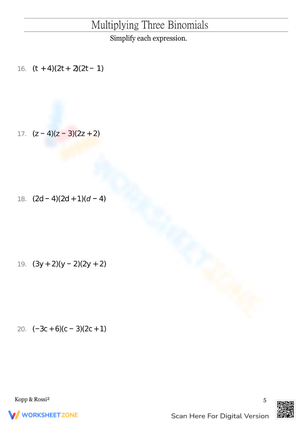
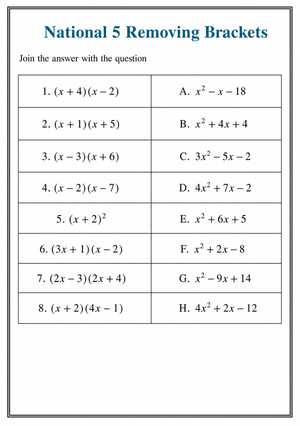
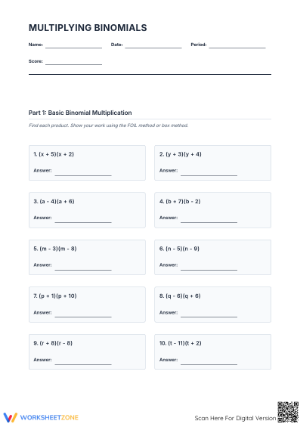
- Binomial and polynomial products: Students multiply two binomials or multi-term expressions and collect the result into simplified form.
- Special products: Students work with patterns such as (a+b)² and (a+b)(a−b), learning to recognize the structure before applying it so the work doesn't collapse into arithmetic errors.
- Radical multiplication: Students multiply expressions involving square roots or nth roots and simplify the product when possible.
- Mixed algebraic multiplication review: Students work through several expression types on one worksheet without labels indicating which rule applies — which is where real fluency gets tested.
That last category is harder than it looks. Students who handle each skill cleanly in isolation often stall when the worksheet stops announcing the operation type. A progression that moves from single-skill practice to unlabeled mixed problems — rather than jumping straight to the mixed format — gives students a better path to genuine fluency rather than pattern-matching on problem structure.
Mistakes Students Make That These Worksheets Surface
The most consistent error in algebraic multiplication at this level is partial distribution. When students expand 3x(2x² - 5x + 4), many correctly handle the first two terms and then either drop the constant or copy it unchanged, producing 6x³ - 15x² + 4 instead of 6x³ - 15x² + 12x. The constant doesn't look like it belongs to the variable group, so the multiplication never reaches it.
Binomial squaring carries a related but more visible version of this. Students who apply the FOIL process correctly to (x+3)(x+2) will still write (x+3)² = x² + 9, eliminating the middle term entirely — because squaring feels categorically different from multiplying two separate binomials, even though the operation is identical. Flagging this pattern explicitly before assigning squared-binomial worksheets is worth the 90 seconds it takes; otherwise it surfaces on the test without warning.
A second class of errors happens after the multiplication is complete. Students expand correctly and then combine unlike terms — adding 3x² and 5x as though the degree doesn't matter, or losing a negative sign during collection. Sorting graded errors into multiplication errors and simplification errors makes the reteaching conversation much more precise. If the setup is correct and only the simplification is wrong, the core instruction landed; you're addressing a different skill. If the setup keeps failing, the multiplication itself needs another round of focused practice before mixed review makes any sense.
Building These Worksheets Into the Weekly Flow
The most productive structure for Grade 10 algebra practice is a short weekly cycle: a single-skill worksheet on the first day of instruction, a review of common errors on the second day, and a mixed-type worksheet by the third or fourth day. That sequence respects the principle that students consolidate a procedure more durably before being asked to distinguish between procedures — which is exactly what a unit test requires.
Bell work is one of the best slots for a focused multiplication worksheet. Those first 6 to 7 minutes after students sit down are often lost to transition; a 4- to 5-problem practice set turns that window into retrieval, which produces better retention than re-reading notes the night before. Problem count matters here — an 8-problem warm-up runs long and cuts into instruction time. Keep bell-work sets tight.
Substitutes also benefit from clearly labeled multiplication worksheets for 10th grade matched to the current unit. A sub without strong algebra background can still run the class if the worksheet groups problems by type and includes an answer key. Materials without keys or with cluttered formatting tend to go unused on sub days, which wastes the time entirely.
For homework, a worksheet with a predictable format and steady repetition works better than anything requiring students to choose between strategies. Save unlabeled mixed-type practice for classwork, where a student who is stuck can ask a question. Homework is where routine procedural reinforcement belongs.
Standard Alignment
The skills in this set align directly with HSA-APR.A.1 from the Common Core State Standards for High School Algebra, which addresses performing arithmetic operations on polynomials and expects students to add, subtract, and multiply polynomial expressions fluently. In classroom terms, binomial and polynomial multiplication worksheets are the core of this standard, while monomial multiplication and distributive property practice function as prerequisite skills that many Grade 10 students still need to consolidate when the unit begins. Special products — squared binomials and conjugate pairs — connect forward to HSA-SSE.A.2, which involves recognizing structure in expressions. That pattern-recognition skill becomes critical in the factoring units that typically follow polynomial multiplication in most course sequences.
Adjusting These Worksheets for a Range of Learners
In most Grade 10 classrooms, the readiness gap in algebra is wider than the course title suggests. Some students enter the polynomial multiplication unit without reliable command of the distributive property; others can multiply binomials accurately but lose terms when expressions have four or five terms. Those two gaps look similar on a quiz but require different responses.
For students who need more support, use multiplication worksheets for 10th grade that include partial setups — problems where the first distribution step is already written out and students complete the simplification from there. That format isolates one cognitive step at a time and makes it clearer whether the student's issue is with the multiplication structure itself or with combining like terms afterward. Once accuracy on the partial format is solid, remove the first step and require the full process from setup through simplification.
For students ready for extension, move to worksheets where expression types are unlabeled, coefficients are larger or fractional, or radical terms appear inside the factors. A useful self-checking habit worth teaching at this level: after expanding a product, substitute a simple value — x = 1 or x = 2 — into both the original expression and the expanded form. If the outputs match, the multiplication is almost certainly correct. That technique transfers across the entire algebra course and is more useful long-term than completing additional problems of the same type.
Frequently Asked Questions
What multiplication skills are actually taught in Grade 10 math?
Grade 10 multiplication is algebraic, not arithmetic. The core skills are multiplying monomials using exponent rules, distributing a monomial or binomial across a polynomial, multiplying two binomials or larger expressions, recognizing and applying special product patterns, and multiplying radical expressions. Number fact fluency from earlier grades is assumed; these worksheets address expression-level operations involving variables, exponents, and multiple terms.
How many problems should a Grade 10 multiplication worksheet include?
For bell work or a focused in-class practice set, 5 to 8 problems is a reasonable range. Homework worksheets can include more repetition — 12 to 16 problems is common for a single-skill assignment. Mixed review sets used for test prep often include fewer items because each problem requires more decision-making; 8 to 10 varied problems can fill a 20-minute block without rushing through the material.
How do these worksheets differ from multiplication practice in earlier grades?
Multiplication worksheets for 10th grade diverge from earlier resources almost entirely in what the multiplication operates on. Earlier grades practice multiplication as an operation on numbers; Grade 10 worksheets apply it to algebraic expressions — meaning students must track variables, exponents, and multiple terms simultaneously across each problem. The procedural steps involved carry a higher error rate than single-digit fact practice, which is why single-skill worksheets tend to outperform broad mixed reviews at the start of an algebra unit.













 Interactive Worksheet Maker
 Quiz Maker
 Word Search Maker
 Crossword Puzzle Maker
 Word Scramble Generator
 Sentence Scramble Generator
 Handwriting Worksheet Generator
 Name Tracing Generator
 Fill In The Blank Generator