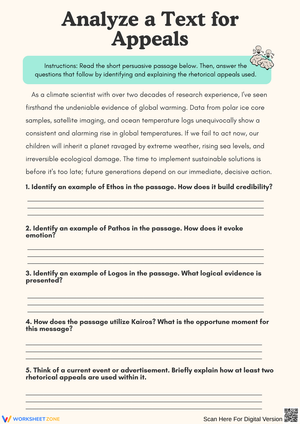
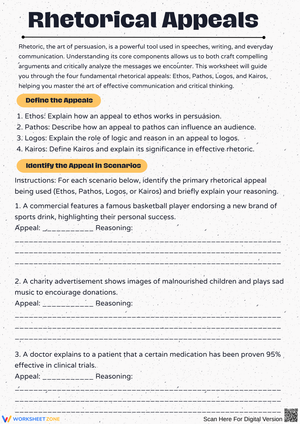
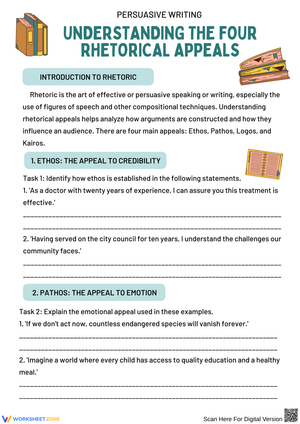
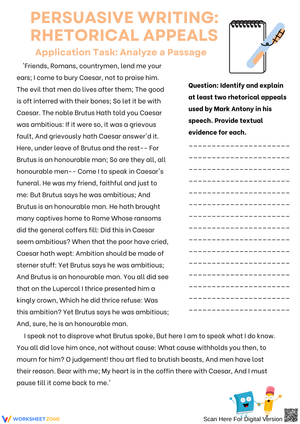
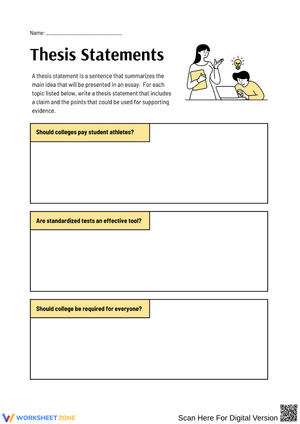
These persuasive writing worksheets for 10th grade break one of the most cognitively demanding tasks in secondary ELA — sustained written argument — into discrete moves that students can practice before attempting a full essay. Each worksheet targets a specific skill: writing a precise claim, selecting relevant evidence, constructing a counterclaim that actually engages the opposing view rather than dismissing it, or revising a body paragraph for logical completeness. Teachers get a set that drops into an existing argument unit rather than requiring new material to be built from scratch.
What These Worksheets Build
The skills covered in these persuasive writing worksheets for 10th grade follow the sequence a writer actually has to navigate — not the sequence a rubric lists after the essay is turned in. Students who articulate strong positions during class discussion often go silent on paper, and these worksheets address that gap by making the thinking visible one step at a time.
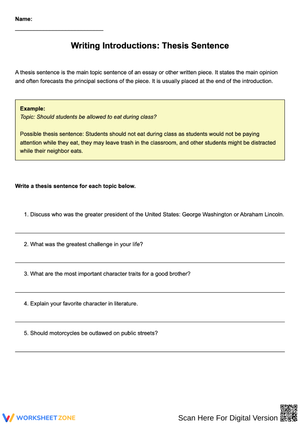
- Claim precision: Students rewrite broad statements into arguable, specific claims using a narrowing protocol that asks them to test whether a reasonable person could disagree with what they've written.
- Reason-versus-evidence distinction: One of the most durable confusions in 10th grade argument writing is treating reasons and evidence as interchangeable. These worksheets make students label and sort each before drafting a sentence.
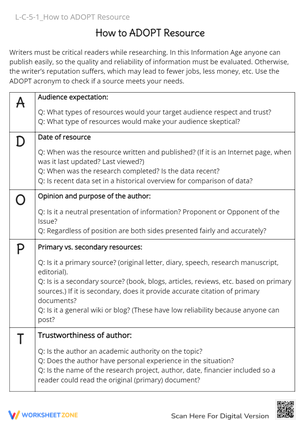
- Evidence evaluation: Students assess source credibility and relevance before selecting which detail best supports a given reason — not simply the first detail they locate.
- Commentary and warrant: Students write the sentence that explains how a piece of evidence connects to the claim, which is the move most often missing from 10th grade body paragraphs.
- Counterclaim development: Students practice identifying the strongest version of the opposing argument — not a strawman — and then building a rebuttal that concedes something real before pushing back.
- Logic-focused revision: Checklists ask students to verify that each piece of evidence actually supports the stated reason, and that transitions signal logical relationship rather than just sequence.
Frequent Student Errors Worth Catching Early
The error that appears most reliably in 10th grade argument writing is the missing warrant — the sentence that explains why the evidence matters for the specific claim. A student will write a focused claim, cite a credible statistic, and then move to the next paragraph. The reasoning stays in their head. What lands on the page reads like: "Schools should start later. Research shows that teenagers need 8–10 hours of sleep. Therefore, a later start time benefits students." The evidence exists, but no sentence does the work of connecting that sleep data to the specific policy claim. These worksheets require students to write that connecting sentence explicitly before the paragraph is considered complete.
The second consistent problem is surface-level counterclaim handling. Students who understand they're supposed to address the other side will write: "Some people disagree, but I still think my point is correct." That is an acknowledgment, not a counterclaim. The counterclaim worksheets ask students to state the opposing position in its strongest, most reasonable form and then identify precisely where and why it falls short — not just assert that it does. That task is harder than most 10th graders anticipate, and repeated practice produces clear, measurable improvement in rebuttal quality.
How to Sequence These Worksheets Into Your Week
Each worksheet is self-contained, but the set is designed for sequential use across a writing unit. A five-day argument sequence works well when each day carries one focused task. Day one: students use the topic-to-claim worksheet to test three possible positions on the same issue and select the most arguable. Day two: a reasons-and-evidence chart with a short source text, requiring students to label whether each piece of information functions as a reason or evidence, then match the two intentionally. Day three: the counterclaim organizer, done with a partner so students can pressure-test each other's rebuttals in real time. Day four: a paragraph-drafting worksheet that requires written commentary after each piece of evidence before the student advances. Day five: a logic-first revision checklist applied to the paragraph written the previous day.
Collecting only the claim-and-evidence organizer before students begin a full draft is one of the most efficient formative moves available. It takes five minutes to scan a class set, and it immediately reveals which students are working from weak or off-topic evidence — a problem that, left uncorrected, compromises every paragraph they write. Catching it at the planning stage rather than after a completed draft is submitted saves both teacher time and the frustration of students who have already committed to defending poor evidence choices.
Station rotations also fit here. When students need repeated practice without sitting through another whole-class lesson, three stations — claim writing, evidence selection, peer rebuttal — let different students work on their actual sticking points. The worksheets are clear enough that transitions between stations don't require re-explanation from the teacher every rotation.
Standard Alignment
These worksheets align to CCSS.ELA-LITERACY.W.9-10.1, which requires 9th and 10th graders to write arguments that introduce claims, distinguish them from counterclaims, develop both with evidence and reasoning, and maintain formal style through a logically consistent conclusion. In classroom terms, this standard typically anchors the dedicated argument writing unit most 10th grade ELA teachers place in fall or spring semester. The worksheets address each sub-strand — W.9-10.1a through W.9-10.1e — through separate practice tasks rather than combining everything into a single undifferentiated activity. Teachers documenting skill coverage for curriculum maps can point to specific worksheets for specific sub-standards, which simplifies both planning and reporting obligations.
Adjusting the Work for a Range of Writers
Persuasive writing worksheets for 10th grade serve a mixed-ability classroom best when the support structures are targeted rather than uniform. For students who freeze at the claim-writing stage, a sentence frame — Although [concession], [subject] should [action] because [reason] — provides enough direction to start without determining the content for them. For students whose claims remain vague, a three-question narrowing protocol ("What exactly should happen? Who decides? Under what conditions?") pushes toward precision without the teacher rewriting the sentence outright.
Writers who are ready for more challenge benefit from open-ended planning pages that ask them to map the internal logic of their argument — identifying not just what each piece of evidence demonstrates but what it would take to disprove it. That move, drawn from Toulmin argument analysis, sharpens analytical thinking faster than any generic "strengthen your argument" directive. These students usually need less organizational direction and more substantive intellectual pressure, and the open-ended worksheets deliver that without requiring a separate assignment entirely.
Frequently Asked Questions
How are these worksheets different from assigning an essay prompt?
An essay prompt asks for a finished product. Each worksheet in this set isolates a single writing move — drafting the claim, selecting evidence, constructing the counterclaim — and asks students to practice that move before combining everything in a full draft. The separation matters because 10th grade writers who struggle with argument usually aren't weak at all of it; they're stuck at one or two specific points. Working through the set shows both teacher and student exactly where the breakdown is happening.
Can these be used for on-demand or timed-writing preparation?
Directly. Students who regularly practice a prewriting routine become noticeably more organized when writing under time pressure. Several of the persuasive writing worksheets for 10th grade in this set double as quick planning tools — a claim, two or three reasons, key evidence, and a flagged counterclaim — and students who internalize that habit carry it into testing conditions without needing to be reminded to plan first.
Is there a meaningful difference between persuasive and argumentative writing at this level?
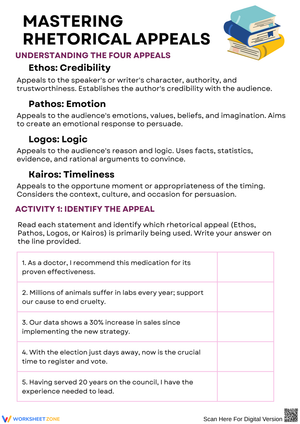
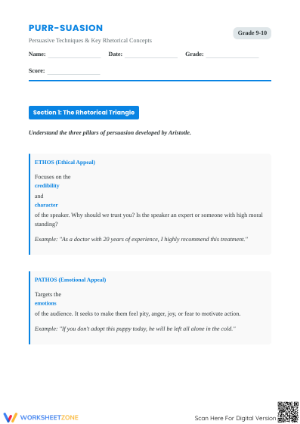
In most 10th grade ELA classrooms, the terms overlap in practice. Persuasive writing has historically emphasized rhetorical appeals and audience awareness; argumentative writing as defined by the Common Core foregrounds logical structure, evidence quality, and counterclaim development. These worksheets address both dimensions — students consider audience and tone alongside the logical rigor that W.9-10.1 requires — so teachers don't need to choose one framing and abandon the other.
How long does each worksheet take in class?
Most worksheets fit within 15–25 minutes of class time, depending on how much surrounding discussion or peer work the teacher builds in. A full argument unit using the entire set runs approximately five to seven days of focused writing practice, not counting independent drafting and revision time. Teachers who want a shorter cycle can use individual worksheets as warm-up tasks or exit tickets rather than running the full sequence from start to finish.












 Interactive Worksheet Maker
 Quiz Maker
 Word Search Maker
 Crossword Puzzle Maker
 Word Scramble Generator
 Sentence Scramble Generator
 Handwriting Worksheet Generator
 Name Tracing Generator
 Fill In The Blank Generator