


























0
Views
0
Downloads

0.0
0
Save
0 Likes
Share
ADOPT Method: Evaluating Sources Worksheet - Critical Thinking
0 Views
0 Downloads
Paste this activity's link or code into your existing LMS (Google Classroom, Canvas, Teams, Schoology, Moodle, etc.).
Students can open and work on the activity right away, with no student login required.
You'll still be able to track student progress and results from your teacher account.
Information
Description
What It Is:
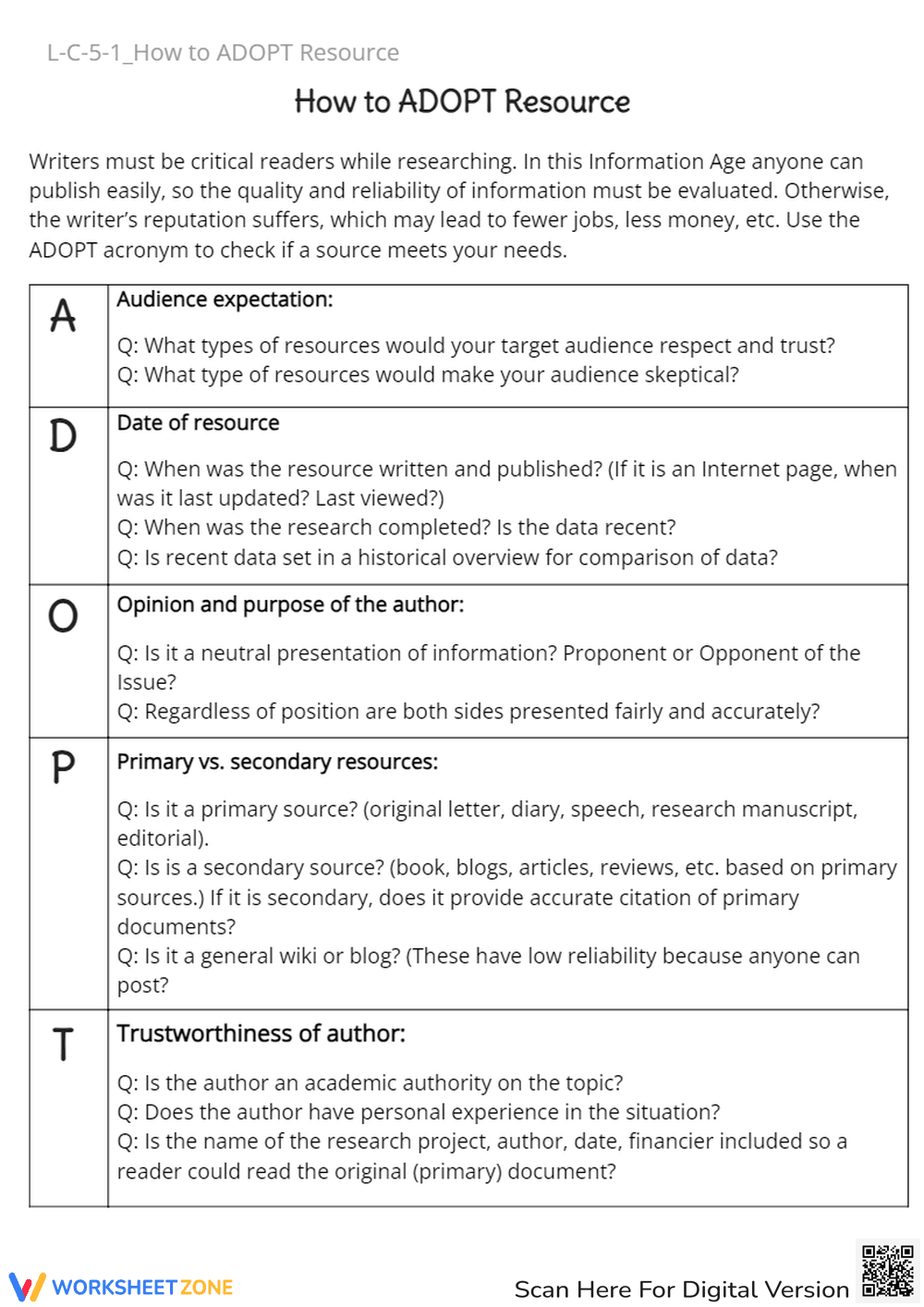
This is an educational worksheet titled 'How to ADOPT Resource.' It guides students on how to critically evaluate sources using the ADOPT acronym. The worksheet provides a series of questions related to Audience expectation, Date of resource, Opinion and purpose of the author, Primary vs. secondary resources, and Trustworthiness of the author. Each letter of ADOPT has associated questions to help students analyze the source's reliability and validity.
Grade Level Suitability:
This worksheet is suitable for grades 6-12. The concepts of source evaluation and critical reading are important skills for middle and high school students. The complexity of the questions requires analytical thinking and understanding of research principles, making it appropriate for these grade levels.
Why Use It:
This worksheet helps students develop critical thinking skills necessary for evaluating information sources. It teaches them to assess the reliability, credibility, and bias of sources, which is crucial in the digital age. The ADOPT acronym provides a structured approach to source evaluation, making the process easier to understand and apply.
How to Use It:
Students should read the text at the top of the worksheet. Then, when evaluating a source, students should work through the questions for each letter of the ADOPT acronym, answering them based on their analysis of the source. The answers can be written directly on the worksheet or in a separate notebook.
Target Users:
The target users are students in middle school and high school who are learning about research, critical thinking, and source evaluation. Teachers can use this worksheet as part of a lesson on research skills or as an independent activity for students to practice evaluating sources.
This is an educational worksheet titled 'How to ADOPT Resource.' It guides students on how to critically evaluate sources using the ADOPT acronym. The worksheet provides a series of questions related to Audience expectation, Date of resource, Opinion and purpose of the author, Primary vs. secondary resources, and Trustworthiness of the author. Each letter of ADOPT has associated questions to help students analyze the source's reliability and validity.
Grade Level Suitability:
This worksheet is suitable for grades 6-12. The concepts of source evaluation and critical reading are important skills for middle and high school students. The complexity of the questions requires analytical thinking and understanding of research principles, making it appropriate for these grade levels.
Why Use It:
This worksheet helps students develop critical thinking skills necessary for evaluating information sources. It teaches them to assess the reliability, credibility, and bias of sources, which is crucial in the digital age. The ADOPT acronym provides a structured approach to source evaluation, making the process easier to understand and apply.
How to Use It:
Students should read the text at the top of the worksheet. Then, when evaluating a source, students should work through the questions for each letter of the ADOPT acronym, answering them based on their analysis of the source. The answers can be written directly on the worksheet or in a separate notebook.
Target Users:
The target users are students in middle school and high school who are learning about research, critical thinking, and source evaluation. Teachers can use this worksheet as part of a lesson on research skills or as an independent activity for students to practice evaluating sources.


