For Youth Worksheets PDF for 10th Grade
The for youth worksheets pdf for 10th grade in this set address conflict resolution at the level of nuance tenth graders actually need — not the "take turns and share" baseline of middle school, but the harder work of managing emotional triggers, navigating group dynamics, and communicating under real pressure. Each worksheet targets a specific framework or skill: the Thomas-Kilmann conflict styles, structured I-statement construction, digital diplomacy scenarios, and a writing exercise called the Perspective Swap that asks students to reconstruct a conflict entirely from the other person's point of view. Teachers can use any worksheet independently or sequence several into a multi-day SEL unit without additional prep.
What Each Worksheet Targets
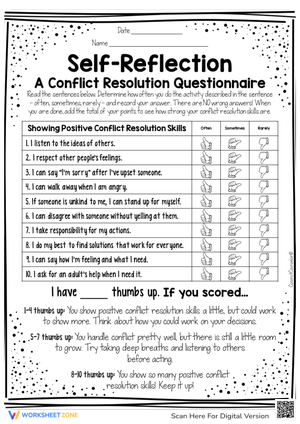
The Thomas-Kilmann self-assessment is the set's entry point. Students complete a brief inventory, score their dominant conflict style — competing, collaborating, compromising, avoiding, or accommodating — and then work through short case scenarios to see each style operating in a concrete situation. A group project dispute, a cafeteria exclusion incident, a miscommunication during a team sport: students identify the style at work and evaluate whether it was the right choice for that context. The goal isn't to eliminate competing or avoiding; it's to help students recognize that defaulting to one style regardless of stakes is the actual problem.
The I-statement worksheets use a three-part structure: "I feel [specific emotion] when [concrete behavior] because [named impact]." Each worksheet includes an emotion word bank that pushes students beyond the three or four words they typically reach for — "mad," "sad," "fine," and occasionally "frustrated." The bank introduces words like humiliated, overlooked, and dismissed, which describe experiences students regularly have but rarely name precisely. Precision matters here because a vague I-statement still sounds like an accusation, and the whole point of the exercise is to communicate without triggering defensiveness in the other person.
Digital conflict scenarios round out the collection. Each presents a realistic text chain or group chat exchange — the kind of misread tone that escalates into a week-long fallout — and asks students to mark where the conflict accelerated, rewrite one message to shift the dynamic, and decide when the conversation needs to move offline. These are not hypothetical constructions; they mirror what actually circulates through tenth-grade social lives.
Why This Skill Belongs at This Developmental Moment
Tenth grade sits at a specific convergence. Students are managing genuinely complex social terrain — sustained friendships, early romantic relationships, part-time jobs, group projects with real grades attached — while prefrontal cortex development is still incomplete. That gap between feeling something intensely and responding to it thoughtfully is not a character flaw; it is physiology. During a conflict, elevated heart rate and adrenaline make reflective thinking genuinely difficult. Worksheets that name this biology — that explain why the brain goes offline during a confrontation — land differently than ones that simply say "take a breath." Understanding the mechanism reduces shame and increases willingness to try de-escalation strategies, because students stop blaming themselves for losing control and start working the problem instead.
Student Errors Worth Catching Before They Become Habits
The most persistent error in I-statement practice is the disguised accusation. A student writes "I feel like you always dismiss my ideas in group work" and believes it qualifies because it starts with the right words. The construction fails because "I feel like" introduces a judgment, not an emotion. In actual classroom work, roughly half the class makes this exact error on the first attempt — and they push back when it's flagged, because it genuinely sounds correct to them. These worksheets include a self-check step that asks students to circle their emotion word and confirm it names a feeling rather than an interpretation. That one step catches the error before the pattern gets ingrained.
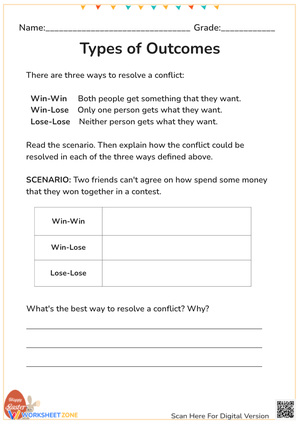
A second consistent pattern: students select "compromising" as the right answer in nearly every scenario because they've absorbed a general message that compromise is fair. The worksheets include at least one scenario — typically involving persistent exclusion or repeated dismissal — where compromise would normalize the harm rather than resolve it. Watching the model break down in a realistic situation forces students to think about fit rather than applying the socially acceptable default. That's a harder cognitive move, and it's exactly why it belongs in the set.
Fitting These Worksheets Into an Already Full Week
The Thomas-Kilmann assessment runs well as an eight-minute bell-ringer at the start of an SEL unit — no setup, no materials, and it immediately generates the self-knowledge that drives the rest of the worksheets. The I-statement exercises work as exit tickets in any class where group work generates friction; a science teacher whose lab groups had a rough session can hand one out in the final ten minutes without derailing content time. The Perspective Swap — writing the full conflict account from the other person's vantage point, including their likely fears and motivations — runs 20 to 25 minutes and fits cleanly inside English class as a character analysis variation, or inside advisory as a restorative practice prompt following a real incident.
This for youth worksheets pdf for 10th grade set also supports peer mediation programs, where student mediators need structured language practice before handling live disputes. The role-play scripts give mediators phrases to fall back on when a conversation stalls. Teachers who run peer mediation programs consistently find that students trained with structured practice escalate situations appropriately — they intervene confidently when they can and recognize when a situation exceeds peer scope rather than pushing through something that needs an adult.
Adjusting the Work for a Range of Learners in the Same Room
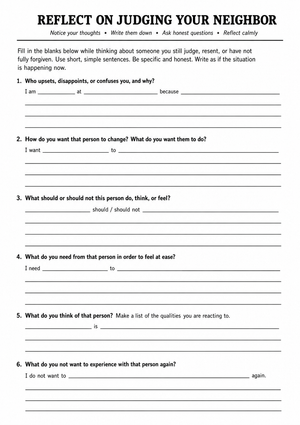
Students who are already emotionally articulate — who can name feelings precisely and understand that behavior usually reflects an unmet need rather than malice — benefit most from the Perspective Swap and digital conflict worksheets, which require inference, sustained writing, and nuanced analysis. For these students, assign the extended prompt: not just what the other person felt, but what underlying fear or pressure drove the behavior and what resolution would address that root cause rather than just the surface friction.
Students who struggle with emotional vocabulary do better starting with the emotion word sort, a warm-up task on one worksheet that groups feeling words by intensity — mild irritation versus full rage, low-level worry versus panic. This builds the vocabulary base they need before attempting I-statement construction. For students with IEPs that include social-emotional goals, moving through the Thomas-Kilmann scenarios one at a time in a small-group pull-out setting — rather than completing the full assessment during a whole-class period — gives them room to process without time pressure compounding the work.
Standard Alignment
These worksheets address CASEL's high school competencies in self-management and relationship skills, the framework embedded in most state SEL standards, including Illinois and California's mandated social-emotional learning requirements. For school counselors working within the ASCA Mindsets and Behaviors framework, the worksheets target the behavior standards related to self-regulation and constructive conflict resolution across the interpersonal skills strand. In ELA classrooms, the I-statement exercises and the Perspective Swap align with CCSS.ELA-LITERACY.W.9-10.3, which calls for narrative writing that develops experience or events from a specific point of view — meaning these resources support standards-based ELA instruction without requiring a formal co-teaching arrangement to justify their use.
Frequently Asked Questions
Can these worksheets be used after a real incident, or do they work better as proactive instruction?
Both settings work, but the approach differs. As proactive instruction, fictional scenarios protect students from feeling exposed — no one's actual conflict is under examination. After a real incident, the Perspective Swap is a strong restorative tool, but it works best once a counselor or teacher has already done initial de-escalation. Handing a worksheet to a student who is still activated rarely produces honest reflection. Wait until the immediate emotional charge has passed, then use the exercise to build toward resolution rather than substitute for a real conversation.
Do teachers need a counseling background to facilitate these worksheets?
Most worksheets are structured enough for any classroom teacher to run using the included teacher notes. The Thomas-Kilmann assessment and I-statement exercises need only a brief orientation. The Perspective Swap and digital conflict worksheets occasionally surface heavier disclosures — students sometimes use a fictional frame to write about actual experiences — so reading responses before group discussion is wise. This is standard practice in any reflective writing assignment, not a specialized clinical skill.
How do the worksheets handle situations where one student is clearly in the wrong?
The conflict-style framework does not require moral equivalence. Students can apply the model to situations where one party's behavior was genuinely harmful, while still analyzing how each person responded and what a better outcome might have looked like. The worksheets do not treat all conflict as symmetrical — they focus on each student's own response patterns regardless of fault. That distinction matters when working through a for youth worksheets pdf for 10th grade lesson on scenarios involving harassment or social exclusion, where framing both parties as equally responsible would do real harm rather than teach anything useful.
Is there an answer key for the open-ended exercises?
The Thomas-Kilmann assessment includes a scoring guide. The I-statement worksheets include a self-check rubric students complete before submitting. For the Perspective Swap and scenario-analysis tasks, a teacher discussion guide replaces a traditional answer key — these exercises involve interpretation, and the quality of a student's reasoning matters more than a single correct output. The discussion guide identifies common response patterns and suggests follow-up questions to push thinking further. Whether used in a full class period or pulled for a small counseling group, the entire collection functions as a for youth worksheets pdf for 10th grade resource that teachers can facilitate with confidence the first time through.
Clear All