




























Views
Downloads
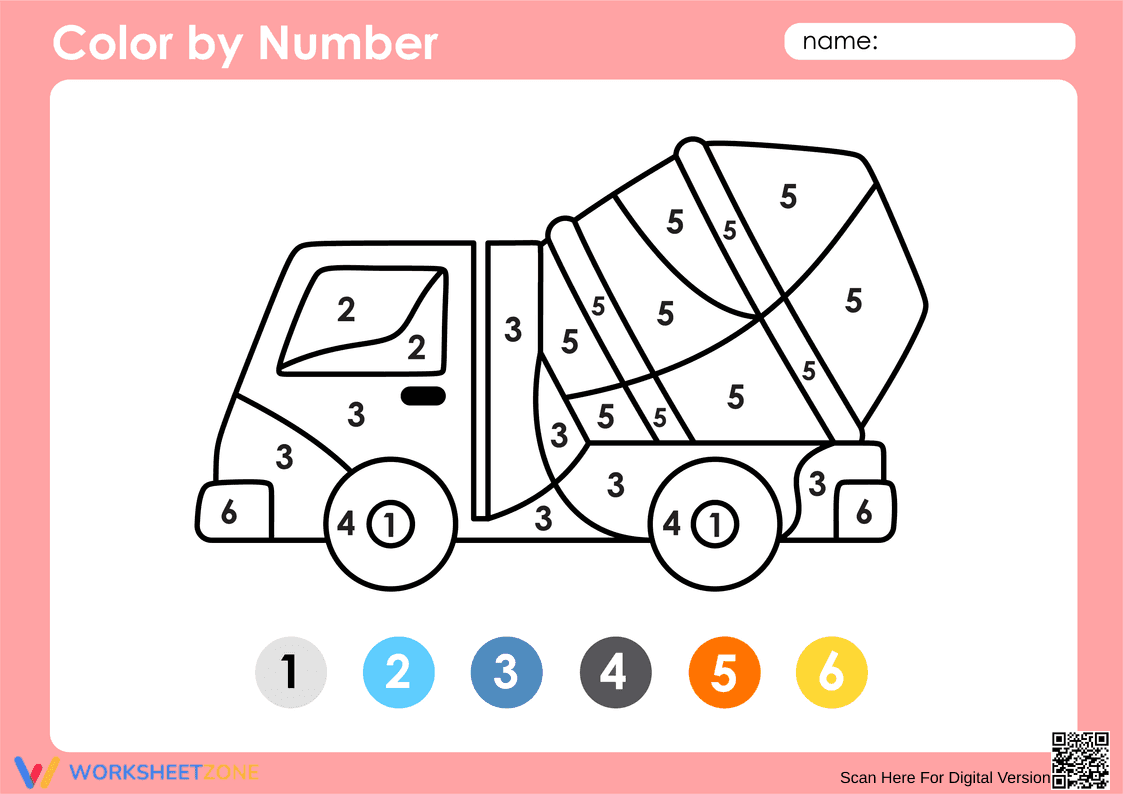

Truck Color by Number Worksheet | Grade K Printable

Paste this activity's link or code into your existing LMS (Google Classroom, Canvas, Teams, Schoology, Moodle, etc.).
Students can open and work on the activity right away, with no student login required.
You'll still be able to track student progress and results from your teacher account.
This printable truck color by number worksheet provides early learners with a focused way to practice number recognition and fine motor control. By matching specific colors to the numbers 1 through 6, students develop the visual discrimination skills necessary for early mathematics and literacy. It is a high-engagement activity that produces a completed artistic result.
At a Glance
- Grade: Kindergarten · Subject: Math & Arts
- Standard:
CCSS.MATH.CONTENT.K.CC.A.3— Identify and represent numbers using written numerals and visual codes- Skill Focus: Number recognition 1–6
- Format: 1 page · 1 task · Visual key included · PDF
- Best For: Morning work or early finishers
- Time: 15–20 minutes
The worksheet features a large, clear illustration of a cement mixer truck divided into 22 distinct numbered segments. At the bottom of the page, a visual color key maps the numbers 1 through 6 to specific shades: grey, light blue, dark blue, black, orange, and yellow. This single-page PDF is designed for high-contrast printing to ensure that young learners can easily distinguish the boundaries of each section.
The zero-prep workflow for this resource is designed for maximum efficiency in a busy classroom. First, print the single-page PDF for your entire class, which takes less than 30 seconds. Second, distribute the sheets along with a standard 6-pack of crayons or colored pencils. Third, review the completed trucks as a quick visual check for number accuracy. Total teacher preparation time is under 2 minutes, making it an ideal emergency sub plan or transition activity.
This activity is aligned with CCSS.MATH.CONTENT.K.CC.A.3, which requires students to identify and work with written numerals. While the primary task is artistic, the cognitive load involves decoding a numeric symbol and translating it into a specific action. This supports the foundational understanding of the relationship between numbers and their representations. Both standard codes can be copied directly into lesson plans, IEP goals, or district curriculum mapping tools.
Use this worksheet during the independent practice phase of a lesson on numbers 1-10. It serves as an excellent formative assessment tool; as you circulate the room, observe which students struggle to match the numeral in the drawing to the numeral in the key. Expected completion time is 15 to 20 minutes depending on the student's fine motor speed and attention to detail.
This resource is tailored for Preschool, Kindergarten, and Grade 1 students who are mastering one-to-one correspondence and numeral identification. It is particularly effective for English Language Learners (ELLs) as the visual key provides a non-verbal path to success. Pair this with a transportation-themed read-aloud or a counting song to create a cohesive thematic unit for your classroom.
According to the RAND AIRS 2024 report on early childhood education, integrating fine motor activities with academic content like number recognition significantly improves retention in learners aged 4 to 6. This truck color by number worksheet utilizes this multi-sensory approach by requiring students to physically engage with the paper while cognitively processing the numeral CCSS.MATH.CONTENT.K.CC.A.3. Research from Fisher & Frey (2014) emphasizes that low-stakes practice, such as coloring, reduces math anxiety and builds the confidence necessary for more complex operations later in the curriculum. By focusing on a limited set of numbers 1 through 6, the worksheet ensures that students are not overwhelmed, allowing them to achieve mastery over a specific subset of the number system. This alignment with evidence-based instructional design makes the resource a reliable tool for both general education classrooms and targeted intervention groups seeking to solidify basic numeracy skills.


