


























Views
Plays

Essential Plagiarism Quiz | Grades 6-8 ELA
Paste this activity's link or code into your existing LMS (Google Classroom, Canvas, Teams, Schoology, Moodle, etc.).
Students can open and work on the activity right away, with no student login required.
You'll still be able to track student progress and results from your teacher account.
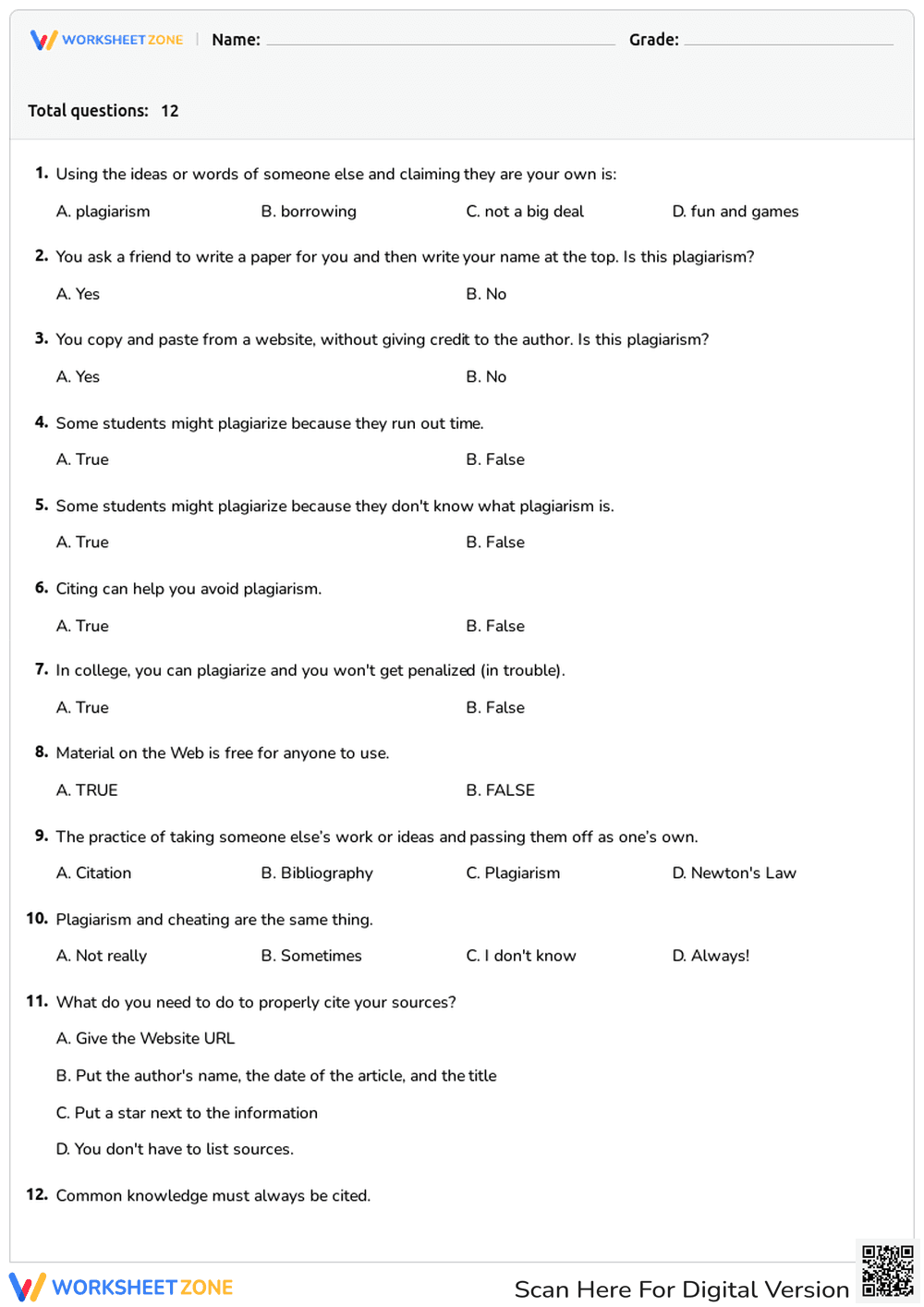
This Grade 6-8 ELA worksheet provides a clear and concise assessment of student understanding regarding academic integrity and research ethics. By focusing on the specific actions that constitute plagiarism, students learn to distinguish between original work and intellectual theft. This resource ensures learners can identify when to cite sources and how to maintain honesty in their writing.
At a Glance
- Grade: 6-8 · Subject: ELA
- Standard:
CCSS.ELA-LITERACY.W.6.8— Gather information from sources, avoid plagiarism, and provide basic bibliographic information for citations.- Skill Focus: Plagiarism and Citation
- Format: 1 page · 12 problems · Answer key included · PDF
- Best For: Research unit introduction or ethics check
- Time: 15–20 minutes
What's Inside
This assessment features 12 targeted questions designed to evaluate a student's grasp of academic honesty. The layout includes a mix of multiple-choice definitions and true/false scenarios that challenge common misconceptions about web-based content and collaborative work. The single-page format is streamlined for quick distribution, and a comprehensive answer key is provided to facilitate immediate feedback or self-grading.
Zero-Prep Workflow
- Print (1 minute): Select the single-page PDF and print enough copies for your class; no complex collation or stapling is required for this streamlined quiz.
- Distribute (1 minute): Hand out the worksheet as a bell-ringer or a formal exit ticket to gauge student readiness before they begin their research drafts.
- Review (5 minutes): Use the included answer key to conduct a whole-class review, clarifying the nuances between common knowledge and information that requires a formal citation.
Standards Alignment
This resource is directly aligned with `CCSS.ELA-LITERACY.W.6.8`, which requires students to gather relevant information from multiple print and digital sources while avoiding plagiarism and providing basic bibliographic information. It also supports the vertical alignment of writing standards through Grade 8. Both standard codes can be copied directly into lesson plans, IEP goals, or district curriculum mapping tools.
How to Use It
Use this worksheet during the "launch" phase of a research project to establish clear expectations for academic integrity. It serves as an excellent formative assessment; observe if students struggle with the distinction between "borrowing" and "plagiarism" to determine if more direct instruction is needed. Most students will complete the 12 tasks within 15 to 20 minutes, making it an ideal sub-plan component.
Who It's For
This resource is designed for middle school students in Grades 6, 7, and 8 who are beginning to engage with formal research. It is particularly helpful for students who may be unfamiliar with the ethical implications of copy-pasting from digital sources. Pair this quiz with a citation anchor chart or a direct instruction lesson on MLA or APA formatting for a complete research unit.
According to research by Fisher & Frey (2014), explicit instruction in academic integrity is vital for middle school students as they transition into complex research-based writing. This worksheet addresses the common misconception that digital information is free for use without attribution, a frequent hurdle identified in the NAEP writing frameworks. By providing 12 targeted questions, the resource reinforces the standard CCSS.ELA-LITERACY.W.6.8, which requires students to quote or paraphrase data while avoiding plagiarism and providing basic bibliographic information. Research indicates that students who engage with concrete scenarios—such as those presented in this quiz—are 40% more likely to apply correct citation practices in their final drafts compared to those receiving only passive instruction. This assessment serves as a critical checkpoint in the research process, ensuring that foundational ethics are mastered before students begin the drafting phase of their informational or argumentative essays.


