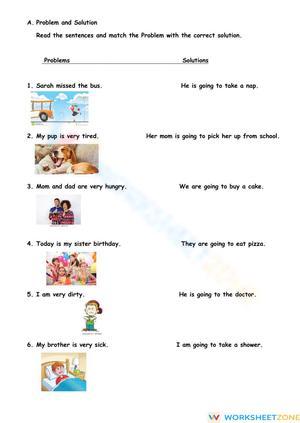
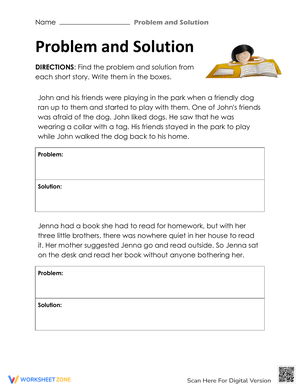
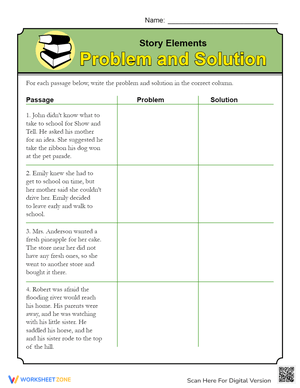
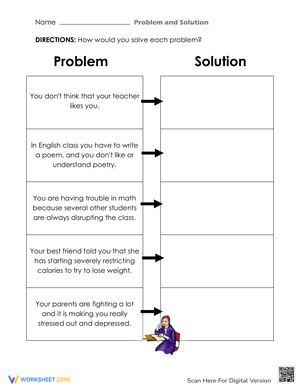
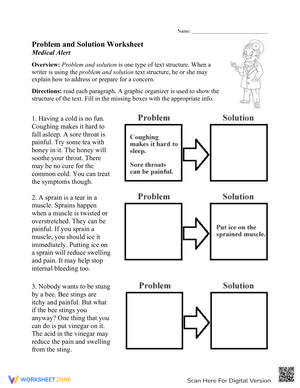
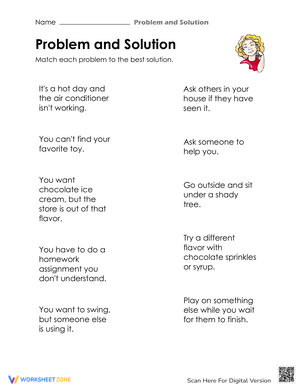
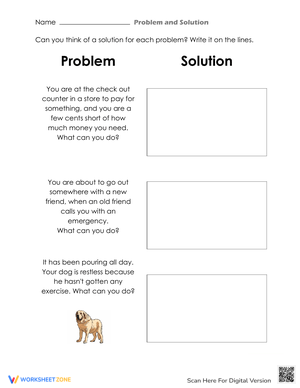
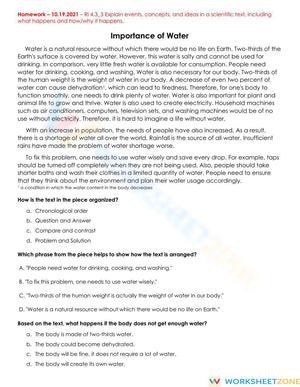
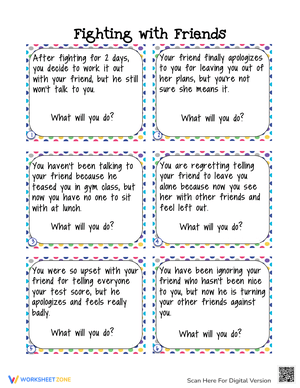
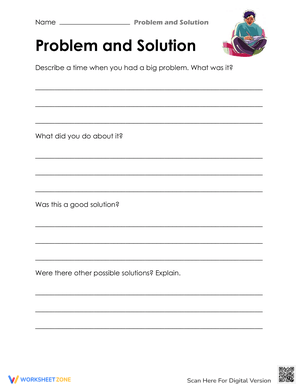
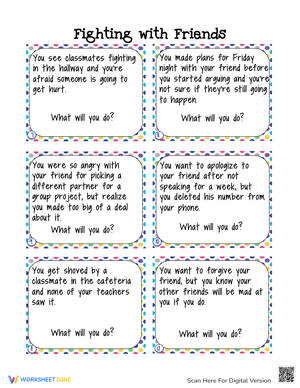
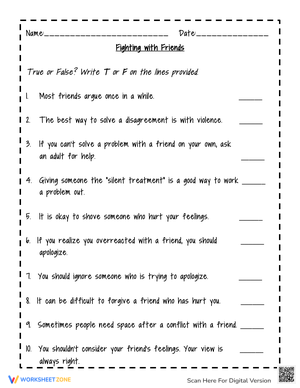
These problem and solution in nonfiction worksheets give grades 3 through 6 teachers a reliable set of resources for one of the most transferable skills in informational reading — recognizing not just what a text says, but how its content is structured. Each worksheet pairs a short nonfiction passage with a task sequence that asks students to name the central problem, identify the author's proposed solution or solutions, and pull specific evidence from the text to support their analysis. The passages cover topics across environmental science, civics, and history, which means teachers can use the set across content-area blocks without sourcing separate material.
What Students Practice Across the Set
The worksheets ask students to identify signal language — specific words and phrases that flag where problems and solutions appear in the text. Students underline or circle these terms directly in the passage before filling in any organizer:
- Problem signals: dilemma, challenge, obstacle, threat, issue
- Solution signals: remedy, resolve, fix, response, improvement
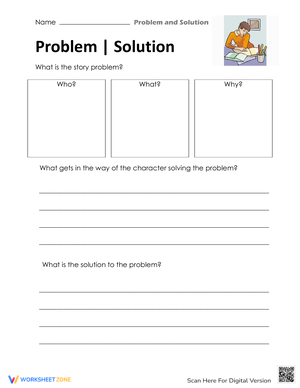
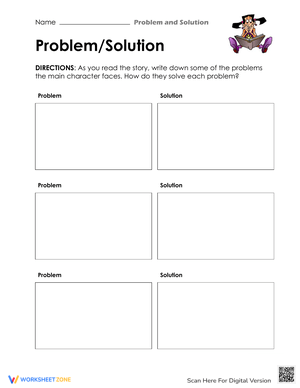
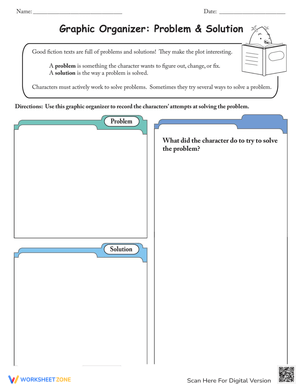
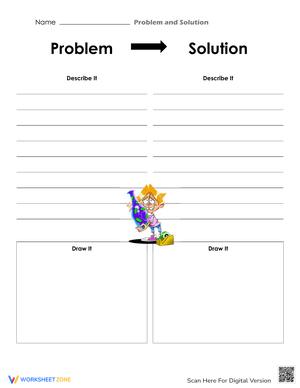
That annotation step — marking the text while reading rather than hunting for answers after the fact — is what separates students who reliably identify text structures from those who guess. Beyond signal word identification, students complete graphic organizers that differ by task complexity. Simpler worksheets use a two-column T-chart, with the problem on the left and the solution on the right. More demanding worksheets use a four-box map that adds space for the underlying cause and the solution's outcome, which reflects the layered way this structure actually appears in complex informational text. Several worksheets also include a short written response asking students to explain in one or two sentences whether the solution presented was sufficient — a task that pushes them from identification into evaluation.
Lesson-Planning Strategies That Work With This Set
These worksheets fit most naturally in the guided reading block or as follow-up to a whole-class think-aloud, not as cold independent work on day one. If students have not encountered the problem-solution structure explicitly before, spend five to ten minutes modeling with a brief think-aloud first — read a paragraph aloud, stop at a signal word like challenge or remedy, and name what type of structure you expect to find. That teacher modeling front-loads the mental process students need before they can replicate it on their own.
During small-group work, problem and solution in nonfiction worksheets function well as a formative check. Rather than collecting them for a grade at the end of class, walk the room while students work on the graphic organizer and look for students writing causes where the problem column should be — that confusion shows up constantly in third and fourth grade and is best caught mid-task. For Friday review blocks or the short stretch before afternoon dismissal, the signal-word annotation tasks work as quick warm-up exercises without requiring full class setup time.
Student Errors Worth Anticipating Before You Teach This Structure
The most persistent confusion — one that can carry well into fifth grade if left unaddressed — is treating the cause of a problem as the problem itself. In a passage about urban flooding, students will often write "too much pavement was built" as the problem when the text identifies flooded basements and street closures as the actual problem. The cause and the problem are not the same thing, and most informational texts do not draw that line clearly for the reader. A brief pre-discussion around the question "What is the situation the author wants fixed?" versus "What caused that situation to happen?" helps most students make the distinction before they begin writing.
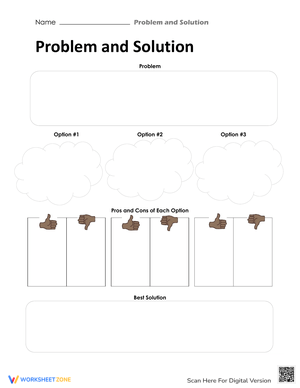
A second error is settling for the first solution mentioned and stopping. Science and civics articles often present multiple proposed solutions, sometimes with caveats about effectiveness. Students in grades 4 and 5 will list one solution and treat the task as complete. The four-box graphic organizer pushes against this by requiring students to return to the text and evaluate the outcome, which reveals how much of the passage they actually processed.
Adjusting the Set for a Range of Learners
Students who struggle with informational text density often hit a wall before they even reach the structural task. For those students, reading the passage aloud together and marking signal words as a group — before any independent work begins — removes the decoding burden from the comprehension task. That separation keeps attention on the structural skill rather than on reading stamina. The T-chart worksheets make the best entry point because the two-category format limits the number of decisions students have to make simultaneously. One honest constraint: students who are significantly below grade level in decoding may find even the shorter passages difficult to process independently — in those cases, the worksheets work better in a read-aloud or pull-out setting than as solo practice.
For students who move through problem-solution identification quickly, the written response tasks are where the real challenge lives. Ask them to write a sentence explaining whether the author's proposed solution would apply to a different context — a question that requires transferring the structure rather than simply extracting it from the text. That extension costs nothing in prep time but raises the cognitive demand considerably.
Standard Alignment
These worksheets address CCSS.ELA-LITERACY.RI.4.5, which asks students to describe the overall structure of a text — including problem and solution — and explain how that structure helps an author develop key ideas. The same standard strand appears at RI.3.8, where students connect sentences and paragraphs within a text, and at RI.5.5, where students compare the structural choices of two authors covering similar topics. In classroom terms, this standard cluster typically becomes the focus during the mid-year informational reading unit in grades 3 through 5, when instruction shifts away from narrative texts toward content-area reading. Using problem and solution in nonfiction worksheets consistently during that unit gives students the repeated, low-stakes practice they need before the skill shows up in standardized reading assessments.
Frequently Asked Questions
How do I introduce this structure to students who have never encountered it before?
Start with an example from the school building before opening any text. Ask the class: "What is a problem our school has? What have people tried to do about it?" Once students name a few situations, point out that they just organized information the same way a nonfiction author does. That two-minute conversation gives students a concrete reference point when they later meet the structure in an article. Then move to a short, explicit passage with clear signal words before sending students to work independently on any worksheet.
My students confuse problem-solution with cause-and-effect. What helps?
This confusion is one of the most durable in informational reading instruction. The clearest distinction to teach explicitly: in cause-and-effect, neither element requires human action — one thing simply leads to another. In problem-solution, there is always an agent — a person, an organization, a government — who actively tries to fix something. If the text says "flooding increased because of deforestation," that is cause and effect. If it says "cities built retention ponds to reduce flooding," that is problem and solution. Teaching students to ask "Did someone try to fix this?" cuts through the confusion faster than sorting signal words alone.
What do I do when a passage offers more than one solution to the same problem?
Multi-solution passages reflect how policy and science writing actually work, and when you are using problem and solution in nonfiction worksheets that include the four-box map format, students have dedicated space to record more than one solution and evaluate each outcome. For initial instruction, assign those worksheets after students have handled the T-chart format confidently. Moving to a passage with three proposed solutions before the single-solution structure is solid tends to produce organizers where students list every solution under the problem column and leave the rest blank — which tells you clearly that the underlying concept still needs work.