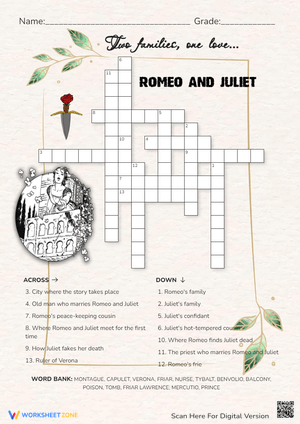
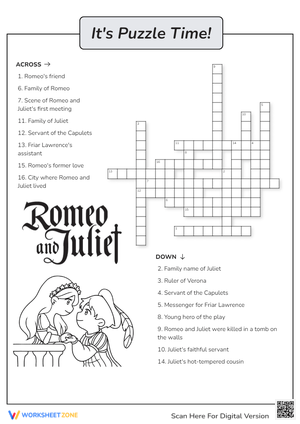
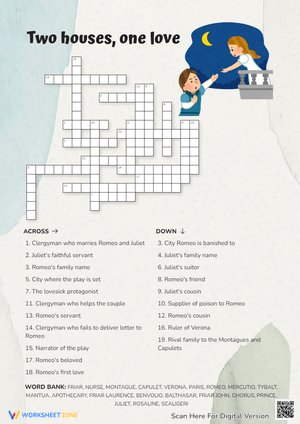
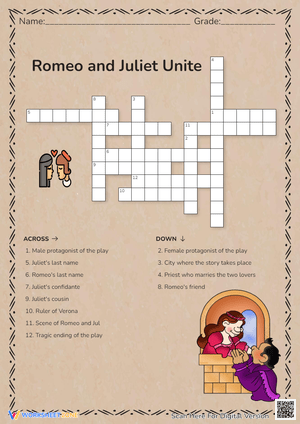
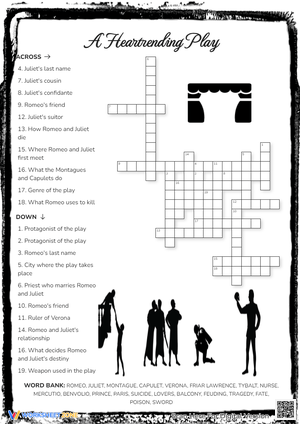
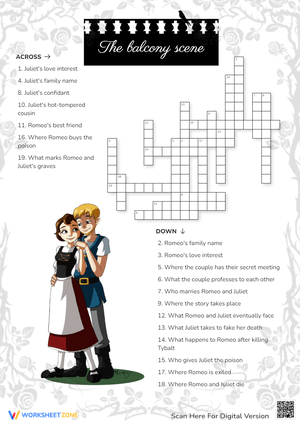
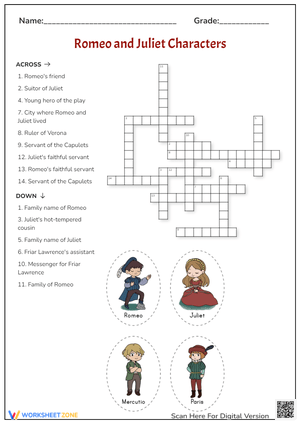
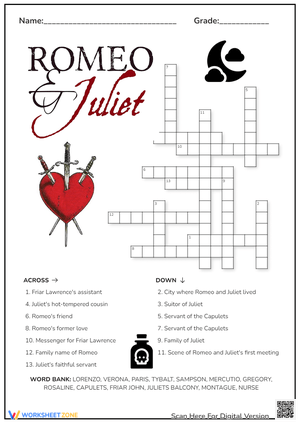
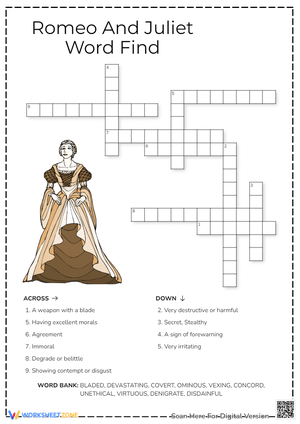
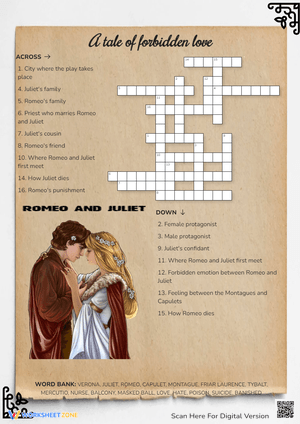
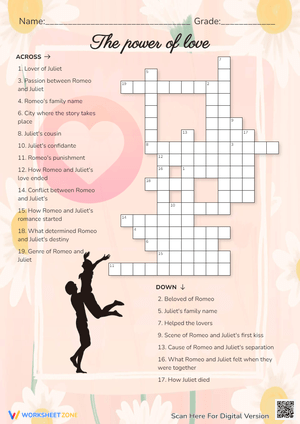
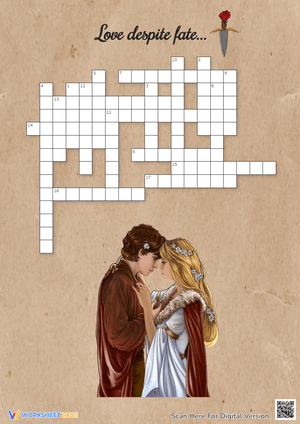
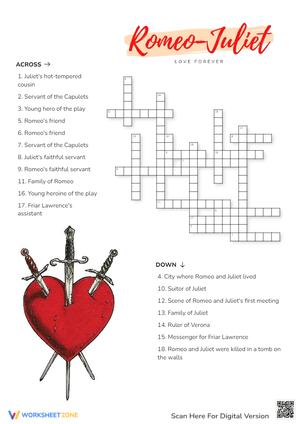
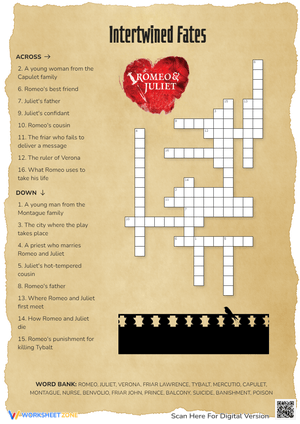
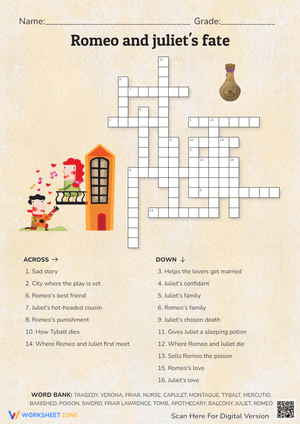
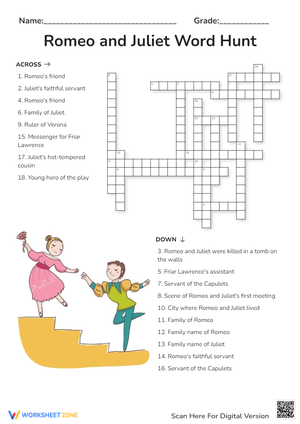
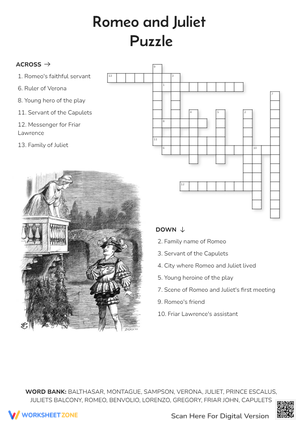
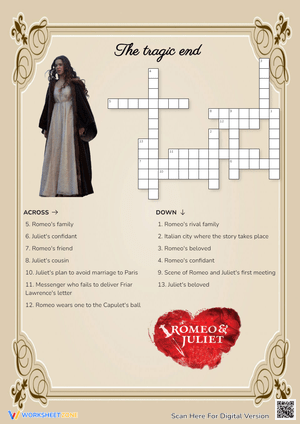
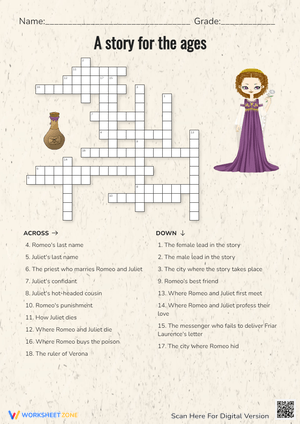
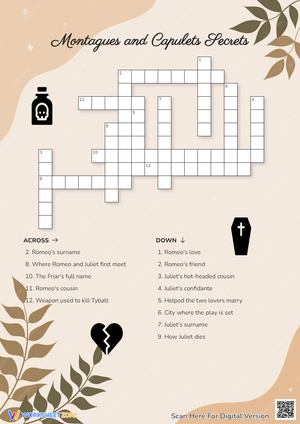
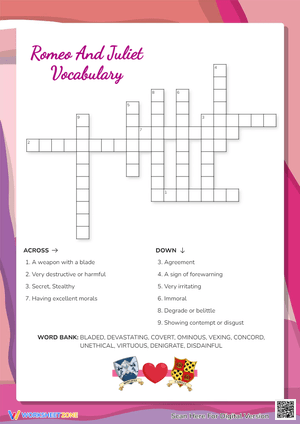
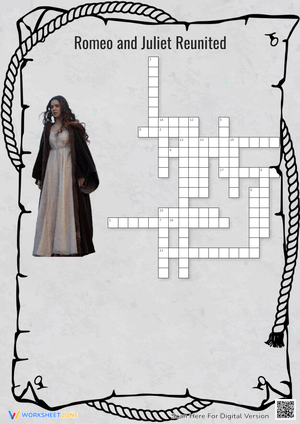
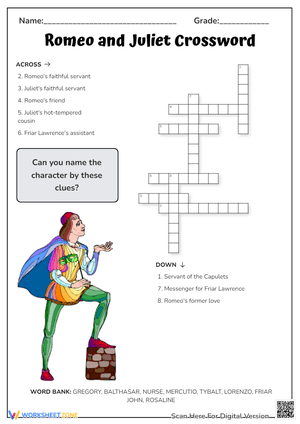
Shakespeare can feel intimidating when students first meet the language, but a Romeo and Juliet crossword puzzle gives them a structured way to enter the play with more confidence. Instead of asking learners to memorize characters, themes, and literary terms from a list, the puzzle turns review into a clue-based challenge. Students must recall names like Romeo, Juliet, Mercutio, Tybalt, Friar Laurence, and Nurse while also thinking about key ideas such as feud, tragedy, fate, love, conflict, and soliloquy.
The strength of a crossword puzzle is that it requires students to connect meaning with vocabulary. A clue such as “the city where the play takes place” leads them to Verona. A clue about “the two families in conflict” points to Montague and Capulet. A clue asking for “a long speech spoken by one character” reinforces soliloquy. Each answer helps students revisit the language of the play in a more active way than simple note review, making the activity useful before discussions, quizzes, writing tasks, or scene analysis.
During a Romeo and Juliet unit, teachers can use the crossword as a warm-up, partner activity, station task, or end-of-act review. After Act I, students might solve clues about the feud, the party, and the first meeting between Romeo and Juliet. Later in the unit, the puzzle can include vocabulary tied to conflict, dramatic irony, character motivation, and tragic structure. This flexibility makes a Romeo and Juliet crossword puzzle especially helpful for keeping students engaged while reinforcing the terms they need for deeper literary understanding.
The activity can also lead into richer classroom work. Once students complete the puzzle, they can choose several answers and explain how each one connects to the play. For example, “fate” can open a discussion about whether the characters control their choices, while “Mercutio” can lead to analysis of humor, loyalty, and conflict. Students can even write their own crossword clues for classmates, which encourages them to think carefully about definitions, plot details, and character roles.
A Romeo and Juliet crossword puzzle is more than a quiet review task. It supports vocabulary retention, reading comprehension, spelling, recall, and literary analysis in a format students can approach independently or collaboratively. Whether used in middle school, high school, homeschool lessons, or tutoring sessions, the puzzle helps make Shakespeare’s world feel more organized, memorable, and accessible for learners.
Frequently Asked Questions
Question 1: What grade levels are Romeo and Juliet crossword puzzles suitable for?
Romeo and Juliet crossword puzzles are most suitable for middle school and high school students, usually grades 6 through 10. Younger students can use simpler puzzles focused on character names, settings, and basic plot details, while older students can handle clues involving literary devices, themes, dramatic structure, and Shakespearean vocabulary. Teachers can choose the difficulty level based on how much of the play students have already studied.
Question 2: What vocabulary is commonly included in a Romeo and Juliet crossword puzzle?
A Romeo and Juliet crossword puzzle often includes character names such as Romeo, Juliet, Mercutio, Tybalt, Benvolio, Friar Laurence, and Nurse. It may also include setting and theme words like Verona, feud, tragedy, fate, love, family, conflict, and exile. More advanced puzzles can include literary terms such as soliloquy, foreshadowing, dramatic irony, metaphor, sonnet, and characterization.
Question 3: How can teachers use a Romeo and Juliet crossword puzzle in class?
Teachers can use the puzzle as a bell-ringer, vocabulary review, partner activity, station rotation, or end-of-act recap. It works especially well after students have read several scenes and need a structured way to review important names, terms, and plot points. To extend the activity, teachers can ask students to explain selected answers, connect terms to specific scenes, or write their own clues based on the play.
Question 4: How does a Romeo and Juliet crossword puzzle support literary understanding?
A Romeo and Juliet crossword puzzle supports literary understanding by requiring students to connect clues with meaning. Instead of simply recognizing words, students must think about character roles, plot events, themes, settings, and literary devices. This strengthens recall and helps students prepare for deeper discussion, written analysis, and comprehension questions about the play.












 Interactive Worksheet Maker
 Quiz Maker
 Word Search Maker
 Crossword Puzzle Maker
 Word Scramble Generator
 Sentence Scramble Generator
 Handwriting Worksheet Generator
 Name Tracing Generator
 Fill In The Blank Generator