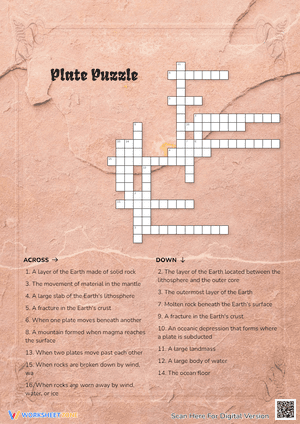
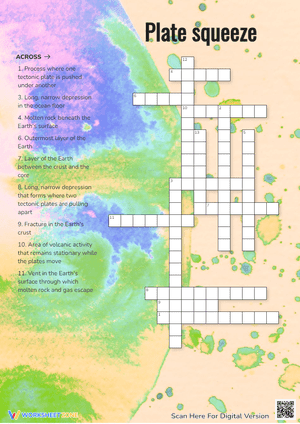
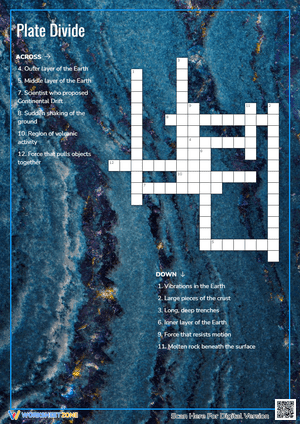
Plate Tectonics Crossword Puzzle worksheets

These plate tectonics crossword puzzle worksheets give Earth science teachers a vocabulary reinforcement tool that matching activities and glossary quizzes cannot replicate — students must hold a definition in working memory, retrieve the correct term, and then verify each letter against the crossing answers. The set covers the foundational language of the unit: boundary types, internal Earth structure, the historical evidence that built the theory, and the geological features produced at each type of plate contact.
What's Inside the Set
Each worksheet targets a cluster of related terms rather than mixing unrelated categories into a single grid. The vocabulary across the set falls into four distinct groups:
- Boundary types and their landforms: convergent, divergent, and transform boundaries; subduction zones, mid-ocean ridges, trenches, rift valleys, and fault lines
- Internal Earth structure: lithosphere, asthenosphere, mantle, crust, core, and the convection currents that drive plate movement
- Theory history: Alfred Wegener, continental drift, Pangea, and the fossil and coastline evidence used to support the hypothesis before modern instrumentation confirmed it
- Seafloor processes: seafloor spreading, magnetic reversal striping, and oceanic crust recycling at subduction zones
A student who completes the grids without a word bank has the vocabulary foundation the unit assessment requires. More importantly, the crossword format enforces correct spelling — a student who understands "asthenosphere" conceptually but has been writing "asthenasphere" in their notes finds out before the exam, not during it.
Mistakes Students Make That These Worksheets Help Surface
The most persistent conceptual error is treating "subduction" and "convergence" as synonyms. Students hear the terms paired so frequently in lectures and videos that the distinction blurs — convergence describes the plate interaction; subduction is one possible outcome, contingent on whether the colliding plates differ enough in density. When a clue reads "the process by which a denser oceanic plate descends into the mantle," a student who has conflated the terms tries writing "convergence" and finds it doesn't fit the letter count. That friction is productive. It creates a moment of self-correction that a matching activity never generates.
A second pattern shows up consistently in student work: "lithosphere" and "asthenosphere" get confused not because students misunderstand the difference but because both words are long, share a suffix, and appear together in nearly every lesson. Students who defined both terms correctly on a warm-up two days earlier will still transpose them mid-puzzle. Worth naming here is an honest limitation of the crossword format — it penalizes misspelling independent of understanding. A student who writes "aesthenosphere" grasps the concept but loses the square, and that outcome deserves acknowledgment when reviewing answers aloud rather than letting the wrong mark stand without comment.
Fitting These Worksheets Into the Flow of a Plate Tectonics Unit
The most effective placement is the day after a conceptual lesson, not the day of. After a video on the Ring of Fire or a boundary diagram activity, students leave class with vocabulary in short-term memory — accessible but unsorted. Distributing one worksheet the following morning as a 10-minute warm-up uses the spacing effect deliberately. The slight delay between first exposure and retrieval requires more cognitive effort, and that effort is what moves terms into long-term storage. Distributing plate tectonics crossword puzzle worksheets at this point in the lesson cycle turns what could be a soft warm-up into a genuine memory consolidation task.
For review days before a unit test, running two worksheets as a timed station works well. A 12-minute window followed by a 5-minute class discussion of the clues that produced the most wrong answers tells a teacher exactly what to reteach before the assessment. Students who thought they had "divergent" locked in discover they were writing it into clues about convergent features. That discussion — brief, targeted, driven by actual errors from that session — is more efficient than another lecture pass through the material.
Adjusting the Worksheets for a Range of Learners
For students who stall mid-grid when they hit an unfamiliar multi-syllable term, a printed word bank removes the spelling obstacle without removing the definitional work. The student still matches meaning to term — they just don't have to hold the spelling in working memory simultaneously. That distinction matters because "asthenosphere" is 12 letters, and a student sounding it out letter by letter has no cognitive bandwidth left to think about what the word actually means. Using plate tectonics crossword puzzle worksheets with a word bank lets that student focus on the science rather than the orthography, which is the actual learning target.
Advanced students benefit from the opposite adjustment. Removing the word bank, writing indirect clues ("the layer whose convection currents are the primary mechanism of plate movement" rather than "the semi-fluid layer below the lithosphere"), and adding a second-pass task all increase demand without requiring a separate handout. A reliable extension: after completing the grid, students write one sentence for each answer explaining how that term connects to at least one other term in the puzzle. That task turns vocabulary recall into a short-form synthesis exercise and takes less than five minutes to assign.
Standard Alignment
These worksheets support NGSS performance expectations MS-ESS2-2, which asks students to construct explanations for how geoscience processes have changed Earth's surface over time, and MS-ESS2-3, which requires analyzing data on fossil distribution, continental shapes, and seafloor structures as evidence for past plate motions. The vocabulary reinforced across the set — boundary types, convection, subduction, seafloor spreading, and Wegener's evidence for continental drift — directly underlies both expectations. In most middle school sequences, this vocabulary work runs in parallel with lab activities where students map boundary locations on global datasets; these worksheets handle the definitional side of that parallel track, ensuring students can name and define what they are mapping.
Frequently Asked Questions
Which terms give students the most trouble on plate tectonics assessments?
"Asthenosphere" is consistently the hardest to spell and the most frequently confused with "lithosphere." Beyond those two, students regularly transpose "convergent" and "divergent" — taking two minutes to teach the Latin roots (converge = come together, diverge = move apart) before any vocabulary activity is time well spent. "Subduction" trips students who understand the process but have rarely written the word. The crossword format surfaces all three of these struggles before the unit test does, which is the point.
How do I handle students who finish at very different paces?
Build the extension task into the original instructions rather than treating early finishers as a management problem. Once the grid is complete, students flip the worksheet and sketch a labeled cross-section showing two boundary types, using at least five terms from the puzzle as diagram labels. Students who need the full period for the crossword complete that; students who finish in eight minutes have meaningful work waiting without additional preparation required.
Do these worksheets work as homework, or are they better used in class?
Plate tectonics crossword puzzle worksheets assigned as homework work best when paired with structured follow-up, not treated as standalone submissions. In-class use gives teachers more diagnostic information — a student working through a grid during a review block and then hearing the class address the sticking points learns more than a student completing the same grid alone at home. If a worksheet does go home, ask students to circle any answer they were uncertain about. Those circled terms become the agenda for a five-minute opening review the following day.
Are these appropriate for high school Earth science, or are they pitched at middle school?
The vocabulary spans both levels. Boundary types, subduction, seafloor spreading, and the internal Earth structure terms appear in 9th-grade Earth science standards as readily as they do in middle school NGSS. A version with complex, indirect clues and no word bank works well in a high school course. The same set, distributed with a word bank and more direct clue phrasing, lands appropriately in 6th or 7th grade. The content suits both; the instructional level adjusts through how each worksheet is presented.